Aloe vera has been used on skin for thousands of years. It's one of the most studied plant ingredients in dermatology. It works. But if you've ever picked up an "aloe vera body lotion" hoping to actually feel the difference, you probably noticed... it just felt like regular lotion. That's not a coincidence. Here's what the research says aloe actually does for skin — and why most formulas built around it fail to deliver.
What aloe vera actually does for skin
Aloe vera gel — the clear inner leaf pulp — contains a dense mix of active compounds that have been studied extensively for their effects on skin. The most important ones:
- Acemannan — a long-chain polysaccharide that increases the skin's water-binding capacity and has demonstrated wound-healing and anti-inflammatory effects in multiple clinical trials
- Aloin and emodin — anthraquinone compounds with antimicrobial and anti-inflammatory properties
- Glycoproteins — accelerate cell proliferation and repair, which is part of why aloe has been studied for sunburn, wound care, and post-procedure recovery (including tattoo healing). If you're using aloe for that specific purpose, our guide on how long to use aloe vera on a new tattoo breaks down the full recovery timeline.
- Vitamins C and E — both antioxidants; vitamin C in particular plays a role in collagen synthesis
- Zinc and magnesium — trace minerals involved in barrier function and reducing skin reactivity
A 2019 review in the Journal of Dermatological Treatment confirmed that topical aloe vera significantly reduces transepidermal water loss (TEWL) — the rate at which skin loses moisture to the environment. Reduced TEWL means better hydration retention and a more functional skin barrier. A separate randomized controlled trial found aloe vera gel outperformed a placebo cream in reducing dryness and improving skin elasticity over 8 weeks.
So yes — aloe works. The problem isn't the ingredient. It's what's built around it.
Why most aloe vera body lotions don't actually deliver
Cosmetic ingredients are listed on labels in order of concentration. Water is almost always first in a conventional lotion — often making up 60–80% of the formula. After that comes glycerin, then emulsifiers, preservatives, thickeners, and stabilizers. Aloe vera frequently appears near the bottom, sandwiched between fragrance and a preservative, which legally means it can be present at concentrations well below 1%.
At that concentration, you're getting the marketing value of "aloe vera" on the label without any meaningful amount of the active compounds shown in research. The studies showing aloe's benefits used concentrations ranging from 25% to 100% aloe gel — not the trace amounts that make it into most retail formulas.
But there's a second problem that's less obvious: even when a formula contains meaningful amounts of aloe, what it's suspended in determines how well those compounds penetrate and how long the effects last.
The base ingredient is doing more work than you think
Skin hydration isn't just about adding water or water-attracting ingredients — it's about barrier repair. Your skin's outer layer (the stratum corneum) maintains hydration through a lipid matrix made up of ceramides, free fatty acids, and cholesterol. When that matrix is intact, it holds moisture in. When it's disrupted — from washing, weather, aging, or synthetic irritants — it lets water escape faster than you can replace it.
This is why most water-based lotions require constant reapplication. They add surface hydration without addressing the barrier itself. The minute the water evaporates, your skin is back to baseline.
Repairing the barrier requires lipids — specifically, fatty acids that closely match what your skin already produces. A 2018 review in the International Journal of Molecular Sciences found that the fatty acid profile of the skin's natural lipid layer is dominated by oleic acid (C18:1), palmitic acid (C16:0), and stearic acid (C18:0). Ingredients that supply these fatty acids in similar ratios can directly integrate into the barrier and rebuild what's been lost.
Most synthetic emollients (dimethicone, mineral oil, petrolatum) sit on top of the skin. They reduce water loss by occlusion — sealing the surface — but they don't contribute to rebuilding the barrier's lipid structure. They also don't go anywhere. Skin that needs these to feel comfortable isn't getting better; it's becoming dependent.
Why tallow and aloe work together
Grass-fed beef tallow has a fatty acid composition that closely mirrors human skin lipids. It's approximately 40–50% oleic acid, 24–30% palmitic acid, and 10–14% stearic acid — a profile that allows it to integrate into the skin's barrier rather than just coat the surface. Unlike occlusive synthetic oils, tallow is metabolically compatible with skin, meaning it functions as building material rather than just a sealant.
When you combine tallow with aloe vera at meaningful concentrations, you get complementary mechanisms working together:
- Aloe's acemannan and glycoproteins — soothe inflammation, bind water in the upper layers of skin, and accelerate surface repair
- Tallow's fatty acids — penetrate into the lipid matrix of the stratum corneum, rebuilding the barrier from within and reducing TEWL over time
- Aloe's vitamins C and E — provide antioxidant protection that tallow alone doesn't supply
The result is a formula where the aloe and the base are doing genuinely different jobs — not redundant ones. The aloe isn't just filler in a lipid formula, and the tallow isn't just an occlusive in an aloe formula. They address the same goal (healthy, hydrated skin) through distinct mechanisms.
Compare that to the standard aloe vera body lotion structure: water + glycerin (humectant) + aloe trace + dimethicone (occlusive) + fragrance. The glycerin draws water from the air on good humidity days, the silicone traps it, and the aloe is largely decorative. The formula works well enough that you can feel it — but it doesn't rebuild anything.
What to actually look for in an aloe vera lotion
If you want an aloe product that works rather than one that markets well, here's what to check:
- Where does aloe appear on the ingredient list? If it's in the top 3-5 ingredients, it's present at meaningful levels. If it's near the bottom with preservatives, it's below 1%.
- What's the base? Water is not a bad base, but a lipid-rich base (tallow, shea, certain plant oils) will do more for barrier repair than a water + synthetic emollient base.
- What's in the formula that you don't recognize? Long ingredient lists often indicate fragrance masking, synthetic preservatives, or stabilizers for cheap emulsions. Shorter, recognizable lists usually mean fewer irritants.
- Does it work? A formula that requires reapplication every 2–3 hours to feel comfortable isn't solving the underlying problem — it's managing a symptom.
The AloeTallow formula
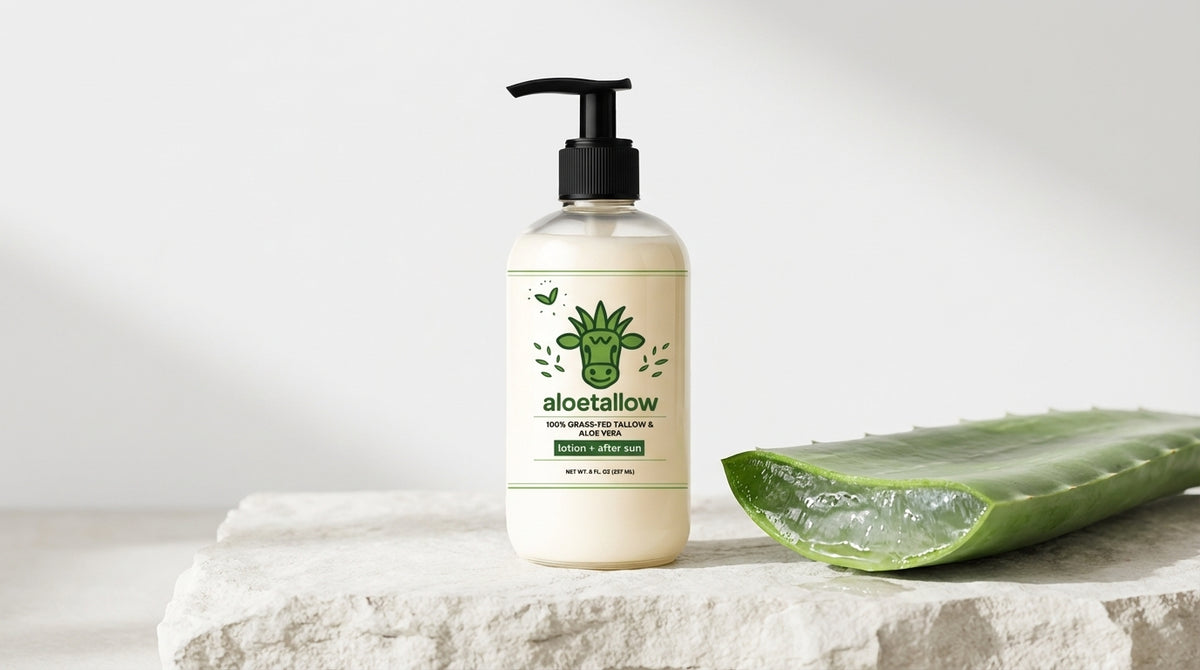
AloeTallow Clean Hydration Lotion is built on grass-fed beef tallow and aloe vera as the two primary active ingredients — not as marketing labels, but as the functional core of the formula. The full ingredient list is short on purpose: tallow, aloe vera, coconut oil, and shea butter. No fragrance, no synthetic preservatives, no emulsifiers to stabilize a cheap water emulsion.
The formula absorbs fully within 1–2 minutes. It doesn't require reapplication every few hours. And for most people, skin that felt dependent on constant moisturizing starts to feel more comfortable on its own after a few weeks — which is what barrier repair actually looks like.
If you've been searching for an aloe vera body lotion that delivers on what aloe is actually supposed to do, the formula around it matters as much as the aloe itself.

8 ingredients. Grass-fed tallow + aloe vera. Nothing you can't pronounce.
Frequently asked questions
How much aloe vera should be in a body lotion for it to actually work?
Research showing benefits from aloe vera used concentrations of 25–100% aloe gel. In a finished lotion formula, you'd want aloe to appear in the first few ingredients on the label to have any meaningful effect. Trace amounts (below ~1%) are unlikely to produce the results shown in clinical studies.
Is aloe vera safe for sensitive skin?
Aloe vera is generally well-tolerated and has been shown in studies to reduce skin reactivity. The exception is latex allergy sensitivity — people with severe latex allergies may react to aloin compounds in aloe. Aloe gel (inner leaf) without the outer leaf rind is lower in aloin and better tolerated.
Can aloe vera lotion replace sunscreen?
No. Aloe vera has mild antioxidant and anti-inflammatory properties but no significant UV-blocking ability. It's an effective post-sun skin repair ingredient, not a protective one.
Why does regular aloe vera lotion feel like it stops working after a while?
Most conventional aloe lotions don't rebuild the skin barrier — they create surface hydration that evaporates. The skin doesn't improve its ability to hold moisture independently, so you maintain the same level of need. A formula that targets barrier repair through compatible lipids tends to require less product over time as skin becomes more self-sufficient.
Is tallow greasy?
Tallow has a reputation for being heavy, but at the right formulation concentration it absorbs completely within 1–2 minutes. A small amount (dime-sized) is typically enough for both arms. Starting with less and allowing it to absorb before adding more prevents the greasy feeling some people associate with animal fats.