
A natural toner should hydrate and prepare the skin barrier between cleansing and moisturizing — adding a thin layer of humectants like aloe vera or glycerin that improves how your moisturizer absorbs. The best natural options are fragrance-free, alcohol-free, and pH-appropriate (4.5-5.5). The most common failure is formulas that include SD alcohol, which strips the barrier ceramides you're about to try to restore.
Toners occupy a strange place in the skincare conversation. Skincare enthusiasts swear by them. Dermatologists wave them off as unnecessary. Beauty brands sell them with promises ranging from "pore minimizing" to "deep cellular renewal." Most people using a toner couldn't tell you exactly what it's supposed to do — they just know it's part of the routine.
That confusion is worth resolving, because when a toner works correctly, it does something genuinely useful. When it doesn't — and most don't — it's either a neutral extra step or, in the case of alcohol-heavy formulas, actively counterproductive.
Here's a clear-eyed look at what a toner is actually supposed to do, why most formulas fail at it, and what ingredients make the difference.

Aloe first. Tallow to seal. 8 ingredients, nothing unnecessary.
8 Clean Ingredients | No Fillers | 1,200+ Happy Customers
get my bottle →What a Toner Is Actually Supposed to Do
The original function of a toner was practical: skin cleansers in the 1950s through 1980s were alkaline and left a residue that needed to be removed. Toners — typically astringent and slightly acidic — stripped that residue and brought skin back to its natural pH range (roughly 4.5–5.5).
Modern cleansers are formulated at or near skin's natural pH, which eliminates the need for a post-cleanse pH correction in most cases. But toners evolved beyond their original job into something with a different, more useful purpose: preparing the barrier for what comes next.
When skin is dry — especially immediately post-cleanse — its ability to absorb subsequent products is reduced. A well-formulated toner adds a thin layer of hydration and humectants to the surface, softening the stratum corneum and increasing permeability. The moisturizer or serum you apply next absorbs more efficiently, spreads more evenly, and delivers its actives more effectively. That's the mechanism. That's why the step exists.
The question is whether the formula you're using is actually doing that — or doing something else entirely.
What Most Toners Get Wrong
The single most common failure in toner formulation is the inclusion of high concentrations of SD alcohol (denatured alcohol). It's in the formula for legitimate reasons: it feels clean on application, evaporates quickly, has a matte finish, and provides a mild antimicrobial effect. It also disrupts the lipid layer of the stratum corneum, increases TEWL immediately post-application, and can trigger a rebound oiliness response in sebum-producing skin.
A 2003 study in Skin Research and Technology demonstrated that repeated application of alcohol-containing topicals significantly impairs barrier function as measured by TEWL — the exact parameter a toner is supposed to help manage. You're stripping the barrier you're about to apply moisturizer to. The moisturizer is playing catch-up from step one.
Astringent toners with witch hazel face a similar issue. Witch hazel in its whole-plant form contains tannins with genuine anti-inflammatory and antioxidant properties. But most commercial witch hazel extracts are diluted in — or themselves contain — significant amounts of alcohol, which overwhelms whatever benefit the tannins provide.
Beyond alcohol, many "natural" toners still contain synthetic fragrance, artificial colors, and preservative systems that add unnecessary sensitization risk, especially when applied to skin that's been freshly cleansed and is temporarily more permeable.
What to Look for in a Natural Toner
A genuinely useful natural toner has a short list of criteria:
- Hydrating actives as the primary function — aloe vera, glycerin, hyaluronic acid, panthenol, or a combination. These increase surface hydration and permeability without disrupting the barrier.
- No SD alcohol — look for "alcohol denat." or "SD alcohol 40" on the ingredient list. If it appears early, the formula is likely stripping more than it's adding.
- pH-appropriate — ideally 4.5–5.5, which matches skin's natural pH range. This ensures the toner isn't causing acid or alkaline stress on skin that's already somewhat vulnerable post-cleanse.
- Fragrance-free — fresh post-cleanse skin is temporarily more permeable. Fragrance compounds that may be innocuous on intact skin are more likely to penetrate and sensitize at this stage of the routine. This connects directly to the broader case for skin barrier repair — every step in a routine either supports or degrades barrier integrity.
How Toner Fits in Your Routine: The Wet Skin Absorption Principle
Placement matters as much as formula. A toner is applied after cleansing and before any serum or moisturizer. The timing is deliberate.
Post-cleanse skin is in a transitional state — residual water from rinsing is evaporating, and if nothing is applied, TEWL temporarily spikes as the surface dries. Applying a humectant-rich toner during this window — especially to skin that's still slightly damp from rinsing — extends the hydration window and primes the barrier for absorption before that evaporation occurs.
This is sometimes called the "wet skin absorption" principle, and it's not exclusive to toners — glycerin-containing moisturizers work better on damp skin for the same reason. But toners make the timing explicit: they're designed to be the bridge between cleansing and moisturizing, applied when skin is most receptive.
Applied correctly, a good toner means your moisturizer goes on to hydrated, prepped skin instead of dry, contracted skin — and you typically need less of it to achieve the same result.

Aloe Vera as a Natural Toner
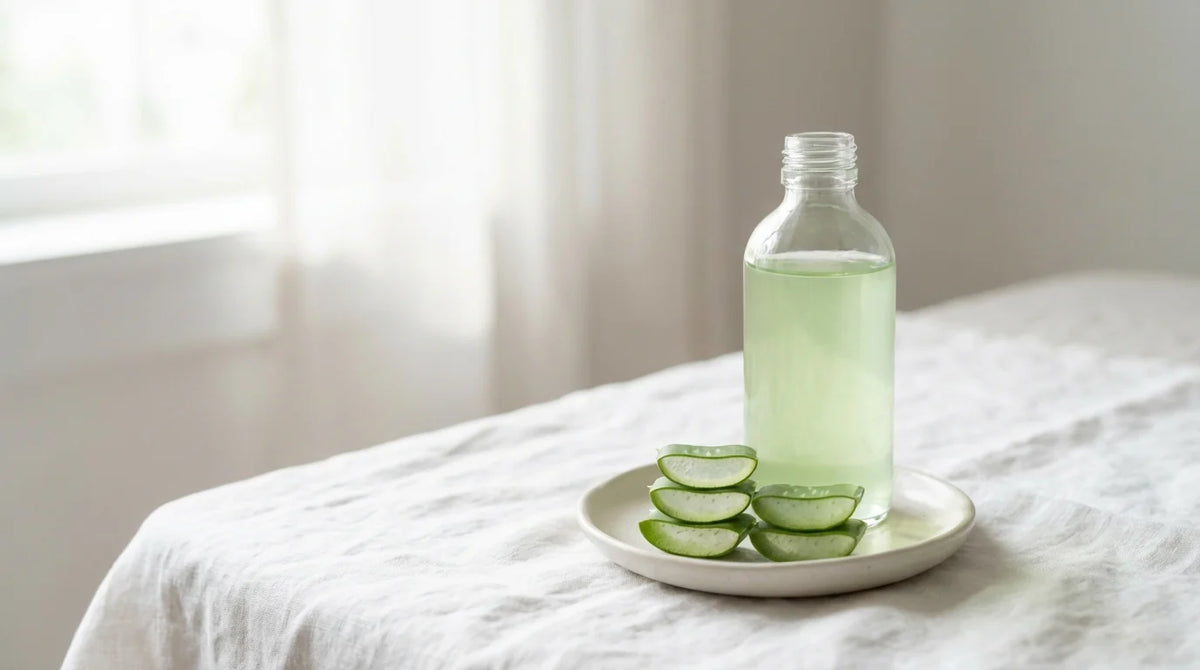
Pure aloe vera gel is the most complete single-ingredient natural toner: pH-appropriate (4.5–5.5), hydrating without occlusion, anti-inflammatory, and well-researched. Its acemannan polysaccharides support fibroblast activity, and naturally present glycosaminoglycans support the skin's water-binding capacity. Use a high-concentration aloe without alcohol or fragrance, applied to damp skin post-cleanse.

How Aloetallow's Formula Connects
aloetallow isn't a toner — it's the moisturizer that follows one. But aloe vera is the first ingredient in the formula, meaning it's the largest component by volume. The same acemannan and glycosaminoglycans that make aloe effective as a standalone toner are present in meaningful concentration in the moisturizer's base.
For a simplified routine, applying aloetallow to slightly damp skin after cleansing captures much of what a toner-then-moisturizer sequence achieves: the aloe acts as the hydrating prep layer, the tallow and shea provide emollient and mild occlusive functions, and glycerin draws in ambient moisture — the whole sequence in one step.
If you're looking for a tallow and aloe daily facial moisturizer, the formula logic is the same: aloe goes first, lipids follow.
Aloe vera first. Tallow to seal. 8 ingredients, nothing unnecessary.
8 Clean Ingredients | No Fillers | 1,200+ Happy Customers
get my bottle →
8 ingredients. Grass-fed tallow + aloe vera. Nothing you can't pronounce.
FAQ
Do you need a toner?
Not strictly — but a well-formulated toner does something useful. It adds a hydrating layer between cleansing and moisturizing that improves how your moisturizer absorbs and distributes. If you're applying your moisturizer to dry, post-cleanse skin without any prep step, a toner can meaningfully improve the efficiency of the products that follow. If you're applying moisturizer to damp skin immediately after rinsing, you're already capturing most of the benefit a toner provides.
What is a natural toner for face?
A natural toner for face should contain hydrating actives — primarily aloe vera, glycerin, or hyaluronic acid — without SD alcohol, synthetic fragrance, or high concentrations of astringents. Pure aloe vera gel is arguably the most complete single-ingredient natural toner: it's pH-appropriate, hydrating, anti-inflammatory, and well-researched. Rose water with glycerin is a close second for people who want something with a pleasant, natural scent.
Can aloe vera be used as a toner?
Yes — and it's well-suited to the role. Aloe vera gel is naturally pH-appropriate for post-cleanse application (pH ~4.5-5.5), hydrates without adding occlusion, contains acemannan and glycosaminoglycans that support the skin's own water-binding capacity, and delivers anti-inflammatory polysaccharides that help manage post-cleanse reactivity. Use a high-concentration aloe gel without alcohol or synthetic additives applied to slightly damp skin after cleansing.
What should a toner do for skin?
A toner's primary job is to hydrate and prep skin between cleansing and moisturizing — increasing surface permeability so the moisturizer that follows absorbs more efficiently and distributes more evenly. Secondary benefits, depending on the formula, include pH normalization, anti-inflammatory support, and light antioxidant activity. What a toner should not do: strip the barrier, introduce fragrance to permeable post-cleanse skin, or use high concentrations of alcohol that increase TEWL before you've had a chance to address it.
Aloe vera first. Tallow to seal. 8 ingredients, nothing unnecessary.
8 Clean Ingredients | No Fillers | 1,200+ Happy Customers
get my bottle →