The anti-aging market is worth over $60 billion globally, and most of it is built on the same premise: collagen is declining, so you need products that stimulate collagen production or fill in the gaps where it's been lost. Retinoids, peptides, growth factors, hyaluronic acid fillers -- the entire category targets the dermis, the deeper layer of skin where collagen and elastin live. That targeting makes sense as far as it goes. But it misses something fundamental about how wrinkles actually form, and why some people's skin ages visibly faster than others despite using the same active ingredients.
New to tallow? Start with the complete guide: Beef Tallow for Skin: Everything You Need to Know.
Wrinkles are not purely a collagen story. They're also a barrier story. And the barrier is where tallow's composition becomes relevant to aging skin in ways that most anti-wrinkle products don't address at all.
What the science says about skin aging and the lipid barrier
Your skin's outermost layer -- the stratum corneum -- is a lipid-dependent structure. It's built from dead skin cells (corneocytes) held together by a matrix of ceramides, cholesterol, and free fatty acids arranged in lamellar sheets. This lipid matrix is what prevents water from escaping through the skin surface. When it's intact, your skin stays hydrated, plump, and smooth. When it breaks down, water loss accelerates, and the skin deflates -- literally. That deflation is what makes fine lines visible.
Here's what the research shows about how this system changes with age. A 1991 study in the Journal of Investigative Dermatology by Ghadially et al. found that barrier recovery after disruption slowed significantly in aged skin compared to young skin. The mechanism wasn't mysterious: aged skin produced fewer lamellar bodies -- the lipid-secreting organelles that rebuild the barrier after damage. Fewer lamellar bodies means less lipid secretion. Less lipid secretion means a thinner, more porous barrier. A more porous barrier means higher transepidermal water loss (TEWL). Higher TEWL means chronically dehydrated skin. Chronically dehydrated skin wrinkles.
A 2001 study in the British Journal of Dermatology confirmed this trajectory: TEWL increases progressively with age, and the correlation between elevated TEWL and visible wrinkle depth is statistically significant. The researchers concluded that impaired barrier function is an independent contributor to the visible signs of skin aging -- not just a side effect of collagen loss, but a parallel mechanism.
This is the gap that most anti-aging products don't address. Retinoids work on cell turnover and collagen stimulation in the dermis. Peptides signal fibroblasts to produce more collagen. Hyaluronic acid draws water into the epidermis temporarily. But none of these rebuild the lipid barrier that's losing structural integrity with age. They work underneath or around it. The barrier itself -- the thing that keeps moisture from leaving -- gets thinner and more permeable every decade, and the product category built around aging largely ignores it.
Why conventional anti-aging products fall short on barrier repair
The issue isn't that retinoids and peptides don't work. Many of them do, within their specific mechanisms. The issue is that they're solving one problem while another problem -- barrier thinning -- progresses unchecked. And in some cases, the actives themselves make the barrier problem worse.
Retinoids increase cell turnover, which is beneficial for texture and collagen stimulation. But accelerated turnover means the barrier is being disrupted and rebuilt more frequently, and in aged skin where lamellar body production is already compromised, that faster turnover can outpace the barrier's ability to recover. A 2009 study in the Journal of Cosmetic Dermatology documented that retinoid use was associated with increased TEWL and barrier disruption, particularly in the first 8-12 weeks of use. The standard recommendation is to push through this adjustment period -- but during that period, the barrier is measurably weaker.
Hyaluronic acid is a humectant. It pulls water toward itself. Applied topically, it can draw moisture from the environment into the upper layers of skin -- but in low-humidity environments, it can draw water from deeper skin layers toward the surface, where it evaporates. Without an occlusive layer on top to seal that moisture in, hyaluronic acid can actually increase net water loss. The barrier is the occlusive layer. If the barrier is compromised, the humectant works against you.
Most conventional anti-aging moisturizers use silicones (dimethicone, cyclomethicone) to create the feel of a protective layer on the skin. Silicones do reduce TEWL temporarily by forming a breathable film. But they're inert -- they don't contribute any lipids to the barrier's lamellar structure. They sit on top. When you wash them off, the barrier is in the same state it was before. The silicone was a temporary patch, not a structural repair.
What aging skin actually needs -- in addition to the actives that target collagen -- is a source of barrier-compatible lipids that can integrate into the lamellar structure and slow the progressive thinning that drives age-related dehydration. That's a specific molecular requirement, and not many ingredients meet it.
How tallow's fatty acids address age-related barrier decline
Beef tallow from grass-fed cattle has a fatty acid profile that sits remarkably close to human sebum: approximately 47% oleic acid, 26% palmitic acid, and 14% stearic acid. Human sebum is dominated by the same fatty acids in similar proportions. This isn't coincidence -- both are mammalian fats evolved to protect skin from environmental exposure and water loss.
A 2024 peer-reviewed study published in Cureus (Pham et al., PMC11193910) confirmed that grass-fed beef tallow shares the primary fatty acid composition of human sebum, supporting its biocompatibility with skin.
The relevance to aging skin is direct. The lipids that your barrier is progressively producing less of as you age are the same lipids that tallow delivers in high concentration. Specifically:
Palmitic acid is a primary component of the barrier's lamellar bodies. A 2003 study in the Journal of Lipid Research demonstrated that palmitic acid is essential for normal lamellar body assembly and secretion. When palmitic acid availability is reduced -- as it is in aging skin with declining sebum production -- lamellar body formation is impaired, and barrier recovery slows. Topical delivery of palmitic acid has been shown to partially compensate for this age-related decline.
Stearic acid is one of three key lipids (with ceramides and cholesterol) that form the structural mortar between corneocytes. A 1993 study by Man et al. in the Journal of Clinical Investigation found that applying the correct ratio of these three lipids accelerated barrier recovery, while applying any single lipid alone or in the wrong ratio actually delayed recovery. Stearic acid in the context of the broader lipid mixture found in tallow contributes to this ratio in a way that isolated stearic acid supplements do not.
Oleic acid enhances penetration of other compounds into the stratum corneum. For aging skin, this means that the fat-soluble vitamins present in grass-fed tallow -- A, E, K -- are carried into the skin layers where they can be utilized, rather than sitting on the surface. Oleic acid also has documented emollient properties that directly address the rough texture associated with barrier-impaired skin.
The vitamin connection: A, E, and K in aging skin
Grass-fed beef tallow naturally contains fat-soluble vitamins that are independently relevant to skin aging. These aren't added ingredients -- they're present in the fat because that's where the animal stores them.
Vitamin A (retinol precursors). The entire prescription retinoid category is built on vitamin A's ability to accelerate keratinocyte turnover and stimulate collagen production in the dermis. Grass-fed tallow contains beta-carotene and other vitamin A precursors at levels that provide a low-dose, continuous delivery when applied topically. This isn't equivalent to a prescription retinoid -- it's a gentler, sustained exposure that may support cell turnover without the barrier disruption that concentrated retinoids cause.
Vitamin E (alpha-tocopherol). The primary lipid-soluble antioxidant in skin tissue. A 2005 review in Molecular Aspects of Medicine documented vitamin E's role in neutralizing the lipid peroxidation that damages barrier fats. UV exposure, pollution, and normal metabolic processes generate free radicals that attack the unsaturated fatty acids in the barrier's lamellar structure. Vitamin E intercepts those radicals at the point of damage. In aging skin where the barrier is already thinner and more vulnerable, this antioxidant protection is increasingly relevant.
Vitamin K. Less commonly discussed in skincare but relevant to aging. Vitamin K supports microcirculation in the skin and has been studied for its effects on dark circles and vascular changes associated with aging. A 2004 study in the Journal of Cosmetic Dermatology found that topical vitamin K improved the appearance of dark circles and bruising -- both related to the microvascular fragility that increases with age. Grass-fed tallow's vitamin K content isn't therapeutic-dose, but it's a consistent low-level delivery of a compound that supports the microvascular health of aging skin.
The combination matters as much as the individual vitamins. Fat-soluble vitamins are most bioavailable when delivered in a lipid matrix -- which is exactly what tallow provides. Taking vitamin E in a pill doesn't get it to your skin barrier efficiently. Applying it in a fat that your skin recognizes and integrates does.
How barrier hydration affects the appearance of wrinkles
There's a straightforward mechanical relationship between skin hydration and wrinkle visibility that's worth understanding clearly.
When the skin's lipid barrier is intact and TEWL is low, the epidermis retains water. Hydrated epidermal cells are plump -- they fill out the surface of the skin and reduce the depth of fine lines. This is why your skin often looks smoother in the morning after sleeping (reduced environmental exposure, less barrier stress) and why fine lines appear more pronounced in the afternoon (accumulated barrier stress, higher TEWL).
A 2002 study in Skin Research and Technology measured the relationship between hydration levels and wrinkle depth directly. Researchers found that a 10% increase in stratum corneum hydration produced a measurable reduction in the depth of fine lines in the crow's feet area. The effect was temporary when achieved with humectants alone (which pull water in but don't prevent its escape). It was more sustained when achieved with occlusives that reduced TEWL (which keep water from leaving).
This is the distinction that matters for aging skin. Humectants provide a temporary plumping effect. Occlusives -- particularly barrier-compatible lipids that integrate into the lamellar structure rather than just coating the surface -- provide a more sustained hydration effect because they address the structural deficit that's causing the water loss in the first place.
Tallow's role here isn't as a wrinkle treatment in the conventional sense. It doesn't stimulate collagen or relax muscles. What it does is rebuild the lipid barrier that aging skin is progressively losing, which reduces the chronic dehydration that makes fine lines and wrinkles more visible. It's addressing the architecture, not the symptom.
Practical tips for using tallow on aging skin
- Layer it over your actives. If you use retinol, vitamin C, or peptides, apply those first and let them absorb. Then apply a tallow-based moisturizer on top as the occlusive seal. This sequence lets the actives penetrate while the tallow protects the barrier and locks in hydration. The barrier support may also reduce the irritation that retinoids commonly cause.
- Apply to damp skin. After cleansing, pat your face until it's slightly damp (not dripping). Then apply. The occlusive layer traps that residual moisture against the skin, maximizing the hydration effect.
- Use it at night. Nighttime is when your skin does the majority of its repair work. Barrier recovery is fastest during sleep. Providing barrier-compatible lipids at the time when your skin is actively rebuilding its lamellar structure gives those lipids the highest chance of being incorporated into the barrier.
- Focus on the areas that age first. Around the eyes, the nasolabial folds, the forehead, and the neck -- these are the areas where the barrier thins earliest and TEWL is highest. A small amount of tallow pressed gently into these areas delivers concentrated barrier support where it's most needed.
- Be patient with results. Barrier repair is not instant. Lamellar body formation, lipid secretion, and structural integration take time. Most people notice a change in skin texture and hydration within 2-3 weeks of consistent use. Changes in fine line appearance may take 4-6 weeks as the barrier reaches a new equilibrium.
The Aloetallow formula
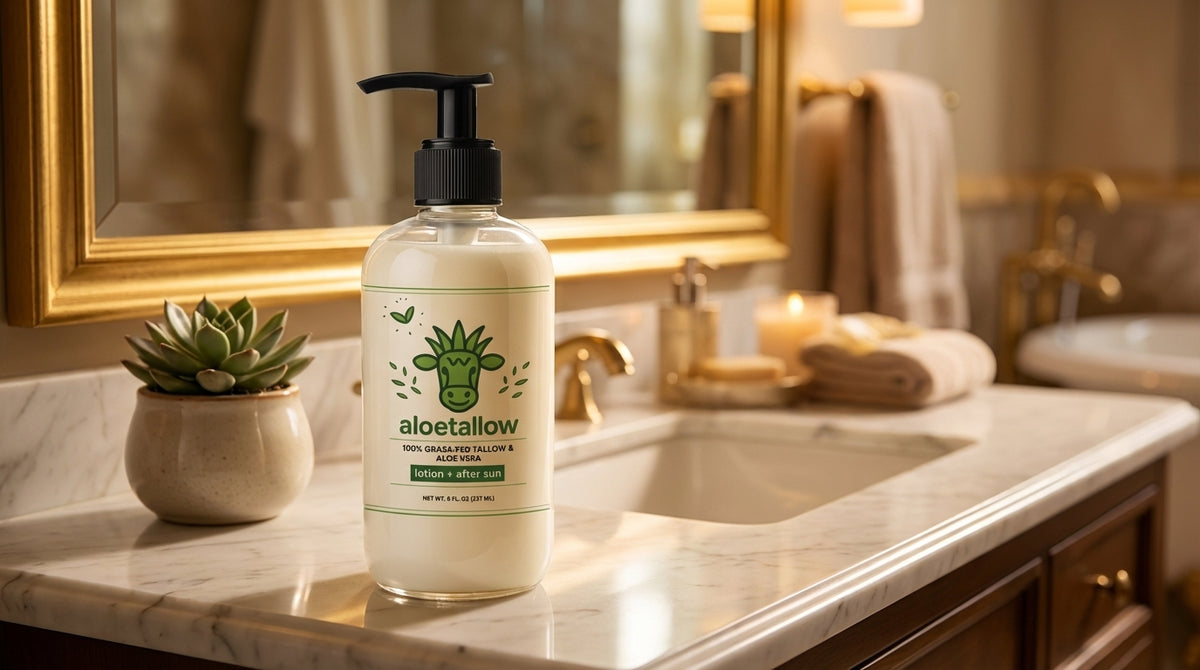
If you're looking for a tallow-based moisturizer built for this specific purpose, Aloetallow combines 100% grass-fed beef tallow with aloe vera in an 8-ingredient formula -- no fragrance, no silicones, no seed oils. The grass-fed sourcing preserves the full vitamin A, E, and K content along with the CLA and favorable omega ratio that commodity tallow lacks. The aloe vera provides additional hydration support and keeps the texture practical for daily facial use.

8 ingredients. Grass-fed tallow + aloe vera. Nothing you can't pronounce.
Frequently asked questions
Can tallow actually reduce wrinkles?
Tallow doesn't work like a retinoid or a filler -- it doesn't directly stimulate collagen or plump lines with a volumizing agent. What it does is restore the lipid barrier that aging skin progressively loses, which reduces chronic transepidermal water loss and keeps the epidermis more hydrated. Better-hydrated skin has measurably shallower fine lines. The effect is structural and cumulative rather than cosmetic and temporary.
Is tallow better than hyaluronic acid for aging skin?
They do different things. Hyaluronic acid is a humectant -- it draws water toward itself. Tallow is an occlusive -- it prevents water from escaping. For aging skin with a compromised barrier, the occlusive function is often the missing piece. Hyaluronic acid without an occlusive layer on top can actually increase water loss in low-humidity environments. The most effective approach for aging skin is typically both: a humectant to attract moisture, sealed with an occlusive to keep it there.
Will tallow make my aging skin break out?
Aging skin tends to produce less sebum, which makes it less prone to congestion from occlusive products than younger, oilier skin. Most people over 40 with dry or combination skin tolerate tallow well. If you're concerned, patch test on the jawline for a week before applying to the full face. The compositional similarity between tallow's fatty acids and human sebum also means it's less likely to disrupt your skin's lipid environment than ingredients with dissimilar profiles.
How does tallow compare to prescription retinoids for anti-aging?
They're not interchangeable. Prescription retinoids are the strongest evidence-based intervention for collagen stimulation and cell turnover in aging skin. Tallow addresses a different mechanism -- barrier repair and lipid replenishment -- that retinoids don't target and can actually impair. The most logical approach is to use them together: retinoid for collagen stimulation, tallow-based moisturizer for barrier protection. The tallow may also reduce the irritation and TEWL increase that retinoids commonly cause.
At what age should I start using tallow for anti-aging benefits?
Barrier function begins declining measurably in the mid-30s, with lamellar body production and sebum output both decreasing progressively. If you're noticing that your skin feels drier than it used to, takes longer to recover from environmental stress, or shows fine lines more prominently by the end of the day, those are signs of barrier thinning -- and that's when barrier-compatible lipids become most relevant. There's no wrong time to start, but the research suggests that supporting the barrier proactively before significant thinning occurs may slow the visible progression.
Wrinkles aren't inevitable in the way most people understand them. Yes, collagen declines with age. Yes, gravity and UV damage accumulate. But the degree to which wrinkles are visible is heavily influenced by hydration -- and hydration is controlled by the lipid barrier. A barrier that's losing structural integrity every year will produce progressively more dehydrated, more wrinkled skin regardless of what actives you apply underneath. Rebuilding that barrier with lipids your skin recognizes and can integrate is the intervention that most anti-aging routines are missing. The science points to it clearly. Whether tallow is the right delivery vehicle for you depends on your skin type and your routine -- but the barrier mechanism it addresses is relevant to everyone whose skin is aging.
Sources
- Pham, et al. (2024). Tallow, Rendered Animal Fat, and Its Biocompatibility With Skin. Cureus. PMC11193910