You've done this before. You stood in the skincare aisle — or scrolled through an endless product page — reading labels that said "natural," "plant-based," "nourishing." You bought the one that felt right. You used it for a week. And your skin still felt tight by mid-afternoon, still flaked around your nose in winter, still looked dull under fluorescent lights. So you bought another one. Same cycle. Same disappointment.
Here's the question worth asking: what does "natural moisturizer" actually mean in scientific terms? What has to happen at the cellular level for your skin to stay hydrated — and which ingredients have the evidence behind them to make that happen?
The answer isn't a single miracle ingredient. It's understanding how your skin barrier works — and then choosing a formula that's actually compatible with it.
What a Moisturizer Actually Has to Do
Your skin doesn't need to be "fed moisture." It needs to retain moisture it already has and repair the structure that keeps it in. Those are two different jobs, and most products only attempt one — poorly.
The outermost layer of your skin, the stratum corneum, functions like a brick wall. Corneocytes (dead skin cells) are the bricks. The "mortar" between them is a precise mixture of ceramides, cholesterol, and free fatty acids — roughly in a 1:1:1 molar ratio, according to research published in the Journal of Investigative Dermatology. When that lipid matrix is intact, transepidermal water loss (TEWL) stays low, and your skin feels soft, smooth, and resilient.
When the mortar breaks down — from harsh cleansers, dry air, UV exposure, or aging — water escapes faster than your body can replace it. That's when skin gets dry, irritated, and reactive. A meaningful moisturizer has to do two things:
- Occlude — form a physical layer that slows water loss
- Replenish — deliver lipids and compounds that are structurally compatible with the skin's own barrier
A 2018 review in the International Journal of Molecular Sciences confirmed that topical lipids matching the skin's native composition — particularly palmitic acid, stearic acid, and oleic acid — integrate more effectively into the stratum corneum than synthetic alternatives. The closer the match, the better the repair.
Why Most "Natural" Moisturizer Formulas Fail
The word "natural" on a skincare label is legally meaningless. The FDA does not regulate the term. A product can contain 90% synthetic ingredients and still call itself natural. So what's actually in most of these formulas?
Pick up the average "natural moisturizer" at a drugstore or even a boutique skincare shop. Here's a typical ingredient list pattern:
- Water (Aqua) — first ingredient, meaning it's the largest component by volume
- Glycerin — a humectant that pulls water to the skin surface (helpful in humid conditions, but can actually draw water out of skin in dry environments if not sealed with an occlusive)
- Cetearyl alcohol / cetyl alcohol — fatty alcohols used as emulsifiers and texture agents
- Dimethicone or cyclomethicone — silicones that create a temporary smoothing film but don't integrate into the lipid barrier
- Phenoxyethanol, parabens, or other synthetic preservatives — necessary because the high water content breeds bacteria
- Fragrance — often a proprietary blend of dozens of undisclosed chemical compounds
Notice the structural problem: when your first ingredient is water and your "active" ingredients are humectants without adequate occlusion, you're essentially applying something that evaporates. A 2015 study in Skin Pharmacology and Physiology found that water-based moisturizers without effective occlusive components showed diminished TEWL improvement within four hours of application — meaning the "hydration" didn't last a morning.
And here's the deeper issue: many of these formulas contain none of the lipids your skin barrier actually needs. They sit on top. They feel nice for twenty minutes. But they don't rebuild anything.
The preservative load is another concern. Water-based formulas require antimicrobial preservation to prevent mold and bacterial growth. Each additional preservative is another potential irritant — particularly for people with sensitive or reactive skin. A formula with fewer water-dependent components simply needs less chemical intervention to stay stable.
Why the Base Ingredient Matters More Than the Marketing
If the goal is to deliver skin-compatible lipids that actually integrate into the stratum corneum, the base ingredient — the fat or oil carrying everything — becomes the most important decision in a formula.
This is where beef tallow stands out in a way that surprises most people.
Tallow rendered from grass-fed cattle contains a fatty acid profile remarkably close to human sebum — the oil your skin produces naturally. Specifically:
- Palmitic acid (~26%) — the most abundant saturated fatty acid in human skin lipids, critical for barrier integrity
- Oleic acid (~47%) — a monounsaturated fatty acid that enhances skin penetration and flexibility
- Stearic acid (~14%) — a key structural fatty acid in the skin's lipid mortar
- Palmitoleic acid (~3-4%) — an antimicrobial fatty acid naturally present in sebum
A 2017 analysis in Lipids in Health and Disease compared the fatty acid composition of various animal and plant fats to human subcutaneous fat. Beef tallow showed the highest degree of structural similarity — closer than coconut oil, shea butter, or olive oil.
Why does this matter? Because the stratum corneum doesn't accept every lipid equally. Research on lipid barrier repair shows that fatty acids matching the skin's native profile integrate into the intercellular matrix more efficiently, reducing TEWL and restoring barrier function faster than mismatched lipids. A 2012 study in the Journal of Clinical Investigation by Peter Elias and colleagues demonstrated that applying lipids in the wrong ratio can actually delay barrier recovery.
Grass-fed tallow also delivers fat-soluble vitamins — A, D, E, and K2 — in their naturally occurring forms. These aren't added after the fact. They're present in the fat because the animal consumed nutrient-dense forage. Vitamin A (retinol) supports cell turnover. Vitamin E (tocopherol) functions as a lipid-soluble antioxidant that protects cell membranes from oxidative damage. Vitamin D plays a documented role in skin cell differentiation and immune modulation.
In short: tallow doesn't just sit on your skin. It speaks your skin's biochemical language.
Why Tallow + Aloe Vera Work Together
Tallow handles the lipid side of barrier repair — the fats, the occlusion, the structural compatibility. But the skin barrier isn't just lipids. It also depends on hydration from below, anti-inflammatory signaling, and support for the cells doing the actual repair work.
That's where aloe vera earns its place — not as a fragrance or a marketing angle, but as a functional complement.
Aloe barbadensis leaf gel contains over 75 identified bioactive compounds. The ones most relevant to moisturization and skin repair include:
- Acemannan — a polysaccharide that has been shown to stimulate fibroblast activity and support wound matrix formation (Journal of Ethnopharmacology, 2009). Fibroblasts produce collagen and the extracellular matrix that gives skin its structure. This wound-repair activity is also why aloe vera is commonly used in tattoo aftercare -- for a detailed look at that application, see our guide on the aloe vera tattoo aftercare timeline.
- Glucomannan — interacts with growth factor receptors on fibroblasts, promoting collagen synthesis. A study in the Annals of Dermatology (2009) found that topical aloe vera increased collagen content and changed collagen cross-linking patterns in skin, improving elasticity.
- Salicylic acid (naturally occurring) — a mild exfoliant that helps clear dead surface cells, allowing lipids to penetrate more effectively
- Vitamins C and E — antioxidants that protect newly repaired skin cells from free radical damage
- Polysaccharide film formation — aloe gel creates a light hydrating layer that helps hold moisture against the skin's surface
Here's why the pairing is more effective than either ingredient alone: aloe provides water-binding hydration and cellular support, while tallow seals it in and delivers the structural lipids for long-term repair. It's the humectant-occlusive partnership that dermatological science says is optimal — except both ingredients are also delivering bioactive compounds beyond their primary role.
Most conventional formulas try to achieve this with water + glycerin + silicone. The difference is that tallow and aloe each bring functional complexity — vitamins, fatty acids, polysaccharides, antioxidants — that synthetic combinations simply don't replicate.
What to Actually Look For in a Natural Moisturizer
Forget marketing claims. When you're evaluating any moisturizer — "natural" or otherwise — here's a practical checklist grounded in what the science says your skin actually needs:
1. Read the first five ingredients
These make up the bulk of the formula. If water is first and the next four are emulsifiers, thickeners, or silicones, the product is mostly filler. Look for functional lipids and active botanicals in the top positions.
2. Check for skin-compatible fatty acids
Palmitic acid, stearic acid, oleic acid. These should come from the base ingredient itself — not be listed as isolated additives at the bottom of the label. Tallow, emu oil, and certain plant butters provide these naturally.
3. Count the ingredients
A moisturizer doesn't need 30 ingredients. Every additional compound is another variable your skin has to process — and another potential irritant. The most effective barrier-repair formulas tend to be simple.
4. Look for real occlusion
If the product doesn't contain an effective occlusive — something that physically slows transepidermal water loss — it won't keep your skin hydrated for more than a few hours. Animal fats, beeswax, and certain plant oils (like jojoba) provide meaningful occlusion. Silicones provide temporary occlusion but don't contribute to barrier repair.
5. Question the preservative system
Water-heavy formulas need aggressive preservation. If a product lists multiple synthetic preservatives, ask why — and whether a less water-dependent formula could achieve the same (or better) results with less chemical intervention.
6. Ignore the front of the label
"Natural," "clean," "pure," "dermatologist-tested" — none of these terms have enforceable legal definitions in the U.S. The ingredient list on the back is the only part that tells you what you're actually putting on your skin.
The AloeTallow Formula
We built AloeTallow around these principles. Not because we wanted to create a trendy product, but because the science pointed to a straightforward conclusion: skin-compatible lipids + functional hydration, in a simple formula, without unnecessary additives.
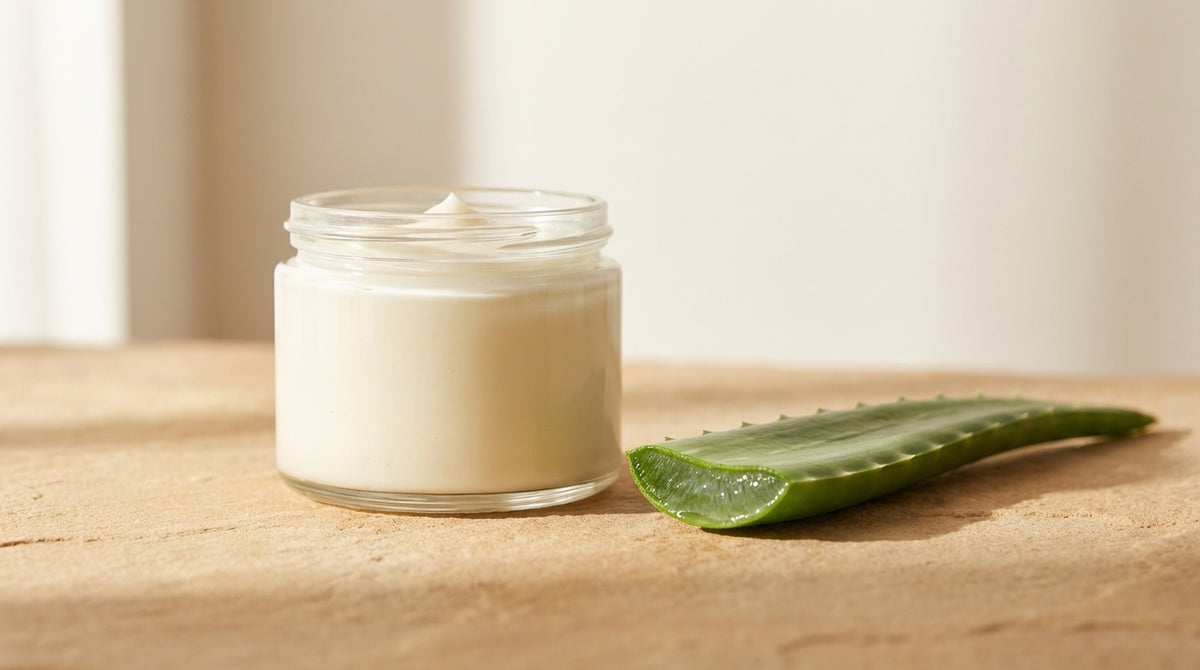
The ingredient list is short: grass-fed beef tallow and aloe vera. That's the foundation. No water filler. No synthetic emulsifiers. No silicones. No fragrance compounds.
The tallow we use is rendered from grass-fed cattle, which matters because the fatty acid profile and fat-soluble vitamin content vary significantly based on the animal's diet. Grass-fed tallow is higher in conjugated linoleic acid (CLA), omega-3 fatty acids, and vitamins A and E compared to grain-fed sources.
The aloe vera is included not as a token botanical, but as a functional partner — delivering acemannan, glucomannan, and natural antioxidants that complement tallow's lipid profile.
The result is a moisturizer that works the way your skin works. It absorbs without leaving a greasy film. It supports barrier function for hours — not minutes. And it does it with an ingredient list you can read in under five seconds.
See the full ingredient list and try it yourself →

8 ingredients. Grass-fed tallow + aloe vera. Nothing you can't pronounce.
FAQ
What makes a moisturizer truly "natural"?
There's no regulated definition, so the label alone doesn't tell you much. In practical terms, look for a formula where the primary ingredients are minimally processed, derived from whole sources (animal or plant), and free of synthetic emulsifiers, silicones, and artificial fragrances. The ingredient list — not the front-of-package marketing — is the only reliable indicator.
Can a natural moisturizer really work as well as a conventional one?
In many cases, better. Conventional moisturizers rely on water, humectants, and silicones that provide temporary smoothness but don't deliver the lipids needed for actual barrier repair. Formulas built on skin-compatible fats like tallow deliver both occlusion and structural fatty acids — addressing the root of dryness rather than masking it. The published research on fatty acid compatibility supports this approach.
Won't tallow feel heavy or greasy on my skin?
Properly rendered tallow absorbs efficiently precisely because its fatty acid profile is so close to human sebum. Your skin recognizes and integrates these lipids rather than leaving them sitting on the surface. Most people describe well-made tallow-based moisturizers as rich on application but non-greasy within minutes. A little goes a long way — you need much less than you would with a water-based lotion.
Is a natural moisturizer good enough for very dry or winter-damaged skin?
This is actually where natural lipid-based moisturizers tend to outperform conventional ones. In cold, low-humidity environments, water-based formulas evaporate faster and humectants like glycerin can pull moisture out of skin if there isn't enough ambient humidity. A tallow-based formula provides heavy occlusion and delivers fatty acids that repair the compromised barrier — exactly what severely dry skin needs. Multiple studies on TEWL reduction support the use of lipid-rich occlusives over humectant-dominant formulas in dry conditions.
How do I know if my current moisturizer is actually working?
Ask yourself two questions: Does your skin feel hydrated for more than 3-4 hours after application? And is your skin's overall condition improving over weeks — not just feeling temporarily smoother right after you apply? If the answer to either is no, your moisturizer is likely masking dryness rather than repairing it. An effective barrier-repair moisturizer should reduce your skin's dependence on reapplication over time, because it's restoring the structure that holds moisture in naturally.