
Yes, tallow is good for skin — particularly for dry, barrier-compromised, or mature skin. Its fatty acid profile (oleic, palmitic, stearic, and palmitoleic acids) closely mirrors the lipids that make up the human skin barrier, which is why it performs differently from petroleum-based alternatives that only coat the surface.
We break down the full research in one place: Beef Tallow for Skin: Everything You Need to Know.
A 2024 peer-reviewed study published in Cureus (Pham et al., PMC11193910) confirmed that grass-fed beef tallow shares the primary fatty acid composition of human sebum, supporting its biocompatibility with skin.
The shift away from tallow in the twentieth century wasn't because science found something better. It was economics — petroleum was cheap, stable, and scalable. Now tallow is coming back, and the fatty acid research gives a clear answer as to why.

Grass-fed tallow. 8 ingredients. The science-backed formula.
8 Clean Ingredients | No Fillers | 1,200+ Happy Customers
get my bottle →The Chemistry: What Tallow Is Made Of
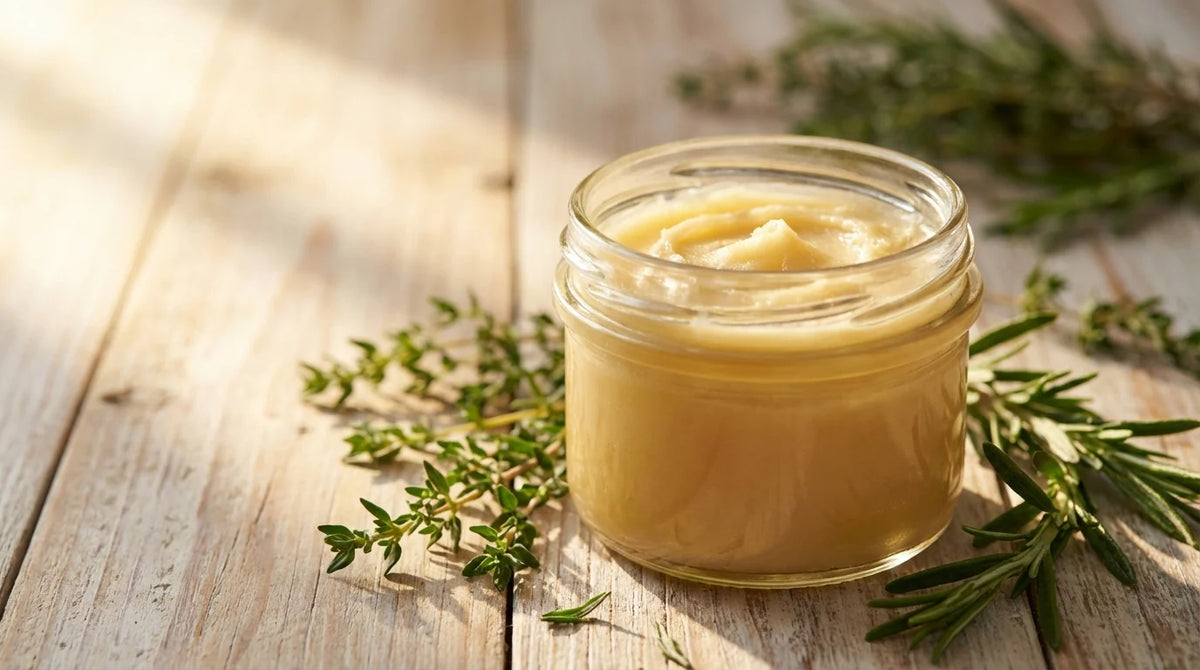
Tallow is rendered beef fat — suet from around the kidneys, slow-melted and filtered to produce a stable, shelf-stable lipid. The fatty acid profile of grass-fed beef tallow looks like this:
- Oleic acid (~42–47%) — monounsaturated omega-9, the dominant fatty acid in human sebum
- Palmitic acid (~24–28%) — saturated fatty acid, a primary component of the skin's intercellular lipid matrix
- Stearic acid (~14–19%) — saturated fatty acid, barrier-stabilizing and anti-inflammatory in character
- Palmitoleic acid (~3–5%) — monounsaturated fatty acid found in human sebum, with documented antimicrobial activity
- Minor fatty acids — myristic, linoleic, and others making up the remainder
Tallow also contains fat-soluble vitamins A, D, E, and K — present in concentrations that vary significantly based on what the animal ate. Grass-fed cattle produce tallow with notably higher vitamin concentrations than grain-fed animals.

Grass-Fed vs. Conventional Tallow: Does Sourcing Matter?
For basic fatty acid composition, the difference between grass-fed and grain-fed tallow is modest. But for vitamin content and CLA concentration, sourcing matters significantly.
Grass-fed cattle produce fat with substantially higher concentrations of fat-soluble vitamins A, D, E, and K. Grass-fed tallow also contains meaningful concentrations of conjugated linoleic acid (CLA) — a fatty acid with documented anti-inflammatory and antioxidant properties largely absent in grain-fed tallow. For topical skincare, grass-fed sourcing provides a more nutritionally complete lipid.
Tallow for Different Skin Types: Who Benefits, Who Should Be Careful
Dry skin: The clearest candidate. Dry skin is typically characterized by a depleted lipid matrix — exactly what tallow's fatty acid profile is positioned to replenish. Most people with dry or very dry skin report meaningful improvement: reduced flaking, improved softness, and better barrier resilience.
Normal skin: Tallow works well as a daily moisturizer for normal skin types, particularly when formulated into a lotion. The minimal ingredient profile is a practical advantage — less exposure to the synthetic fragrances, emulsifiers, and preservatives that conventional lotions require.
Sensitive or reactive skin: Tallow's short formulation requirements mean fewer potential sensitizers. Synthetic fragrance is the number one cause of cosmetic contact dermatitis; a tallow-based product with eight ingredients has a dramatically different sensitizer risk profile than a conventional lotion with twenty-five.
Oily or acne-prone skin: This is where caution is warranted. Oleic acid — the dominant fatty acid in tallow — increases the fluidity of the stratum corneum's lipid bilayers. For skin types that already produce excess sebum, adding more oleic-rich lipid can tip toward increased congestion. Patch testing is essential. Our post on does tallow clog pores covers this more specifically.
Barrier-compromised skin (eczema, psoriasis, post-procedure): Eczema-affected skin shows documented deficiencies in ceramides and free fatty acids — the same lipids that tallow provides. While tallow is not a medical treatment, its fatty acid profile makes it a rational moisturizer choice for compromised skin. Patch test thoroughly before broad application.
Mature skin: Aging skin produces less sebum, contributing to a thinner barrier and fine lines. Tallow's vitamin A content supports collagen production and cell turnover in its natural retinol form. Combined with its barrier-relevant fatty acids, it addresses several of the physical changes that make mature skin drier and more reactive.
You can find more specific guidance for different skin concerns on our is beef tallow good for skin post, which covers the science of biocompatibility in more depth.
Fatty acids your skin actually recognizes. 8 ingredients.
8 Clean Ingredients | No Fillers | 1,200+ Happy Customers
get my bottle →The Formulation Question: Raw Tallow vs. a Formulated Lotion
Raw tallow is a solid fat at room temperature — applied directly, it absorbs slowly and can feel greasy. Many people try it, find it inconvenient, and conclude tallow doesn't work for them. The issue is the formulation, not the ingredient. A well-emulsified tallow lotion — combined with water-binding ingredients and other skin-compatible lipids — absorbs significantly faster and works for daily use on the body and face.
The Aloetallow Formula
We formulated aloetallow to make grass-fed tallow practical for daily use: Aloe Vera, Grass-Fed Beef Tallow, Coconut Oil, Shea Butter, Carrot Seed Hydrate, Glycerin, Emulsifying Wax, PE9010. Eight ingredients, each present for a functional reason. No synthetic fragrance, no petrolatum, no mineral oil, no silicones. Find it at aloetallow.com.
8 ingredients. Grass-fed tallow + aloe vera. Nothing you can't pronounce.
FAQ
Is tallow good for skin?
For most skin types — yes, and for chemically grounded reasons. Tallow's fatty acid profile (oleic, palmitic, stearic, palmitoleic) closely mirrors the lipids that make up the human skin barrier, making it more biocompatible than synthetic or petroleum-derived alternatives. Grass-fed tallow also provides naturally occurring fat-soluble vitamins A, D, E, and K. The main caveat: oily or acne-prone skin types should patch test carefully, as tallow's high oleic acid content may contribute to congestion in already sebum-rich skin.
Is beef tallow or pork lard better for skin?
Both have overlapping fatty acid profiles and historical use on skin. Beef tallow has higher stearic and palmitoleic acid content; lard is higher in oleic. For skin barrier support, tallow's fatty acid profile may offer a slight advantage, and grass-fed tallow has a more favorable vitamin and CLA profile than commercially available lard. Grass-fed sourcing is also more established for beef tallow.
Is tallow comedogenic?
Moderately — typically rated 2–3 on a 0–5 scale. The concern is its oleic acid content, which can contribute to congestion in oily or acne-prone skin. For dry, normal, or barrier-compromised skin, the comedogenic risk is low in practice. In a formulated lotion, tallow is diluted, reducing the risk compared to raw tallow. Patch test before broad facial use if you have oily or acne-prone skin.
Grass-fed tallow. 8 ingredients. The science-backed formula.
8 Clean Ingredients | No Fillers | 1,200+ Happy Customers
get my bottle →Sources
- Pham, et al. (2024). Tallow, Rendered Animal Fat, and Its Biocompatibility With Skin. Cureus. PMC11193910