If you've ever looked up tallow skincare, you've probably run into some version of this: "tallow is comedogenic — it will clog your pores." It's the #1 objection in every Reddit thread, every review comment section. And it's worth taking seriously. But the full picture is more complicated than a single number on a scale that most people don't understand — including most of the people citing it. Here's what the science actually says.
What the comedogenicity scale actually measures (and what it doesn't)
The comedogenicity scale rates ingredients from 0 to 5 based on their likelihood of blocking pores:
- 0 — won't clog pores
- 1 — very low likelihood
- 2–3 — moderate; depends on skin type and formulation
- 4–5 — high likelihood of causing comedones
Tallow typically scores between 2 and 3 on this scale, depending on which source you consult. That puts it in the moderate range — similar to shea butter (0–3, varies by source), argan oil (0), and well below coconut oil (4) or cocoa butter (4), which are found in thousands of "natural" skincare products.
Here's the part most people skip: the scale was developed in the 1970s using rabbit ear tissue. Researchers applied ingredients to the inner ear canal of rabbits and counted follicular plugs. Rabbit ear skin is not human facial skin. It's thinner, has a different follicular density, and reacts differently to occlusive substances. The scale has never been formally validated against human clinical outcomes at the individual ingredient level.
That's not a reason to throw the scale out — it's a directional signal, not a verdict. But it means a score of 2 on the comedogenicity scale is not the same as "this ingredient will give you breakouts." It means the ingredient warrants attention, particularly for people with already-congested skin.
Why most people with acne-prone skin don't break out from tallow
The comedogenicity number is one data point. What actually happens on people's skin is another.
Anecdotally — and there's a lot of it — most people who switch from conventional moisturizers to a simple tallow-based formula report fewer breakouts over time, not more. The reason probably has less to do with tallow specifically and more to do with what they stopped using.
Conventional moisturizers, even expensive ones marketed to sensitive or acne-prone skin, routinely contain:
- Fragrance — the single biggest hidden irritant in skincare; a single "fragrance" listing can contain dozens of synthetic compounds, many of which are known sensitizers
- Alcohols — drying alcohols like denatured alcohol strip the skin barrier, triggering rebound oil production
- High-comedogenic plant oils — coconut oil (4), wheat germ oil (5), and flaxseed oil (4) are all common in "natural" products and score significantly higher than tallow
- Emulsifiers and preservative systems — ingredients like PEG compounds and certain parabens can disrupt the microbiome over time
When you reduce the ingredient list, you reduce the number of potential irritants. A shorter formula isn't automatically better — but it does mean fewer variables when your skin reacts to something.
"I'd been breaking out along my jaw for two years and blamed everything — diet, hormones, my pillowcase. Switched to tallow balm in January and it was the only thing I'd changed. Two months later the congestion is basically gone. I think it was the fragrance in my old moisturizer the whole time."
The oleic acid question: why tallow feels heavier than some oils
Tallow's fatty acid profile is worth understanding if you're trying to figure out whether it'll work for your skin type.
Tallow is high in oleic acid (roughly 40–50%, depending on the animal's diet). Oleic acid is a larger molecule that penetrates deeper into the skin. This is why tallow feels richer and more occlusive than something like rosehip or hemp seed oil. It's moisturizing and good for a compromised skin barrier — but if you're prone to clogged pores, it can feel heavy, especially on already-oily areas.
High-linoleic oils — rosehip, hemp seed, evening primrose — sit lighter on the skin. Linoleic acid is a smaller molecule. It absorbs faster and is less occlusive. Some research suggests that people with acne-prone skin are often deficient in linoleic acid and that supplementing topically with high-linoleic oils can improve comedone formation over time.
This isn't a case of one being better than the other. It's about skin type and barrier condition:
- Dry or compromised barrier: High-oleic oils like tallow are generally a better fit
- Oily or congestion-prone: You may do better with a lighter, high-linoleic oil — or use tallow only on drier areas
- Combination skin: Apply tallow selectively; avoid the T-zone if that's where you congest
Grass-fed tallow in particular tends to have a more favorable fatty acid ratio than conventional tallow, with higher levels of conjugated linoleic acid (CLA) and fat-soluble vitamins (A, D, E, K) that support healthy cell turnover.
If you have acne-prone skin, here's how to actually test this
Don't apply a new product to your entire face and wait to see what happens. That's how people end up writing angry reviews that blame the wrong ingredient.
Patch test properly:
- Apply a small amount to a discrete area — inside the wrist, behind the ear, or a small patch on your jaw if that's where you typically break out
- Leave it for 24–48 hours without washing it off
- Check for redness, itching, or any reaction
- If no reaction, introduce it into your routine on one part of your face at a time — don't change anything else in the same window
If you do break out after introducing tallow, it's worth asking: did you change anything else at the same time? Laundry detergent, pillowcase, diet, stress level, where you are in your cycle? Breakouts lag by 2–4 weeks. What shows up this week is usually a reaction to something from last week.

8 ingredients. Grass-fed tallow + aloe vera. Nothing you can't pronounce.
Related Reading
- Beef Tallow for Skin: What It Is, How It Works
- Tallow for Eczema: What the Science Says
- Beef Tallow for Acne: The Honest Breakdown
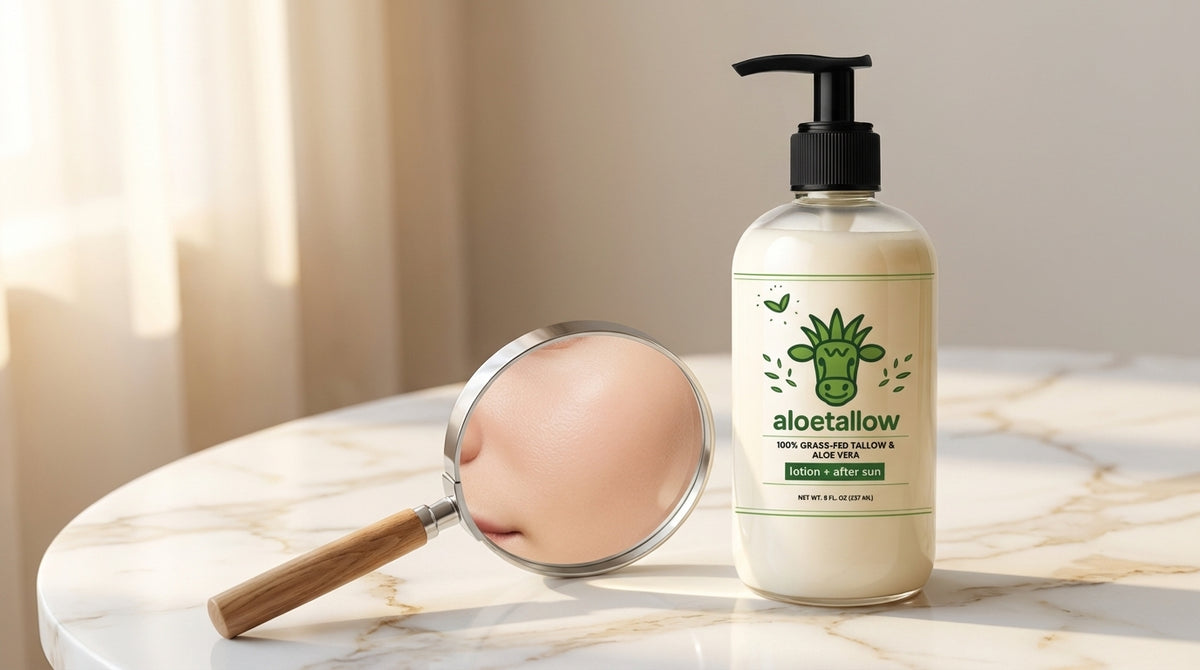
This is why we formulated Aloetallow with 8 ingredients, no fragrance, and grass-fed tallow as the base. We're not trying to hide complexity behind a long ingredient list. We wanted something that a skeptical person — someone who reads labels and has been burned by "clean" products that weren't actually clean — could look at and understand immediately. Fewer ingredients means fewer places for something to go wrong.