Can You Use Tallow and Aloe as a Daily Facial Moisturizer?
Yes — tallow and aloe blends work as a daily facial moisturizer. Grass-fed tallow has a comedogenic rating of 2 out of 5, absorbs without a greasy residue, and paired with aloe vera delivers both oil-phase barrier support and water-phase hydration in one step.

8 ingredients. Grass-fed tallow + aloe vera. Nothing you can't pronounce.

The Clogged Pores Question
The biggest hesitation about using tallow on the face is pore-clogging. Here's the actual data: comedogenicity is rated 0–5, where 0 is non-comedogenic and 5 is highly comedogenic. Grass-fed tallow sits at 2 — meaning it's unlikely to clog pores for most skin types.
For comparison: coconut oil (often praised as a natural moisturizer) rates 4. Cocoa butter rates 4. Olive oil rates 2–3. Tallow's lipid profile is close to human sebum, which means the skin recognizes it and absorbs it rather than treating it as a foreign substance that might block pores.

Why Tallow and Aloe Make an Effective Daily Facial Moisturizer
A good face moisturizer addresses two things: water loss and water delivery. Tallow handles the first — its fatty acids form a lipid barrier that slows transepidermal water loss (TEWL). Aloe vera handles the second — it's a humectant that draws water into the skin through acemannan polysaccharides.
Together, they do what most single-ingredient moisturizers can't: lock moisture in and pull more in from the environment.
How to Use Tallow and Aloe on Your Face
- Morning — apply a pea-sized amount after cleansing, let absorb 2–3 minutes before sunscreen
- Night — slightly heavier application; overnight barrier repair is when tallow works best
- Dry patches — dab a small extra amount on tight spots around the nose and forehead
- First use — patch test on your jawline for 24–48 hours before full face use
- Acne-prone skin — start slow (once daily, night only) and monitor for the first 2 weeks
A little goes a long way. For face use, start with less than you think you need — a small pea-sized amount covers the full face. Too much can feel heavy.
Who Benefits Most From Tallow and Aloe on the Face
- Dry skin — gets the most benefit from barrier reinforcement and deep hydration
- Sensitive skin — fragrance-free formula with 8 ingredients reduces irritation risk
- Skin irritated by other products — tallow's simplicity helps reset an overloaded routine
- Aging or mature skin — declining sebum production means tallow fills the gap
- People simplifying their routine — one product that handles moisture for face and body
Why Customers Trust aloetallow
- ✔ Comedogenic rating 2/5 — safe for face use
- ✔ Fragrance-free, dye-free, 8 total ingredients
- ✔ Grass-fed tallow sourced in the USA
- ✔ FDA MoCRA registered facility, GMP compliant
- ✔ Free shipping on orders over $40
8 ingredients. Grass-fed tallow + aloe vera. Nothing you can't pronounce.
Frequently Asked Questions
Can you use tallow and aloe as a daily facial moisturizer?
Yes. A tallow and aloe blend works as a daily face moisturizer. The key is using a product with a low comedogenic rating (tallow is 2/5), fragrance-free ingredients, and the right amount — a pea-sized amount for the full face, morning and night.
Will tallow make my face oily or shiny?
A small amount (pea-sized) absorbs within a few minutes for most people. The aloe vera base helps it feel lighter than a pure tallow balm. If your skin is very oily, start with just a night application and see how your skin responds before using it in the morning.
Can I use tallow face moisturizer under sunscreen?
Yes. Apply tallow moisturizer first, let it absorb for 2–3 minutes, then apply your mineral or chemical SPF on top. Tallow doesn't contain SPF and doesn't block UV protection when used as a base layer.
Is tallow face cream good for acne-prone skin?
It depends on the individual. Grass-fed tallow has a comedogenic rating of 2/5, which means it's unlikely to clog pores. That said, acne-prone skin varies widely — patch testing for 2 weeks before committing to daily use is the right approach.
Related Reading
CURRENT PRODUCT DETAILS
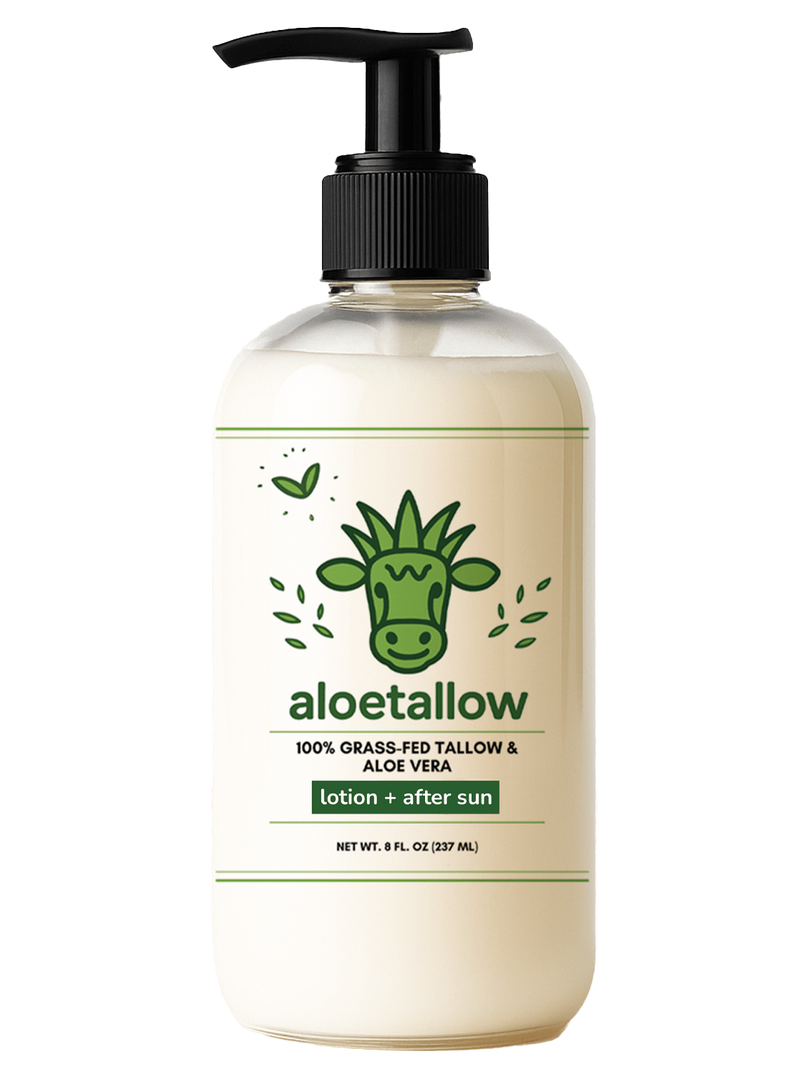
aloetallow is a face and body lotion made with aloe vera juice and grass-fed beef tallow, supplied in an 8 fl oz (237 mL) pump bottle.
- An aloe-based lotion emulsion, rather than an anhydrous tallow balm.
- Also contains coconut oil, shea butter, vegetable glycerin and emulsifying wax NF.
- Contains steam-distilled carrot seed essential oil. Check the ingredient list if you avoid essential oils.
- Preserved with PE 9010: phenoxyethanol and ethylhexylglycerin.
- No added fragrance; the ingredients can have a mild natural scent.
- One Bottle $29.99 USD Available
- Two Pack: Popular $49.99 USD Available
- Best Value Pack $69.99 USD Available
One-time purchase prices shown. Choose your option on the product page.
view product details