If you have sensitive skin, you've probably done everything right. You switched to fragrance-free. You bought the ones labeled "gentle" and "hypoallergenic" and "for sensitive skin." You patch tested. You went slower. And your skin still reacted — maybe not every time, but enough times that you've stopped trusting product labels entirely.
That distrust is reasonable. The "sensitive skin" category in skincare is one of the most marketing-heavy and least scientifically consistent categories on the shelf. Here's what's actually happening in reactive skin, why most sensitive-skin formulas don't fix it, and why the ingredient count matters more than the "gentle" label.
What sensitive skin actually is
Sensitive skin is not a fixed trait. It's a condition — and in most cases, it traces back to barrier dysfunction.
Your skin's outer layer, the stratum corneum, is built from dead skin cells held together by a lipid matrix of ceramides, free fatty acids, and cholesterol. When that matrix is intact, it does two things: it keeps water in, and it keeps irritants out. When it's damaged or depleted, the opposite happens — moisture escapes, and environmental triggers reach the nerve fibers and immune cells closer to the surface.
The result is skin that reacts to things it shouldn't: a new cleanser, a change in weather, a product that "should" be fine. This isn't an allergic response in the traditional sense. It's a structural problem — the barrier isn't doing its job, so things that would normally be filtered out are getting through.
A 2016 review in the Journal of the European Academy of Dermatology and Venereology found that the majority of people who self-identify as having "sensitive skin" show measurably elevated transepidermal water loss (TEWL) — the rate at which water evaporates out of the skin. High TEWL is a direct indicator of barrier compromise. The sensitivity isn't the root problem. It's the symptom.
This matters because it changes what the solution actually is. If sensitive skin is primarily a barrier problem, then the most important thing you can put on your skin isn't a "gentle" formula — it's something that actively helps rebuild the barrier. Not just something that avoids irritating it.
Why most "sensitive skin" products keep failing
The paradox of the sensitive skin market is that many products designed for it still contain the ingredients most likely to cause reactions.
Fragrance is the most common contact allergen in skincare, appearing in countless products labeled "for sensitive skin." "Unscented" is not the same as fragrance-free — many unscented products contain masking fragrance to neutralize other odors. The American Contact Dermatitis Society has listed fragrance components among the most frequent patch-test positives year after year for decades.
Preservatives are necessary in water-based formulas to prevent microbial growth, but several common preservative systems — methylisothiazolinone, formaldehyde-releasing preservatives, and certain parabens — have documented sensitization rates in the literature. A 2019 study in Contact Dermatitis found methylisothiazolinone to be one of the most frequently identified allergens in patch testing across European clinics.
Emulsifiers — the ingredients that keep water and oil from separating in a lotion — include some that are structurally disruptive to the skin barrier. Sodium lauryl sulfate (SLS) is the most studied; even at concentrations far below those used in cleansers, it measurably increases TEWL. It appears in some body creams, often not prominently disclosed.
Drying alcohols — SD alcohol, denatured alcohol, alcohol denat. — are used in many lightweight lotions to create a fast-absorbing, non-greasy feel. They disrupt the lipid matrix and trigger rebound dryness. They appear frequently in "sensitive skin" toners and serums.
The problem isn't that brands are being dishonest. A product can legitimately be fragrance-free and still contain three of the above. "Sensitive skin" on a label means the brand removed some things. It doesn't mean the formula is actually barrier-supportive — or that it doesn't contain something else that creates a problem for reactive skin.
Why tallow behaves differently on reactive skin
Beef tallow's fatty acid profile — predominantly oleic acid, palmitic acid, and stearic acid — closely mirrors the composition of human sebum and the lipid matrix of the stratum corneum. This isn't a coincidence of marketing; it reflects the biochemical similarity between mammalian fats and human skin lipids.
When you apply tallow to compromised skin, you're not just adding a film on the surface. You're providing the raw materials the stratum corneum uses to rebuild its mortar layer. A 2018 review in the International Journal of Molecular Sciences documented that palmitic and stearic acid are direct precursors in ceramide synthesis — the same ceramides that make up the structural lipid matrix. Depleted ceramides are a core feature of barrier-compromised, reactive skin.
This is different from most emollients, which smooth and soften the surface without contributing to barrier repair. It's also different from occlusives like petrolatum, which slow water loss effectively but are biochemically inert — they seal the surface while the skin does its own repair work.
For people with sensitive skin, the other significant factor is ingredient count. Tallow-based formulas — when made simply — can have 5–10 total ingredients. Every ingredient in a formula is a potential allergen, irritant, or sensitizer. A formula with 8 ingredients has a fundamentally different risk profile than one with 40, even if none of the 40 are "known" allergens. Most reactions to skincare are idiosyncratic — meaning they're specific to the individual's immune system, not to a known allergen list. Fewer ingredients means fewer opportunities for an unexpected reaction.
Grass-fed tallow also contains fat-soluble vitamins A, D, E, and K — present because pasture-raised animals synthesize them from the grasses they eat. Vitamin A supports normal cell turnover and cornification (the maturation of skin cells into the corneocytes that form the barrier). Vitamin E is a fat-soluble antioxidant that protects skin lipids from oxidative degradation — relevant for reactive skin, where inflammation and oxidative stress are often elevated.
The role of aloe vera for reactive skin
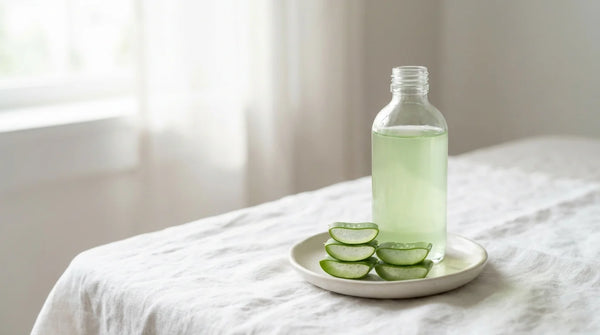
Aloe vera is one of the few topical ingredients with a genuine and well-documented record for calming reactive skin. Its anti-inflammatory effects come primarily from aloe-emodin and several polysaccharides, which have been shown in multiple studies to suppress inflammatory cytokine activity in skin tissue.
A 2009 study in the Journal of Drugs in Dermatology found aloe vera gel to be effective at reducing the skin's inflammatory response — relevant not just for sunburn but for any condition involving surface-level irritation and barrier disruption. The same polysaccharides that create aloe's characteristic gel also form a light, breathable film on the skin surface, providing mild occlusion without the heaviness of a pure fat.
For reactive skin specifically, aloe's cooling and anti-inflammatory properties address the immediate irritation while the tallow's lipid content works at the structural level. They work on different parts of the problem simultaneously — which is why combining them makes more sense than either alone for sensitive skin applications.
How to introduce tallow if your skin is reactive
Patch test first — always. Even with a minimal-ingredient formula, any new product should be tested on a small area (inside of the elbow is standard) and left for 24–48 hours before applying more broadly. This is true regardless of how simple the ingredient list is. Reactive skin can respond to things that aren't typical allergens.
Start with body, not face. Body skin is less reactive than facial skin in most people, with a thicker stratum corneum and fewer sebaceous glands. If you're uncertain how your skin will respond, start with arms or legs rather than the face. Give it 1–2 weeks before introducing it to the face.
Apply to slightly damp skin. Tallow is an occlusive emollient — it works best when there's moisture already present to seal in. Applying to completely dry skin reduces effectiveness and can feel heavier than necessary. After a shower, pat until just barely dry, then apply.
Use less than you think. A small amount goes a long way. Oversaturating reactive skin with any product — even a gentle one — can create problems. Start with a pea-sized amount for the face or a thin layer for the body, and add more only if needed.
Audit the rest of your routine simultaneously. If you're trying to rebuild a compromised barrier, you can't apply a barrier-supportive product over a cleanser or toner that's damaging the barrier. Check your cleanser for sulfates and drying alcohols. Check your toner for alcohol denat. A barrier-supportive moisturizer can't fully compensate for upstream damage.
Give it three to four weeks. The stratum corneum renews itself roughly every 28 days. Reactive skin that's been chronically compromised may take the full cycle before you see meaningful improvement. Don't assess after three days.
A note on sourcing: why grass-fed matters for sensitive skin
The nutrient profile of tallow reflects the diet of the animal it came from. Grass-fed tallow contains significantly higher levels of conjugated linoleic acid (CLA) — estimated at 2–3x the levels found in grain-fed tallow — as well as more favorable omega-6 to omega-3 ratios and higher concentrations of fat-soluble vitamins.
CLA has documented anti-inflammatory properties in dermal tissue. For sensitive skin — which often involves a low-grade inflammatory component — this distinction is more relevant than it might be for skin that isn't reactive. Grain-fed tallow is still an effective moisturizer; grass-fed tallow provides more of the specific compounds that support barrier health and reduce inflammation.
Rendering quality also matters. Tallow rendered at high heat degrades the fat-soluble vitamins and can introduce oxidized fatty acids, which have the opposite effect on skin. Low-temperature dry rendering preserves the lipid integrity and vitamin content. If a product doesn't specify how the tallow was rendered, that's worth asking about.
If you're looking for something built around these principles, Aloetallow is what we made specifically for this. It's grass-fed beef tallow combined with aloe vera — 8 ingredients total, no fragrance, no synthetic preservatives. We built it for people whose skin doesn't respond well to conventional formulas, where the barrier is the underlying issue and fewer inputs is the right approach. More than 130 customers have reviewed it, and the recurring theme in the reviews from people with reactive skin is that it's the first product that didn't cause a new problem while trying to fix the original one.

8 ingredients. Grass-fed tallow + aloe vera. Nothing you can't pronounce.
Frequently asked questions
Is tallow likely to cause a reaction on sensitive skin?
Less likely than most conventional moisturizers, primarily because of the ingredient count. That said, no ingredient is universally non-reactive — some people are sensitive to lanolin, which is structurally related to tallow, and a small number may react to beef-derived ingredients. Always patch test. For most people with sensitive, reactive, or fragrance-sensitized skin, tallow's simple fatty acid profile and minimal ingredient list make it one of the lower-risk options available.
Can I use tallow if I have rosacea?
Rosacea is more complex than standard sensitive skin because it involves vascular reactivity in addition to barrier dysfunction. Some people with rosacea do well with tallow — particularly as a night moisturizer on areas that aren't actively flushed. Others find rich fats occlusive enough to trap heat during flares. If your rosacea is actively flaring, let the acute phase settle before introducing any new product. Consult your dermatologist about integrating new topicals into a rosacea management protocol.
How is tallow different from other "natural" moisturizers for sensitive skin?
Most plant oils are predominantly linoleic acid (omega-6) or oleic acid, with varying ratios. They work as emollients — they fill gaps between skin cells and improve surface texture. Tallow's fatty acid profile is uniquely close to human sebum, and its palmitic and stearic acid content provides substrate for ceramide synthesis, not just surface coverage. For barrier-compromised sensitive skin, that structural contribution is the meaningful difference.
Is tallow safe for children or people with very reactive skin?
Tallow-based formulas — when kept simple and fragrance-free — are among the gentler options available. The fatty acids are the same type the body produces itself. That said, "sensitive skin" includes a wide range of conditions, some of which require dermatologist guidance (severe eczema, contact dermatitis with known allergens, autoimmune-driven skin conditions). For general reactive skin in children or adults, a simple patch test is the appropriate first step. For medically complex skin conditions, talk to a dermatologist before introducing any new topical.
Can I layer tallow under other products?
Yes, but order matters. Tallow is an emollient and occlusive, which means it's most effective as the last step in a routine — it seals in what's underneath. If you're using a humectant (glycerin, hyaluronic acid) for added hydration, apply it first to slightly damp skin, then apply tallow on top. Tallow under a water-based serum won't work as well — the tallow creates a partial barrier that water-based products can't penetrate as effectively.
The honest answer on sensitive skin is this: most reactive skin is a structural problem, not a product-matching problem. You don't need the right "gentle" formula — you need something that helps rebuild what's broken. That's a different category of product than most of what's sold in the sensitive skin aisle, and it's worth understanding the distinction before spending another six months rotating through the same shelf.