Your Hand Lotion Shouldn't Make Your Hands Sting
You wash your hands, reach for the lotion, apply it — and within seconds, your skin prickles. Maybe it's a faint burn across the knuckles. Maybe it's a low-grade itch between your fingers that wasn't there before. You tell yourself it's normal. That the lotion is "absorbing." That dry, cracked skin just reacts that way.
It's not normal. And the ingredient responsible is almost certainly fragrance.
Fragrance is the most frequently identified contact allergen in dermatological literature — more common than preservatives, more common than dyes, more common than any single surfactant. And it shows up in the overwhelming majority of hand lotions on the market, including many labeled "gentle," "sensitive," or "dermatologist-tested." The question isn't whether fragrance causes skin irritation. The science settled that decades ago. The real question is why it's still in almost everything — and what happens to your skin barrier when you apply it multiple times a day.
What Fragrance Actually Does to Your Skin
The word "fragrance" on an ingredient label isn't a single compound. It's a catch-all term that can represent anywhere from a handful to over 100 individual chemicals blended together. Under current FDA regulations, manufacturers aren't required to disclose the specific components of a fragrance blend — they're classified as trade secrets. So when you see "fragrance" or "parfum" on a lotion label, you're looking at a black box.
What the research tells us is clear. A landmark 2007 study published in Contact Dermatitis by Schnuch et al. tested over 78,000 patients and found that fragrance mix I (a standardized panel of eight common fragrance allergens) produced positive patch test reactions in 9.2% of patients — the single highest category among all allergens tested. A 2014 review in the Journal of the American Academy of Dermatology confirmed fragrance as the most common cause of allergic contact dermatitis from cosmetic products.
The mechanism works like this:
- Sensitization: Many fragrance compounds are haptens — small molecules that penetrate the stratum corneum (the skin's outermost layer), bind to skin proteins, and trigger an immune response. The first few exposures may cause no reaction. But over time, T-cells become primed to recognize the compound as a threat. This is called delayed-type hypersensitivity.
- Oxidation: Certain fragrance chemicals — particularly limonene, linalool, and geraniol — aren't inherently allergenic in their pure form. But when exposed to air, they oxidize into hydroperoxides, which are potent sensitizers. A 2012 study in Contact Dermatitis by Christensson et al. found that oxidized linalool caused positive patch test reactions in 5–7% of dermatitis patients, compared to near-zero reactions from the non-oxidized form.
- Barrier disruption: Many fragrance compounds are volatile solvents. They don't just sit on the skin's surface — they penetrate the lipid matrix of the stratum corneum, disrupting the organized arrangement of ceramides, cholesterol, and fatty acids that form the skin barrier. This increases transepidermal water loss (TEWL) and makes skin more permeable to other irritants.
- Cumulative irritation: Hand lotion is reapplied multiple times daily. Each application delivers a fresh dose of fragrance compounds to already-compromised skin. Research published in British Journal of Dermatology has demonstrated that repeated low-dose exposure to fragrance allergens can induce clinical contact dermatitis even in individuals who initially tested negative.
This isn't a rare sensitivity. The European Commission's Scientific Committee on Consumer Safety (SCCS) identified 82 individual fragrance substances as established contact allergens, and 24 of them are now required to be individually labeled on products sold in the EU. In the United States, that level of disclosure still isn't required.
Why Most Hand Lotion Formulas Fail
Pick up any conventional hand lotion — drugstore, department store, it doesn't matter — and read the ingredient label. Here's what you'll typically find:
Water, glycerin, mineral oil or dimethicone, cetyl alcohol, stearic acid, fragrance, methylparaben, propylparaben, DIPA-oleth-3 phosphate, triethanolamine...
Let's break down the structural problem:
The base is mostly water and occlusives
The first ingredient is almost always water. The "moisturizing" effect comes primarily from occlusives like mineral oil, dimethicone, or petrolatum that trap that water against the skin's surface. These don't repair anything. They create a temporary seal. When you wash your hands, the seal breaks and you're back to baseline — or worse, because the skin hasn't actually rebuilt its own lipid barrier.
Fragrance is there for repeat purchase
Fragrance doesn't serve any dermatological function. It exists for one reason: sensory experience. Studies in consumer behavior consistently show that scent is one of the top factors in lotion purchase decisions and brand loyalty. Manufacturers know that the immediate "this smells nice" moment in the store drives sales. The slow, invisible process of barrier degradation over weeks doesn't show up in customer satisfaction surveys — at least not directly.
"Unscented" doesn't mean fragrance-free
This is where it gets deceptive. "Unscented" products can still contain fragrance — the term means the product has no perceptible scent, not that fragrance chemicals are absent. Manufacturers sometimes add masking fragrances specifically to neutralize the smell of other ingredients. The label you need to look for is "fragrance-free," which means no fragrance compounds were added at all. But even that term isn't regulated by the FDA, so you still need to check the ingredient list.
Preservative systems compound the problem
Water-based formulas require preservatives to prevent microbial growth. Common ones — formaldehyde releasers like DMDM hydantoin, isothiazolinones like methylisothiazolinone (MI) — are themselves established contact allergens. When you combine fragrance sensitization with preservative sensitization, you get compounding irritation. A 2019 study in Dermatitis found that patients sensitized to fragrance were significantly more likely to also react to common preservatives, suggesting a pattern of cumulative barrier compromise.
For anyone looking for a natural hand lotion without fragrance, the ingredient list is the only thing that matters — not marketing language, not label claims, not brand positioning.
Why the Base Ingredient Matters More Than the "Active"
The skincare industry loves to market around hero actives — hyaluronic acid, niacinamide, vitamin E, shea butter. But in a hand lotion, the base determines whether the product actually supports barrier repair or just creates the sensation of moisture while the barrier continues to deteriorate.
Your skin's outermost barrier — the stratum corneum — is structured like a brick-and-mortar wall. The "bricks" are corneocytes (dead skin cells). The "mortar" is a precise mixture of ceramides (~50%), cholesterol (~25%), and free fatty acids (~15%). When this lipid matrix is intact, your skin holds water, resists irritants, and maintains its flexibility. When it's compromised — by overwashing, harsh detergents, or irritating lotion ingredients — TEWL increases, inflammation follows, and sensitivity compounds.
Grass-fed beef tallow has a fatty acid profile that closely mirrors the lipid composition of human skin. The primary fatty acids in tallow include:
- Oleic acid (~47%): A monounsaturated omega-9 fatty acid that's also the most abundant fatty acid in human sebum. It enhances penetration and delivers deep hydration without disrupting barrier structure when present in balanced ratios.
- Palmitic acid (~26%): A saturated fatty acid that comprises roughly 25% of the skin's own lipid barrier. It integrates into the mortar layer and supports structural integrity.
- Stearic acid (~14%): Another saturated fatty acid found naturally in the stratum corneum's lipid matrix. Research published in the Journal of Lipid Research has shown that stearic acid supplementation improves barrier function in compromised skin.
- Palmitoleic acid (~3-4%): An omega-7 fatty acid with documented antimicrobial properties. It's found in human skin but declines significantly with age.
This compatibility matters. When you apply a lotion whose base closely matches your skin's existing lipid structure, the fatty acids can integrate into — rather than disrupt — the barrier. Synthetic occlusives sit on top. Plant oils with high linoleic acid ratios can thin the barrier (as documented in research on oleic-to-linoleic acid ratios and barrier disruption). Tallow works with the skin's own architecture.
Why Tallow + Aloe Work Together
If tallow addresses the lipid side of barrier repair, aloe vera addresses the inflammatory and hydration side — and the two mechanisms are complementary, not redundant.
Aloe vera gel contains several compounds relevant to irritated hand skin:
- Acemannan: A polysaccharide that stimulates macrophage activity and modulates inflammatory cytokine production. Research in Phytotherapy Research has shown it supports wound-healing cascades without suppressing the immune system entirely — it modulates the response rather than blocking it.
- Aloin and aloesin: Compounds with documented antioxidant properties that reduce oxidative stress in damaged skin cells. This is relevant because fragrance-induced irritation involves oxidative pathways — particularly when oxidized terpenes are the sensitizing agents.
- Glycoproteins: These have demonstrated anti-inflammatory effects in multiple studies, reducing bradykinin-mediated pain responses and prostaglandin synthesis.
- Natural polysaccharides: These function as humectants, drawing water into the stratum corneum. Unlike synthetic humectants that can pull water from deeper skin layers in low-humidity environments, aloe's polysaccharides create a hydration reservoir within the upper layers.
When you combine tallow's lipid-compatible fatty acids with aloe's anti-inflammatory and humectant properties, you get a formula that addresses both halves of barrier repair: restoring the structural lipids and calming the inflammation that fragrance and other irritants created in the first place.
This isn't about one ingredient being better than the other. It's about the combination addressing the full scope of what fragrance-damaged hand skin actually needs.
What to Actually Look for in a Hand Lotion
If you're trying to eliminate fragrance-related irritation, here's the practical checklist:
- The ingredient list should be short. Fewer ingredients means fewer potential sensitizers. If the label has 25+ ingredients, most of them aren't there for your skin — they're there for shelf stability, texture, or sensory experience.
- Look for "fragrance-free," not "unscented." Then verify by reading the actual ingredient list. If you see "fragrance," "parfum," "essential oil blend," or any of the 26 EU-listed fragrance allergens (linalool, limonene, citronellol, geraniol, etc.), it's not fragrance-free regardless of what the front label says.
- Check the base, not the hero ingredient. If the first three ingredients are water, dimethicone, and mineral oil, the "shea butter" listed at the bottom is there at a fraction of a percent — it's marketing, not function.
- Prioritize lipid-compatible bases. Tallow, lanolin (if not wool-allergic), and certain whole-fat plant butters provide fatty acids that integrate into the skin barrier. Silicones and mineral oil create occlusion without structural repair.
- Avoid water-heavy formulas if you wash your hands frequently. Water-based lotions require preservative systems. More preservatives mean more potential allergens. Anhydrous (waterless) or low-water formulas need fewer preservatives and deliver higher concentrations of active lipids per application.
- Look for anti-inflammatory support. Aloe vera, colloidal oatmeal, or calendula — compounds with documented soothing properties that help calm skin already sensitized by fragrance exposure.
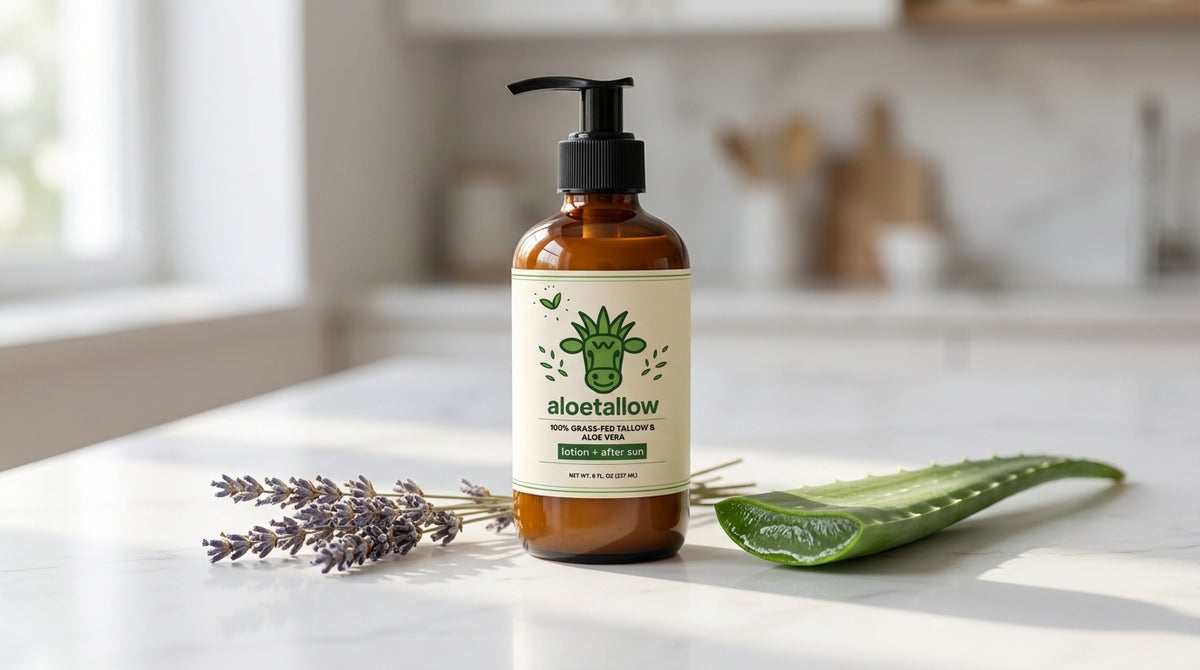
The AloeTallow Formula
We made AloeTallow with a short ingredient list and no fragrance — not because it's trendy, but because the science shows fragrance doesn't belong in a product designed to support skin barrier function.

8 ingredients. Grass-fed tallow + aloe vera. Nothing you can't pronounce.
The formula combines grass-fed beef tallow (lipid-compatible fatty acids for structural barrier repair) with aloe vera (anti-inflammatory polysaccharides and humectant support). No fragrance. No "parfum." No essential oil blends added for scent. No synthetic preservatives required by a water-heavy base.
If your current hand lotion stings, burns, itches, or leaves your skin feeling like it needs reapplication within an hour, the formula itself may be the problem — not your skin.
FAQ
Is fragrance really worse than other common irritants in hand lotion?
By the numbers, yes. Fragrance consistently ranks as the #1 contact allergen in dermatological patch testing across multiple large-scale studies spanning decades and hundreds of thousands of patients. Preservatives like methylisothiazolinone are a distant second. What makes fragrance particularly problematic is the combination of high sensitization rates, the sheer number of individual compounds involved, and the fact that many of those compounds become more allergenic as they oxidize over time on your shelf.
Can essential oils in "natural" lotions cause the same problems as synthetic fragrance?
Yes. Essential oils contain many of the same allergenic compounds — linalool, limonene, geraniol, citral — that are identified contact allergens whether they come from a lab or a plant. Lavender oil, tea tree oil, and citrus oils are among the most frequently documented essential oil sensitizers. "Natural" fragrance is still fragrance as far as your immune system is concerned. The SCCS makes no distinction between synthetic and natural sources when listing established contact allergens.
If I've been using scented lotion for years without a reaction, am I safe?
Not necessarily. Fragrance allergy develops through sensitization, which is a cumulative process. You may tolerate a compound for years before your immune system reaches the threshold where it mounts a clinical response. The European Society of Contact Dermatitis notes that fragrance allergy can develop at any age, and that prolonged repeated exposure — like daily hand lotion use — is a primary risk factor. The absence of a reaction today doesn't guarantee the absence of a reaction next year.
What's the difference between fragrance allergy and fragrance irritation?
Fragrance irritation (irritant contact dermatitis) is a direct chemical reaction — the fragrance compound damages skin cells or disrupts the lipid barrier, causing redness, burning, or dryness. It doesn't involve the immune system and can happen on first exposure. Fragrance allergy (allergic contact dermatitis) is an immune-mediated response that requires prior sensitization. It typically produces a delayed reaction — redness, itching, or blistering 24–72 hours after exposure. Both are problematic, and both are reasons to avoid fragrance in hand lotion.
Will switching to a fragrance-free lotion fix my irritated hands immediately?
It depends on how much barrier damage has accumulated. If fragrance was the primary irritant, removing it stops the ongoing insult. But barrier repair takes time — typically 2 to 4 weeks for the stratum corneum to fully turn over, and potentially longer if the irritation has been chronic. During that period, supporting the barrier with lipid-compatible ingredients (like the fatty acids in tallow) and anti-inflammatory compounds (like those in aloe vera) gives your skin the building blocks it needs to rebuild. Don't expect overnight results, but most people notice meaningful improvement within the first week of switching.