Best Beef Tallow for Skin: How to Choose the Right Formula
Tallow skincare has gone mainstream — but not all tallow products are made the same. Sourcing quality, ingredient list length, formulation method, and what's been added (or left out) all make a meaningful difference in what you're actually putting on your skin. Here's the buyer's framework we'd apply ourselves, and how aloetallow stands up to each criterion.

8 ingredients. Grass-fed tallow + aloe vera. Nothing you can't pronounce.
aloetallow is a skincare product, not a medical treatment. If you have a diagnosed skin condition, consult a dermatologist before changing your routine.

What Makes Beef Tallow Good for Skin — Starting with the Source
The effectiveness of a tallow product starts before it's ever formulated — it starts with what the animal was fed. Grass-fed cattle produce tallow with a meaningfully different nutritional and fatty acid profile compared to conventionally raised, grain-fed cattle.
- CLA content: Conjugated linoleic acid (CLA) is found in significantly higher concentrations in grass-fed tallow. Research has linked topical CLA to anti-inflammatory and skin-protective effects. Grain-fed tallow contains far less.
- Vitamin profile: Grass-fed tallow is naturally richer in fat-soluble vitamins A, D, E, and K — in bioavailable forms. These aren't added synthetically; they're native to tallow from animals eating nutrient-dense pasture.
- Fatty acid quality: Grass-fed tallow has a more favorable ratio of oleic acid to linoleic acid compared to conventional tallow. Higher oleic acid supports a richer, more skin-compatible lipid structure. High linoleic acid at elevated concentrations may contribute to oxidative stress on the skin surface.
The bottom line: grass-fed sourcing isn't a marketing label — it's a meaningful quality indicator for tallow skincare. If a product doesn't specify grass-fed, it likely isn't.
What to Look for When Buying Beef Tallow Skincare
Here's the evaluation framework we'd use to assess any tallow skincare product before buying:
- Short ingredient list: The best tallow skincare products have fewer than 12 ingredients. If you can't pronounce most of what's listed, that's a sign the formula has been padded with fillers, synthetic thickeners, or cost-cutting additives. Clean formulas are simple formulas.
- No synthetic fragrance: Fragrance — listed as "fragrance" or "parfum" — is one of the most common skin sensitizers in skincare. It has no functional benefit to the skin and adds unnecessary irritation risk. Any tallow product worth using should be fragrance-free.
- Grass-fed sourcing: As covered above, this determines the nutrient density and fatty acid quality of the base material. Grass-fed should be clearly stated, not implied.
- No seed oils: Many tallow products dilute their formula with seed oils — sunflower, safflower, hemp seed, or others high in polyunsaturated fatty acids (PUFAs). These oils oxidize quickly, particularly when exposed to light and heat, and can create lipid peroxides on the skin surface. A high-quality tallow formula shouldn't need them.
- Lotion vs. balm format: Tallow balms are pure tallow or tallow blended with another fat (often beeswax). They're rich but they don't spread easily, can feel waxy, and often don't absorb cleanly. A tallow lotion uses an emulsifier to blend the tallow with a water-based ingredient — typically aloe vera — resulting in a formula that absorbs like a regular moisturizer and works for more skin types, including those that find pure balm too heavy.
Red Flags in Tallow Skincare Products
The tallow skincare category has grown fast, and not all products in it have kept pace with quality standards. Watch for these warning signs:
- Long ingredient lists: More than 15 ingredients in a "clean" tallow product is a contradiction. Extra ingredients typically mean synthetic thickeners, synthetic preservative cocktails, or fillers that dilute the active components you're paying for.
- Fragrance added: "Fragrance" or "parfum" in any tallow product is a dealbreaker for sensitive skin. Even "natural fragrance" or "essential oil blend" carries irritation risk for reactive or compromised skin. Clean tallow skincare should be odor-neutral or carry only the mild natural scent of the base materials.
- Non-grass-fed sourcing: Products that are vague about tallow sourcing — or that simply say "beef tallow" with no qualification — are likely using conventional, commodity-grade tallow. The nutrient and fatty acid differences are real.
- Silicones added: Some tallow products blend in dimethicone or cyclopentasiloxane to create a smoother skin feel. Silicones create a film on the skin and don't allow the tallow's lipids to actually interface with your skin's barrier. They undercut the entire rationale for using tallow in the first place.
- No preservative in water-containing formulas: A tallow lotion — any product with a water base — must contain a preservative to prevent bacterial and fungal growth. If a lotion claims to be "preservative-free," that's not a quality signal — it's a safety concern. Proper preservation at appropriate concentrations is a sign of responsible formulation.
Why aloetallow Fits the Criteria
We built aloetallow to meet every one of the quality markers listed above. Here's how each one applies:
- Grass-fed sourced: Our tallow is sourced from grass-fed cattle in the USA. This isn't a label — it determines the CLA content, vitamin profile, and fatty acid quality of the formula's primary active ingredient.
- 8 ingredients total: The complete ingredient list is eight items. No fillers, no thickeners, no synthetic additives beyond a responsible preservative system at the end of the list.
- Fragrance-free: No added parfum. The formula contains steam-distilled carrot seed oil, which is an essential oil, so it is not essential-oil-free.
- No seed oils: We use coconut oil (medium-chain, stable) as a supportive lipid, not high-PUFA seed oils. Tallow and shea butter are the primary fat-phase ingredients — both low in polyunsaturated fatty acids and highly stable.
- Lotion format, not balm: aloetallow uses aloe vera as its water base and a plant-derived emulsifying wax to create a true lotion that absorbs like a moisturizer — not a heavy balm that sits on the surface. This makes it suitable for face and body, dry and combination skin, and year-round use.
- Responsibly preserved: PE9010 is used at the end of the formula at cosmetically appropriate levels to prevent microbial contamination. It's paraben-free and formaldehyde-free. Proper preservation in a water-containing product is non-negotiable.
- FDA MoCRA registered: Our manufacturing facility is registered with the FDA under MoCRA (Modernization of Cosmetics Regulation Act) and follows GMP (Good Manufacturing Practices). This is a transparency marker that most indie tallow brands don't provide.
The 8 Ingredients
Here is the complete aloetallow formula — nothing hidden, nothing abbreviated:
- Aloe Vera — The water base. Hydrating, soothing, and well-documented for its calming properties on irritated skin. Not a filler — it's the foundation of the formula.
- Grass-Fed Beef Tallow — The primary lipid. Fatty acid profile closely mirrors human sebum. Rich in naturally occurring vitamins A, D, E, and K. Sourced from grass-fed cattle in the USA.
- Coconut Oil — Medium-chain fatty acid source, primarily lauric acid. Stable against oxidation. Contributes to the formula's texture and provides supportive antimicrobial properties.
- Shea Butter — High in oleic and stearic acids with a triterpene fraction linked to anti-inflammatory activity. A well-tolerated emollient across skin types.
- Carrot Seed Oil — Steam-distilled from Daucus carota. Contains beta-carotene and antioxidant compounds that support skin brightness and resilience.
- Glycerin — A non-comedogenic (score: 0) humectant that draws water toward the skin's surface. Compatible with all skin types.
- Emulsifying Wax — Plant-derived. Binds the oil and water phases into a stable lotion. Allows for clean absorption instead of a greasy, occlusive balm texture.
- PE9010 — A paraben-free, formaldehyde-free preservative system. Used at a low concentration to keep the water-containing formula safe from microbial growth. Required for any responsible lotion formulation.

Why Customers Trust aloetallow
- ✔ 8 total ingredients — every one on the label for a reason
- ✔ Grass-fed tallow sourced in the USA
- ✔ No synthetic fragrance, no mineral oil, no silicones
- ✔ FDA MoCRA registered facility, GMP compliant
- ✔ Free shipping on orders over $40
8 ingredients. Grass-fed tallow + aloe vera. Nothing you can't pronounce.
Frequently Asked Questions
What is the best beef tallow for skin?
The best beef tallow skincare products share a few consistent qualities: grass-fed sourcing, a short ingredient list (ideally under 12 ingredients), no synthetic fragrance, no seed oils, and a formulation method that makes the tallow accessible to the skin — either as a clean balm or, preferably, as a lotion using a natural emulsifier. aloetallow meets all of these criteria with 8 total ingredients and grass-fed tallow sourced in the USA.
Is grass-fed tallow better for skin?
Yes — meaningfully so. Grass-fed tallow contains higher concentrations of conjugated linoleic acid (CLA), a more favorable oleic-to-linoleic acid ratio, and higher levels of naturally occurring fat-soluble vitamins A, D, E, and K compared to conventional tallow from grain-fed cattle. These aren't trivial differences. If a tallow skincare product doesn't specify grass-fed, assume it isn't — and that the quality of the base material reflects that.
Should I use tallow balm or tallow lotion?
It depends on your skin type and how you use it. Tallow balm is pure fat — it's deeply occlusive and works well for very dry patches, cracked skin, or people with extremely dry skin who want maximum barrier protection. The tradeoff is texture: balm feels heavy, takes longer to absorb, and can feel waxy on normal-to-combination skin. Tallow lotion (like aloetallow) blends tallow with a water-based ingredient and an emulsifier, creating a formula that absorbs more like a conventional moisturizer. It works for more skin types, is easier to use on the face, and is more comfortable in warmer weather. Most people starting with tallow skincare find lotion more accessible.
How do I know if a tallow product is high quality?
Start with the ingredient label. Grass-fed tallow should appear early in the list (ingredients are listed in descending order by weight). The total ingredient count should be short — under 15 for a lotion, under 5–6 for a balm. There should be no "fragrance" or "parfum" listed. No high-PUFA seed oils. If it's a lotion, there should be a legitimate preservative at the end of the list — the absence of one is a red flag, not a quality feature. And the brand should be transparent about where the tallow is sourced and how the product is manufactured.
Related Reading
CURRENT PRODUCT DETAILS
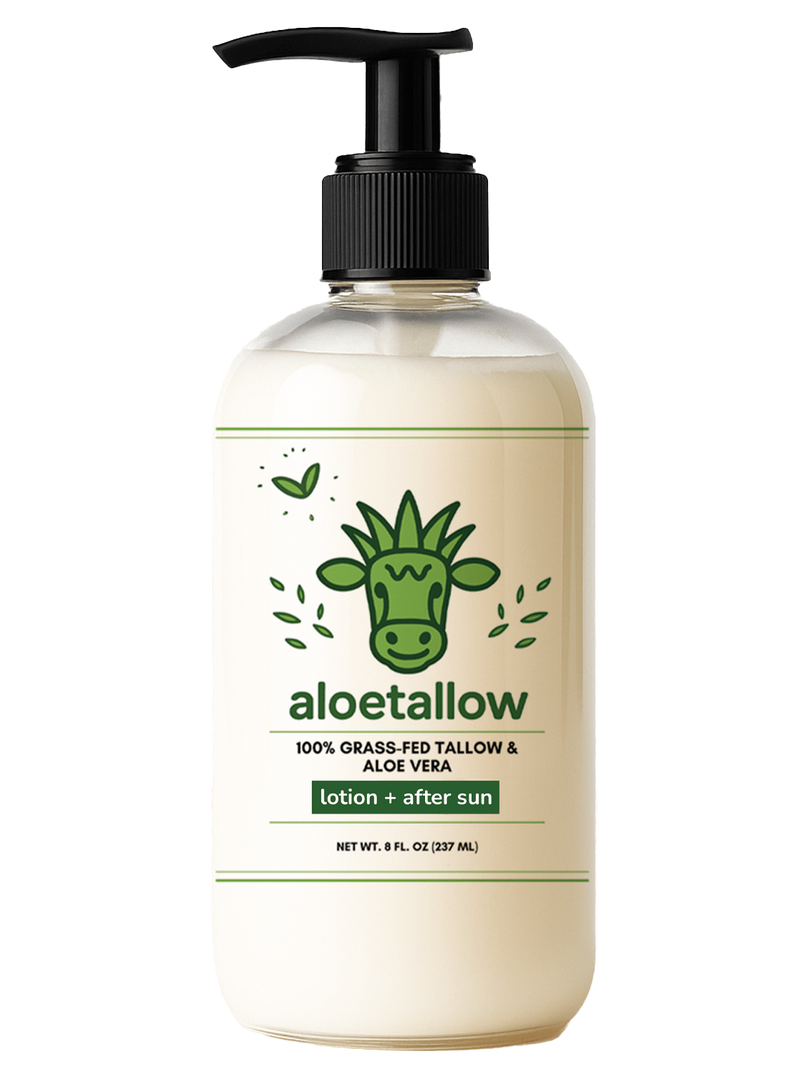
aloetallow is a face and body lotion made with aloe vera juice and grass-fed beef tallow, supplied in an 8 fl oz (237 mL) pump bottle.
- An aloe-based lotion emulsion, rather than an anhydrous tallow balm.
- Also contains coconut oil, shea butter, vegetable glycerin and emulsifying wax NF.
- Contains steam-distilled carrot seed essential oil. Check the ingredient list if you avoid essential oils.
- Preserved with PE 9010: phenoxyethanol and ethylhexylglycerin.
- No added fragrance; the ingredients can have a mild natural scent.
- One Bottle $29.99 USD Available
- Two Pack: Popular $49.99 USD Available
- Best Value Pack $69.99 USD Available
One-time purchase prices shown. Choose your option on the product page.
view product details