Your great-grandmother didn't have a 12-step skincare routine. She didn't layer toner over essence over serum over moisturizer over SPF over primer. She probably used one thing — maybe two — and her skin looked fine. Better than fine, actually, if you look at the photographs.
The ancestral skincare movement isn't nostalgia. It's not a rejection of science. It's what happens when modern dermatology finally catches up to what traditional cultures figured out through thousands of years of practical use: that the simplest, oldest moisturizing ingredients — animal fats, plant gels, beeswax — work as well or better than most of what the $180 billion skincare industry is selling you today.
The difference is that now we can explain why they work, at the molecular level. And the explanation is embarrassingly straightforward.
A brief history of how we got here
For most of human history, skincare was simple. Ancient Egyptians used animal fats mixed with plant oils. Roman women applied a mixture of rendered animal fat and beeswax called "ceroma." Japanese geishas used camellia oil. Indigenous cultures across every continent had their own versions — whale blubber in Arctic regions, shea butter in West Africa, emu oil in Australia, tallow and bear fat in North America.
These weren't luxury products. They were practical solutions to a universal problem: skin gets dry, cracks, and becomes vulnerable when exposed to the elements. Every culture, independently, arrived at the same answer: put fat on it. Specifically, fat that comes from animals or plants, because those are the fats that exist in nature.
Then came the 20th century. The petrochemical industry figured out how to make moisturizers from petroleum byproducts — mineral oil, petrolatum, silicones. These were cheap to produce, shelf-stable for years, and could be manufactured at industrial scale. By the 1950s, they'd replaced traditional ingredients in most commercial skincare products.
The marketing pitch was "better living through chemistry." Petroleum-based ingredients were positioned as cleaner, more refined, more scientific than the animal fats your grandmother used. And for half a century, almost nobody questioned it.
The science is now questioning it. Hard.
Why traditional ingredients actually work (the molecular explanation)
The reason animal fats work as moisturizers is so obvious that it took modern science decades to formally prove it: animal fats are chemically similar to human skin fats because we're all animals.
Your skin barrier — the outermost layer called the stratum corneum — is held together by a lipid matrix composed of ceramides, cholesterol, and free fatty acids. The fatty acid component is primarily oleic acid (40-50%), palmitic acid (20-25%), and stearic acid (10-15%). These are the "mortar" between the dead skin cells that make up your barrier's "bricks."
Grass-fed beef tallow contains oleic acid (40-50%), palmitic acid (25-30%), and stearic acid (15-25%). The overlap with human skin lipids is remarkable but not surprising — it's convergent biology. All mammalian skin uses similar lipid structures because we all evolved from the same template.
A 2019 review in Dermato-Endocrinology confirmed what this similarity implies: topical lipids that structurally match endogenous skin lipids integrate into the barrier more efficiently, reduce transepidermal water loss more effectively, and cause fewer adverse reactions than structurally dissimilar alternatives. Your skin recognizes tallow's fatty acids as building materials, not foreign substances.
Petroleum-based alternatives — mineral oil, petrolatum, dimethicone — create an occlusive layer that sits on top of the skin. They do reduce TEWL (transepidermal water loss). But they don't integrate into the barrier's lipid structure. They're a tarp, not mortar. They cover the gaps without filling them. When you wash the tarp off, the gaps are still there.
The aloe connection
Aloe vera is another ancestral ingredient with modern validation. Ancient Egyptian texts reference aloe as "the plant of immortality." Cleopatra allegedly used it in her daily skincare routine. Greek physicians prescribed it for skin conditions. It's been used continuously for over 3,000 years across dozens of cultures.
The active compound that explains why: acemannan, a polysaccharide unique to aloe vera. A 2008 study in Evidence-Based Complementary and Alternative Medicine found that acemannan stimulated hyaluronan synthesis in dermal fibroblasts — meaning it triggers your skin cells to produce more of their own hyaluronic acid. This is fundamentally different from applying synthetic HA topically. Acemannan activates an internal production pathway rather than adding an external layer.
Aloe also contains vitamins A, C, and E, plus enzymes that provide mild anti-inflammatory effects. A 2019 systematic review in Iranian Journal of Medical Sciences documented aloe vera's wound healing, anti-inflammatory, and skin hydration properties across multiple clinical studies.
The ancient cultures that used aloe didn't know about acemannan or hyaluronan synthesis. They knew it made skin feel better and heal faster. The mechanism took 3,000 years to identify, but the observation was correct from the start.
Beeswax: nature's emulsifier
Every traditional skincare formula that combined oil and water used beeswax. Egyptian ceroma, Greek cold cream, medieval hand salves — beeswax was the universal emulsifier for millennia before synthetic alternatives existed.
Modern emulsifiers — polysorbates, PEG compounds, cetearyl glucoside — are more efficient at creating stable emulsions. They're also more likely to irritate sensitive skin. A 2015 review in Contact Dermatitis documented allergic and irritant reactions to common synthetic emulsifiers, particularly in people with compromised barriers or atopic dermatitis.
Beeswax is slower. It creates a softer emulsion that separates more easily if not formulated carefully. But it's biocompatible, non-irritating to virtually all skin types, and provides its own mild occlusive benefit. It also contains small amounts of vitamin A and has natural antimicrobial properties.
The ancestral formulators chose beeswax because it was available and it worked. Modern dermatology is rediscovering that "available and works" is often a better criterion than "technically optimal but potentially irritating."
The $277 million signal
The tallow skincare market hit $277 million in 2025 and is projected to reach $403 million by 2032. On TikTok, #tallowskincare has billions of cumulative views. "Beef tallow for skin" search volume has grown over 470% year-over-year.
This isn't a fad. Fads don't have this kind of sustained growth trajectory. What's happening is a market correction. Consumers spent decades being told that synthetic ingredients were superior, and they're discovering through personal experience that the traditional alternatives work as well or better — often with fewer ingredients, fewer reactions, and less money spent.
The ancestral skincare movement is broader than tallow. It includes a return to single-ingredient oils (jojoba, rosehip, marula), fermented skincare ingredients (inspired by Korean and Japanese traditions), and minimalist routines that reject the 10-product layering system. The common thread is simplicity: fewer ingredients, more compatible ingredients, less synthetic processing.
A 2022 survey by the International Journal of Cosmetic Science found that 67% of consumers who switched to "clean" or "natural" skincare products reported improved skin condition, with the most-cited improvement being reduced sensitivity and irritation. The researchers noted that this likely reflects removal of irritants rather than superiority of any single natural ingredient — which is exactly the point. When you remove petroleum derivatives, synthetic fragrances, and unnecessary preservatives, skin gets less irritated. Not because natural is magic, but because simple is usually better for a biological system.
What ancestral skincare gets right
The ancestral approach isn't about rejecting science. It's about applying science to validate what worked, rather than inventing replacements for things that weren't broken. Specifically:
- Lipid compatibility over lipid coverage. Traditional fats (tallow, lanolin, emu oil) match human skin lipid profiles. Petroleum alternatives cover the skin but don't integrate. The science now confirms that integration matters for long-term barrier health.
- Fewer ingredients, fewer reactions. Traditional formulas had 3-8 ingredients. Modern formulas routinely have 20-40. Every additional ingredient is a potential irritant, allergen, or sensitizer. Complexity isn't quality.
- Bioactive ingredients, not inert fillers. Tallow delivers fatty acids. Aloe delivers acemannan. Beeswax provides emulsification and mild occlusion. Every ingredient does something. Modern formulas often include water, thickeners, and fragrance that serve the formula's texture and marketing, not your skin.
- Sustainability by default. Tallow is a byproduct of the meat industry — it would otherwise be waste. Beeswax is a byproduct of honey production. Aloe grows in arid conditions with minimal water. None of these require petrochemical extraction, industrial synthesis, or complex supply chains.
What ancestral skincare gets wrong
To be fair about the limitations:
Preservation is real. Traditional formulas had no preservative systems, which meant short shelf lives and potential microbial contamination. Modern preservation (when done with mild, effective preservatives rather than formaldehyde releasers) is a genuine improvement over the ancestral approach.
Sunscreen is modern and essential. Traditional cultures didn't have SPF because they didn't have the chemistry to create it. UV protection is the single most evidence-backed anti-aging intervention, and it's a modern invention. Ancestral skincare works best when it covers moisturizing and barrier repair, not sun protection.
Not everything old is good. Traditional cultures also used lead-based cosmetics, mercury treatments, and arsenic compounds. The ancestral approach is worth following when the ingredients have been validated by modern research. "Old" doesn't automatically mean "good" — it means "worth testing."
An 8-ingredient formula built on ancestral principles
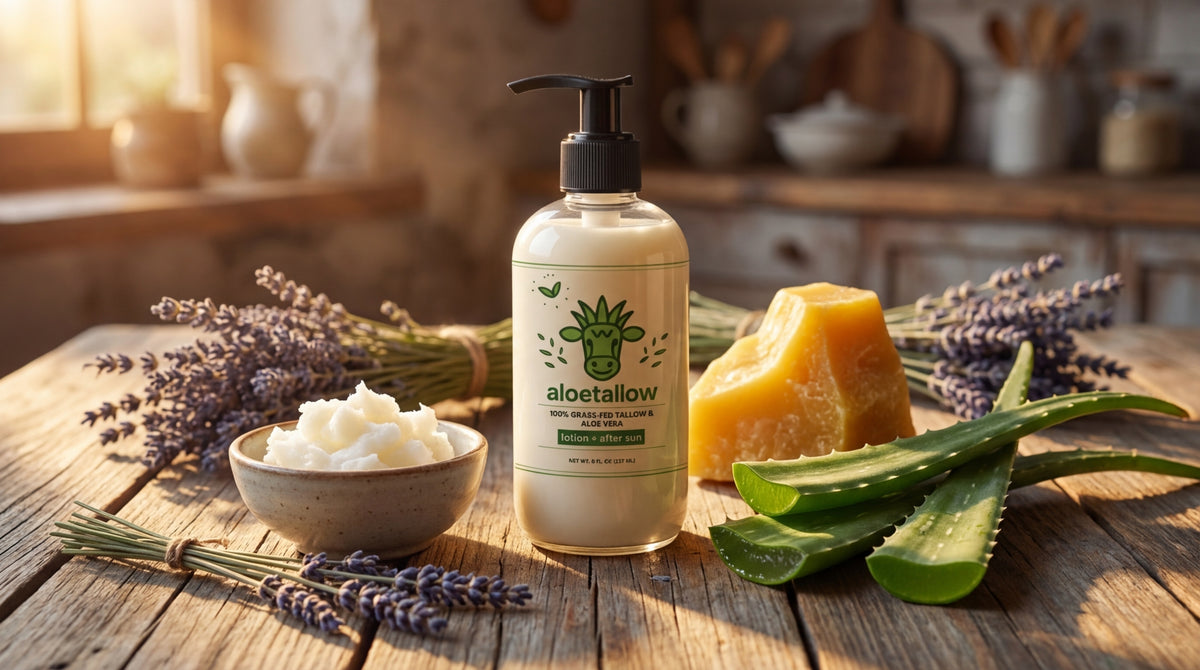
AloeTallow was formulated using exactly this philosophy: ancestral ingredients validated by modern science, combined in the simplest effective formula possible.
- Grass-fed beef tallow — barrier-compatible lipid delivery (oleic, palmitic, stearic acid)
- Aloe vera — acemannan for hyaluronan synthesis
- Jojoba oil — sebum-mimicking lipid
- Beeswax — natural emulsifier
- Rosemary extract — antioxidant preservation
- Vitamin E — antioxidant
- Lavender essential oil — mild antimicrobial
- Frankincense essential oil — anti-inflammatory
Eight ingredients. Every one of them has been used for centuries. Every one of them has modern research supporting its mechanism. No petroleum derivatives. No synthetic emulsifiers. No ingredients that exist solely to make the formula look or smell more "luxurious."
Your great-grandmother would recognize every ingredient on this list. That's the point.

8 ingredients. Grass-fed tallow + aloe vera. Nothing you can't pronounce.
Frequently asked questions
Is ancestral skincare the same as "clean beauty"?
There's overlap, but they're not identical. "Clean beauty" is a marketing term with no regulated definition — it generally means avoiding certain synthetic ingredients, but brands define their own standards. Ancestral skincare is more specific: it's a return to ingredients that traditional cultures used for centuries, validated by modern research. Some clean beauty products use novel synthetic ingredients that have no ancestral precedent. Some ancestral ingredients (like tallow) aren't considered "clean" by vegan-focused clean beauty brands. The terms aren't interchangeable.
Don't modern ingredients work better?
Some do. Retinoids (vitamin A derivatives) for collagen stimulation, sunscreens for UV protection, and certain peptides for targeted cell signaling are genuine improvements over anything available historically. For moisturizing and barrier repair specifically, the science shows that traditional lipid-compatible ingredients perform as well or better than synthetic alternatives. Modern chemistry excels at active ingredients (drugs and quasi-drugs). Traditional ingredients excel at structural skin support (barrier, hydration, protection).
Is tallow skincare vegan?
No. Tallow is rendered animal fat. If you follow a vegan skincare routine, tallow isn't compatible with that. Plant-based alternatives that provide similar fatty acid profiles include shea butter, cocoa butter, and mango butter — though none of them match human skin lipids as closely as tallow does. The post on beef tallow vs shea butter compares the fatty acid profiles in detail.
Why did we stop using tallow in skincare?
Cost and scale. Petroleum-derived ingredients are cheaper to produce, more shelf-stable, and easier to manufacture at industrial volumes. The shift happened in the mid-20th century as the petrochemical industry scaled up and positioned synthetic ingredients as "modern" and "scientific." There was no single moment when someone proved synthetic was better — the market simply followed the economics. Consumers are now re-evaluating that trade-off as the research on lipid compatibility catches up.
How do I start with ancestral skincare?
Simply. Replace your current moisturizer with a tallow-based one and see how your skin responds over 2-4 weeks. Keep your cleanser (gentle, fragrance-free) and your sunscreen. Drop everything else for now. If your skin improves — less dryness, less sensitivity, more even tone — you have your answer. The post on tallow skincare routine provides a full step-by-step guide for transitioning.