You spent the day outside. Maybe the beach, maybe a hike, maybe three hours in the yard that turned into five. Your skin is warm, tight, maybe a little pink. You reach for the after-sun lotion in your cabinet and apply it. It cools. It feels better for twenty minutes. Then it evaporates, and the tightness comes back.
This is the cycle most people are stuck in with conventional after-sun products. They soothe the surface. They don't repair what UV exposure actually damaged. And the reason they don't is structural -- they're built on humectants and cooling agents that address symptoms without replacing what the sun stripped away.
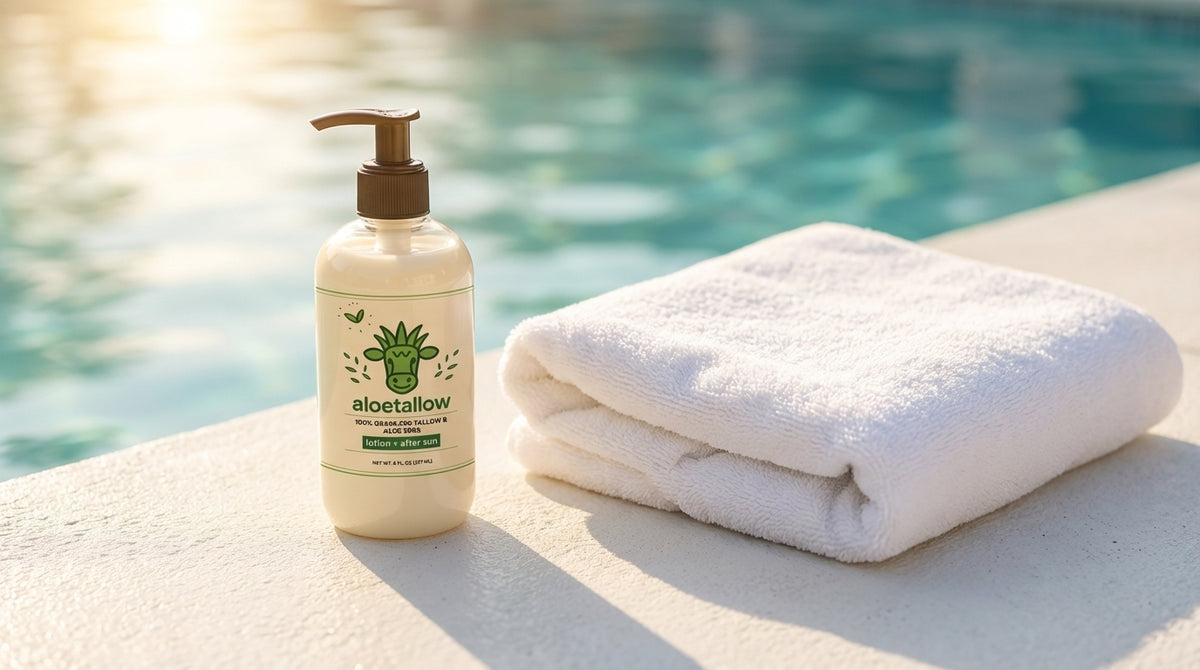
Beef tallow combined with aloe vera takes a fundamentally different approach. It was the reason we created Aloetallow -- not as a general-purpose lotion that happens to work after sun, but as a formula specifically designed for skin that's been through UV exposure. Here's why the combination works at a level most after-sun products can't reach.

8 ingredients. Grass-fed tallow + aloe vera. Nothing you can't pronounce.
What UV exposure actually does to your skin barrier
Sunlight doesn't just turn skin red. UV radiation triggers a cascade of damage that goes well below the surface, and the part most relevant to after-sun care is what happens to the lipid barrier.
The stratum corneum -- your skin's outermost protective layer -- is held together by a matrix of ceramides, cholesterol, and free fatty acids arranged in lamellar structures. These lipid layers are what keep moisture in and irritants out. UV radiation directly degrades this lipid matrix. A 2012 study in the Journal of Investigative Dermatology found that UV exposure causes lipid peroxidation in the stratum corneum, breaking down the fatty acids that hold the barrier together. The result is increased transepidermal water loss (TEWL) -- your skin literally leaks moisture at a rate it wasn't designed to.
A 2015 study in Free Radical Biology and Medicine documented that even sub-erythemal UV doses (meaning exposure levels that don't cause visible redness) significantly depleted vitamin E concentrations in the stratum corneum. Vitamin E is one of the skin's primary lipid-phase antioxidants -- it protects the fatty acids in the barrier from oxidative breakdown. When it gets used up by UV exposure, the barrier's fatty acids become vulnerable.
This is why after-sun care matters even on days you don't burn. The lipid damage starts before the redness does.
Why conventional after-sun products miss the mark
Read the ingredient label on most after-sun lotions and gels. You'll find a pattern: water, aloe vera extract (often from concentrate, not whole leaf), glycerin, a cooling agent like menthol, dimethicone or another silicone, preservatives, fragrance. The active strategy is surface cooling plus humectant hydration plus a silicone film to reduce water loss temporarily.
This approach has three problems.
First, the hydration is temporary. Glycerin and aloe-based humectants draw water to the skin surface, but without an effective occlusive to seal it in, that moisture evaporates -- especially on sun-warmed skin with an already compromised barrier. A 2018 review in the International Journal of Cosmetic Science found that humectant-only formulas provided measurable hydration for approximately 2-4 hours, after which TEWL returned to pre-application levels.
Second, silicones are inert occlusives. They form a film that slows water loss, but they don't deliver any lipid compounds the skin can actually use to rebuild the barrier. They're a temporary bandage, not a repair material.
Third -- and this is the critical gap -- none of these ingredients replace the fatty acids that UV radiation destroyed. Your barrier lost palmitic acid, oleic acid, stearic acid. The conventional after-sun product gives it glycerin, dimethicone, and fragrance. It's addressing the wrong problem.
We covered the broader failure of conventional moisturizers to address barrier damage in the post on natural after-sun lotion and how to actually repair sun-damaged skin. The short version: if the product doesn't supply lipids structurally similar to what the barrier is built from, it can't repair the barrier. It can only sit on top of it.
Why beef tallow is uniquely suited for after-sun recovery
Beef tallow from grass-fed cattle has a fatty acid profile that sits remarkably close to human sebum: approximately 47% oleic acid, 26% palmitic acid, and 14% stearic acid. These are the same fatty acids that dominate the lipid matrix of the stratum corneum -- the ones UV radiation depletes.
This structural similarity isn't a coincidence. Both are mammalian fats, both shaped by biology to protect skin from environmental damage. A 2010 study in the Journal of Lipid Research demonstrated that topical lipids with fatty acid compositions close to endogenous skin lipids were more effectively incorporated into the lamellar structures of the stratum corneum than structurally dissimilar lipids. In practical terms: your skin doesn't just use tallow as a surface coating. It can integrate tallow's fatty acids into the barrier itself.
After UV exposure, this integration capacity matters enormously. Your barrier has been actively depleted of the fatty acids it needs. Applying a lipid source that matches what was lost allows the skin to rebuild rather than just cope.
Grass-fed tallow also delivers fat-soluble vitamins that are directly relevant to UV recovery:
- Vitamin E (tocopherols): The primary lipid-phase antioxidant in skin. UV exposure depletes it. Tallow supplies it in a fat-soluble form that integrates into the lipid matrix where it's actually needed.
- Vitamin A (retinol precursors): Supports keratinocyte differentiation -- the process by which your skin produces new cells to replace UV-damaged ones. A 2015 study in Nutrients confirmed that topical vitamin A in fat-soluble form supports accelerated cell turnover.
- Vitamin D: Plays a role in skin immune response and barrier homeostasis. UV exposure paradoxically both stimulates vitamin D synthesis and damages the skin structures that use it.
- Vitamin K: Supports microvascular integrity. UV-induced redness is partly a vascular response -- vitamin K has demonstrated effects on reducing persistent erythema.
Conjugated linoleic acid (CLA), present in meaningful concentrations only in grass-fed animal fats, adds another layer. A 2014 study in Lipids in Health and Disease found that CLA demonstrated anti-inflammatory effects in dermal tissue -- relevant because UV-induced inflammation is the mechanism behind sunburn progression and longer-term skin damage.
For a deeper look at the science of tallow on skin, including the fatty acid profile and how it compares to human sebum, our post on beef tallow for skin covers the full breakdown.
Why aloe vera is the perfect complement -- specifically after sun
Aloe vera is a mainstay of after-sun care for good reason. But the way it's used in most products -- diluted from concentrate, mixed into a gel with alcohol and fragrance -- undersells what the plant actually does.
Whole-leaf aloe vera gel contains acemannan, a polysaccharide that promotes hydration by stimulating the skin's production of hyaluronan (the same compound marketed separately as hyaluronic acid). A 2008 study in Evidence-Based Complementary and Alternative Medicine found that acemannan application supported measurable increases in dermal hyaluronan content. This means aloe doesn't just add water to the skin surface -- it supports the skin's own hydration mechanism from within.
Aloe also demonstrates well-documented soothing properties. A 2010 review in the Indian Journal of Dermatology found that aloe vera gel showed anti-inflammatory effects comparable to 1% hydrocortisone cream in mild inflammatory conditions. After UV exposure, this anti-inflammatory action works at the surface level -- reducing heat, redness, and the inflammatory cascade -- while tallow works deeper, at the lipid barrier level.
These same repair properties make aloe vera valuable in other skin healing contexts too -- including tattoo aftercare. Our complete guide on aloe vera for new tattoo healing walks through a phase-by-phase timeline for how long to apply it during recovery.
This two-layer approach -- aloe at the surface, tallow in the barrier -- is why the combination outperforms either ingredient alone for after-sun care. Aloe provides immediate relief and active hydration support. Tallow provides the structural fatty acids and fat-soluble vitamins for actual barrier reconstruction. They don't overlap. They complement.
How to use Aloetallow as your after-sun
The application method matters as much as the formula, especially on UV-exposed skin.
- Cool your skin first. Take a lukewarm (not cold) shower or rinse. Cold water constricts blood vessels temporarily but can cause rebound flushing. Lukewarm water brings surface temperature down gradually.
- Apply to damp skin. Pat dry until your skin is just barely damp -- not dripping, not bone dry. The aloe in Aloetallow will lock in that residual moisture while the tallow seals the barrier.
- Use a generous amount. After-sun application is not the time for a pea-sized amount. Sun-exposed skin has elevated TEWL across its entire surface. Cover all exposed areas thoroughly.
- Reapply in 4-6 hours. If you got significant exposure, one application isn't enough. The barrier repair process takes time, and reapplication ensures the skin has continuous access to the fatty acids it needs.
- Continue for 2-3 days post-exposure. UV damage continues to develop for 24-72 hours after exposure (this is why sunburn peaks a day later). Keep applying through the recovery window, not just on the day of exposure.
Why we built this product for after-sun specifically
Aloetallow is 8 ingredients -- every single one chosen for a reason:
- Grass-fed beef tallow -- mirrors your skin's lipid structure, delivers vitamins A, D, E, K, and CLA directly into the barrier
- Aloe vera -- cools inflammation, stimulates hyaluronan production, restores moisture at the surface
- Coconut oil -- softens and restores the skin barrier with lauric acid's antimicrobial support
- Shea butter -- deeply moisturizes, smooths dryness, rich in complementary fatty acids
- Carrot seed oil -- beta-carotene supports skin tone recovery and extends your tan after UV exposure
- Glycerin -- draws moisture into the skin for deep, sustained hydration between applications
- Emulsifying wax (2%) -- binds the water and oil phases into a stable, absorbable lotion
- PE9010 (1%) -- paraben-free preservative that keeps the formula safe without synthetic irritants
No fragrance. No silicones. No alcohol. No menthol that feels cool for ten minutes and then vanishes.
We designed it this way because after-sun skin is reactive skin. The barrier is compromised, penetration is elevated, and anything that wouldn't normally cause irritation can become a trigger when the skin's defenses are down. A short, clean ingredient list isn't a marketing angle on sun-damaged skin -- it's a safety measure. Every unnecessary additive is a potential irritant on a barrier that can't defend against it.
The tallow repairs the lipid structure. The aloe soothes the surface and supports hydration from within. Eight ingredients, two mechanisms, zero fillers. That's the formula, and it's the formula because after-sun skin doesn't need complexity. It needs the right materials delivered without interference.
Frequently asked questions
Can I use beef tallow lotion immediately after sun exposure?
Yes. In fact, sooner is better. The lipid peroxidation process that breaks down your barrier starts during UV exposure and continues for hours afterward. Applying a lipid-rich occlusive like tallow within the first few hours helps limit transepidermal water loss during the critical early recovery window. Cool the skin with lukewarm water first, then apply to damp skin for best absorption.
Is beef tallow after-sun lotion better than aloe vera gel alone?
Aloe vera gel alone provides surface-level cooling and humectant hydration, but it doesn't supply the fatty acids needed to rebuild the lipid barrier that UV damaged. It evaporates relatively quickly without an occlusive to hold it in place. Tallow provides the occlusive seal and the structural lipids. The combination covers both the immediate soothing need and the deeper repair need -- which is why they work better together than either does alone.
Will tallow make my sunburn worse or trap heat in the skin?
No. The concern about "trapping heat" comes from petroleum-based occlusives that form an impermeable film. Tallow is a semi-occlusive -- it reduces water loss without creating a completely sealed layer. It allows some vapor transmission while still protecting the barrier. Cool your skin with a lukewarm rinse before applying, and the tallow will lock in that cooled moisture rather than trapping heat.
How often should I reapply after a day in the sun?
For moderate exposure, apply once after cooling down and again before bed. For significant exposure (visible redness or warmth lasting more than an hour), reapply every 4-6 hours for the first 24-48 hours. UV-induced barrier damage peaks 24-72 hours after exposure, so continuing to apply through the second and third day supports the full recovery window.
Does the grass-fed sourcing matter for after-sun use specifically?
Yes, and it matters more in an after-sun context than in general moisturizing. Grass-fed tallow has higher concentrations of CLA (anti-inflammatory), vitamin E (the antioxidant UV depletes first), and a more favorable omega-6:omega-3 ratio. After UV exposure, your skin is in an inflammatory, oxidatively stressed state. The enhanced anti-inflammatory and antioxidant profile of grass-fed tallow is directly relevant to that specific condition -- not just a general quality marker.