Beef tallow has been used on skin for thousands of years. What's interesting isn't that people are rediscovering it — it's why it got replaced in the first place, and whether that replacement was actually an improvement.
The short version: it probably wasn't. Here's what the research actually shows.
What Is Beef Tallow?
Tallow is rendered fat from cattle. The rendering process separates the fat from connective tissue and impurities through low-heat cooking, leaving a clean, shelf-stable fat that was historically used in everything from cooking to candle-making to skincare.
Grass-fed tallow specifically comes from cattle that ate grass rather than grain. This matters more than it sounds — the diet of the animal directly affects the fatty acid composition of the fat, and the fatty acid composition is what determines how tallow interacts with your skin.
Why the Fatty Acid Profile Matters
Your skin has a lipid barrier — a thin layer of fats that holds moisture in and keeps irritants out. When that barrier is compromised, you get dryness, flaking, sensitivity, and inflammation.
The lipid composition of human skin (sebum) is dominated by three types of fatty acids:
- Oleic acid (omega-9, monounsaturated) — ~25–30% of sebum
- Palmitic acid (saturated) — ~25% of sebum
- Stearic acid (saturated) — ~5–10% of sebum
Grass-fed beef tallow's fatty acid profile:
- Oleic acid: ~40–50%
- Palmitic acid: ~25–30%
- Stearic acid: ~20%
- Plus conjugated linoleic acid (CLA) and fat-soluble vitamins A, D, E, and K
This is closer to the composition of human skin fat than almost any plant oil. That structural similarity is why many people find tallow absorbs more readily than shea butter, coconut oil, or petroleum-based products — the skin recognizes the lipid structure.

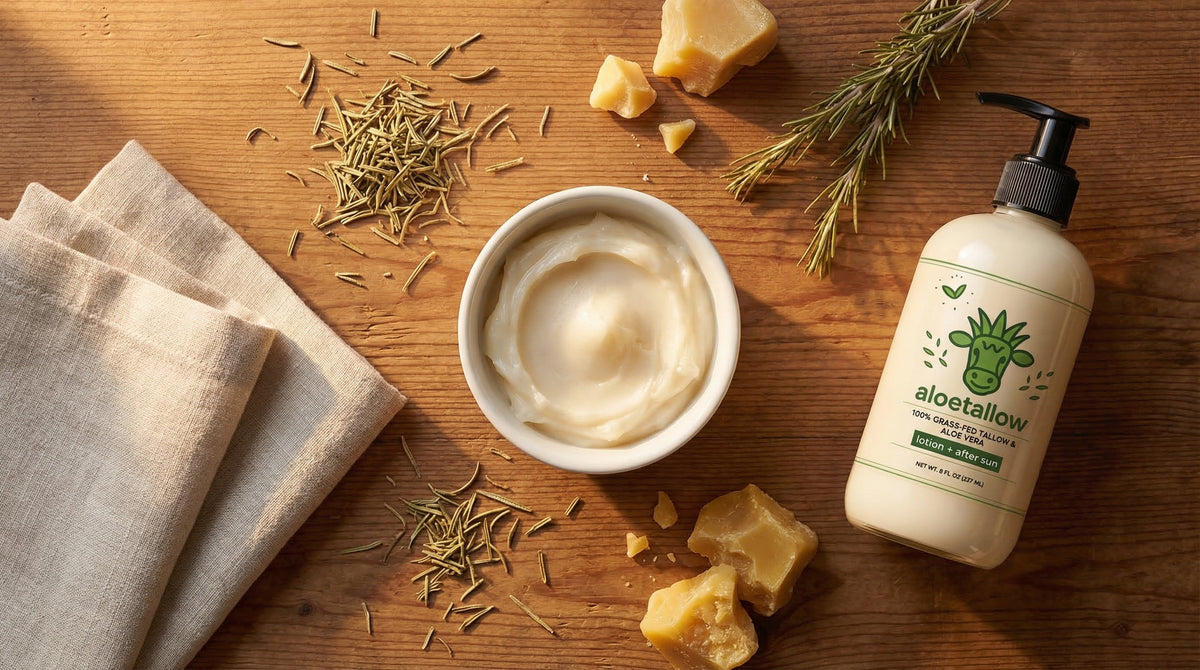
8 ingredients. Grass-fed tallow + aloe vera. Nothing you can't pronounce.
What Conventional Moisturizers Actually Do
Most drugstore and even premium moisturizers work through one of three mechanisms:
- Occlusives (petrolatum, mineral oil, silicones) — sit on top of skin and physically block moisture loss. Effective short-term, but they don't repair the barrier.
- Humectants (glycerin, hyaluronic acid) — draw water into the skin. Work best when there's existing moisture to pull from; can actually dry skin out in low-humidity environments.
- Emollients (plant oils, butters) — soften and smooth the skin surface.
None of these repair the skin's lipid barrier at a structural level. They manage symptoms.
Tallow, because its fatty acid profile is structurally similar to the skin's own lipids, may actually integrate with the barrier rather than just coating it. This is why people with eczema, psoriasis, and chronic dryness often report that tallow works where everything else has failed — they're not just sealing in moisture, they're potentially giving the skin the building blocks it needs.
Does Beef Tallow Actually Work for Skin?
The honest answer is: for most people, yes — particularly people who have struggled with conventional moisturizers.
People who tend to see the best results:
- Dry or dehydrated skin — especially chronic dryness that hasn't responded to standard moisturizers
- Eczema or psoriasis — the anti-inflammatory properties of grass-fed tallow (including CLA and vitamins A and D) may help reduce flares
- Sensitive or reactive skin — tallow is typically fragrance-free and contains few ingredients, which eliminates most common irritants
- Outdoor and active skin — surfers, hikers, and people regularly exposed to wind, salt, and UV benefit from a moisturizer that restores rather than just coats
People who are more cautious about it:
- Acne-prone skin — tallow has a comedogenicity rating of 2–3 (on a 0–5 scale), which is moderate. This doesn't mean it will cause breakouts — the rating is based on an outdated rabbit ear test, not human facial skin — but if you're acne-prone, patch test first.
- Vegans — tallow is an animal product. There are no exceptions to this.
What to Look for in a Tallow Skincare Product
Not all tallow products are equal. A few things worth checking:
Grass-fed sourcing — the fatty acid profile is meaningfully different in grass-fed vs. grain-fed tallow. Grass-fed has more CLA and omega-3s. If the product doesn't specify grass-fed, it probably isn't.
Ingredient count — the whole point of tallow is simplicity. If a tallow product has 20+ ingredients, it undermines the core argument. Look for short, pronounceable lists.
No fragrance — many tallow products add essential oils or fragrance. For sensitive skin, this is counterproductive. The raw tallow may have a faint, neutral beef scent that dissipates on application — a good product minimizes this through formulation, not by masking it with fragrance.
Additional actives — some tallow formulations add aloe vera (which cools inflammation and hydrates), carrot seed oil (rich in beta-carotene), or shea butter. These can complement the tallow's properties without adding synthetic ingredients.
If you're looking for a tallow product built around these principles, Aloetallow is what we made. It's grass-fed beef tallow combined with aloe vera — 8 ingredients total, no fragrance, no synthetic preservatives. The aloe provides immediate hydration and a lighter skin-feel while the tallow works on the barrier. We built it specifically for people whose skin doesn't respond well to conventional lotions and who want something simpler and more structurally effective.
Related Reading
- Does Tallow Clog Pores? What the Science Actually Says
- Tallow for Eczema: What the Science Says About Fatty Acids
- Best Tallow Lotion: A Straight Comparison
The Bottom Line
Beef tallow for skin isn't a trend invented by TikTok. It's a return to an ingredient with a well-understood lipid profile that happens to match what human skin is made of. The reason it fell out of favor in the 20th century had more to do with industrial economics (petroleum byproducts were cheap and easy to mass-produce) than with efficacy.
If you've cycled through CeraVe, Eucerin, Cetaphil, and every clean beauty moisturizer on the market and still have dry, reactive, or problem skin — tallow is worth trying. Not because it's ancient wisdom, but because the fatty acid science makes sense.
Look for grass-fed sourcing, a short ingredient list, and no added fragrance. Patch test if you're acne-prone. Give it two to three weeks before judging.