When you become a parent, the ingredient label becomes a different document. What used to be a glance becomes a line-by-line interrogation. You start Googling things like "is phenoxyethanol safe for newborns" and "what does fragrance actually mean on a label." And that instinct is correct -- because baby skin is fundamentally different from adult skin in ways that make ingredient choices matter more, not less.
Beef tallow has become a topic in this conversation, and for good reason. Its fatty acid profile is remarkably close to the lipids in human skin. But "close to human skin" is a general statement, and parents need specifics. Is tallow safe for babies? What does the research say about infant skin permeability? What should you actually look for -- and avoid -- in a baby moisturizer?
This post walks through the science, no shortcuts. And as always: consult your pediatrician before introducing any new product to your baby's skin, especially for infants under six months.
Why baby skin is not just smaller adult skin
The assumption that baby skin is simply a miniature version of adult skin is one of the most common mistakes in infant skincare. Structurally and functionally, infant skin operates under a different set of rules.
The stratum corneum -- the outermost protective layer of skin -- is approximately 30% thinner in newborns compared to adults. A 2011 study published in Pediatric Dermatology measured transepidermal water loss (TEWL) in newborns and found it was significantly higher than in adults, indicating a less effective moisture barrier. This thinner barrier means two things for moisturizer selection: substances penetrate more easily, and the skin loses moisture faster.
A 2013 review in the Journal of the European Academy of Dermatology and Venereology documented that the skin barrier in full-term infants continues to mature for the first 12 months of life. In premature infants, this timeline extends further. During this maturation window, the skin is more susceptible to irritation, sensitization, and absorption of topical chemicals.
The pH of neonatal skin is also higher at birth (closer to neutral, around 6.5-7.0) and gradually acidifies over the first few weeks to the adult range of 4.5-5.5. This acid mantle is part of the skin's antimicrobial defense system. Products that disrupt this pH progression -- particularly those with alkaline surfactants or strong preservative systems -- can interfere with the skin's ability to establish its natural defenses.
The practical implication is straightforward: every ingredient you put on a baby's skin has a higher probability of being absorbed, a higher probability of causing irritation, and a higher probability of interfering with barrier development than the same ingredient on adult skin. Fewer ingredients means fewer variables. Biocompatible ingredients means lower risk per variable.
The fatty acid argument for tallow on infant skin
The case for beef tallow on skin -- at any age -- starts with its fatty acid composition. Grass-fed beef tallow contains approximately 47% oleic acid, 26% palmitic acid, and 14% stearic acid. These three fatty acids also dominate the lipid composition of human sebum and the intercellular lipid matrix of the stratum corneum.
This matters for baby skin specifically because of what we just discussed about barrier immaturity. The infant stratum corneum is still building its lipid matrix. The lamellar structures that hold moisture in and keep irritants out require specific fatty acids -- primarily palmitic acid, oleic acid, and stearic acid -- to form correctly.
A 2010 study in the Journal of Lipid Research demonstrated that topical lipids with fatty acid profiles similar to endogenous skin lipids were more effectively incorporated into the lamellar structures of the stratum corneum. Lipids with dissimilar profiles -- including many plant oils with high linoleic acid or lauric acid ratios -- sat on the surface without meaningful integration into the barrier architecture.
For an infant whose barrier is actively developing, this integration capacity is significant. You are not just moisturizing the surface. You are providing building materials the skin can actually use to construct a functional barrier.
Tallow also delivers fat-soluble vitamins in a form the skin can readily absorb:
- Vitamin E (tocopherols): A lipid-phase antioxidant that protects the developing barrier's fatty acids from oxidative damage. Present naturally in grass-fed tallow in bioavailable form.
- Vitamin A (retinol precursors): Supports keratinocyte differentiation -- the process by which skin produces healthy new cells. Important during a period of rapid skin development.
- Vitamin D: Plays a role in skin immune function and barrier homeostasis. Particularly relevant for infants with limited sun exposure.
Conjugated linoleic acid (CLA), found in meaningful concentrations in grass-fed animal fats, has demonstrated anti-inflammatory properties in dermal tissue according to a 2014 study in Lipids in Health and Disease. For infant skin that is more prone to inflammatory responses, this is a relevant consideration.
Why short ingredient lists matter more for babies
We covered this principle in depth in our post on why simple ingredient lists work better than "gentle" formulas for sensitive skin. The core argument applies even more forcefully to infant skin.
The average "baby-safe" moisturizer on the market contains 15-30 ingredients. Many of these are functional -- emulsifiers to blend oil and water phases, preservatives to prevent microbial growth, stabilizers to maintain texture, fragrance to create a pleasant scent. Each of these is an additional compound being applied to a permeable, developing barrier.
A 2019 study in Contact Dermatitis analyzed sensitization rates in pediatric populations and found that preservatives and fragrances were the two most common categories of contact allergens in children under two. Methylisothiazolinone (MI), a preservative found in many "gentle" formulations until recently, was identified as a particularly potent sensitizer in infant skin.
The logic of ingredient minimalism for babies is not about being anti-chemical or anti-modern. It is about probability. Each additional ingredient in a formulation represents an additional chance of irritation or sensitization on skin that is already more vulnerable than adult skin. A product with three ingredients has fewer potential points of failure than a product with twenty-three.
This is where tallow-based moisturizers have a structural advantage. Because tallow is inherently occlusive, emollient, and rich in bioavailable fatty acids and vitamins, it can serve multiple functions that conventional formulations need separate ingredients to achieve. Tallow provides the emollient phase, the occlusive barrier, and the active lipid delivery in a single ingredient. That means the total formulation can be dramatically shorter.
Diaper area: barrier protection, not treatment
Let's address the diaper area directly, because it is where most parents first encounter the need for a skin protectant on their baby.
Diaper rash -- technically irritant contact dermatitis -- occurs when prolonged exposure to moisture, urine, and fecal enzymes degrades the skin barrier in the diaper area. The compromised barrier allows irritants to penetrate deeper, triggering an inflammatory response. The standard pediatric recommendation is to apply a barrier protectant at each diaper change to shield the skin from these irritants.
The most common barrier protectants are zinc oxide and petroleum jelly. Both work by creating a physical barrier between the skin and the irritant. This is purely a mechanical function -- neither ingredient repairs the barrier or provides lipids the skin can use.
Tallow functions differently. As an occlusive, it provides the same physical barrier function -- keeping moisture and irritants from direct skin contact. But because its fatty acid profile integrates into the stratum corneum, it simultaneously supports the skin's own barrier recovery. A 2017 review in the International Journal of Molecular Sciences confirmed that lipids structurally similar to endogenous skin lipids enhance barrier repair rates compared to inert occlusives.
To be clear: this is not a claim that tallow treats diaper rash. Severe or persistent diaper rash should always be evaluated by your pediatrician, as it can involve fungal infection or other conditions that require specific treatment. The point is that for routine barrier protection -- the daily preventive layer -- a biocompatible lipid has a functional advantage over an inert one.
What to look for in a baby moisturizer
Whether you choose a tallow-based product or not, these principles apply to evaluating any moisturizer for infant skin:
Short ingredient list. Fewer ingredients means fewer potential sensitizers. Look for products with under ten ingredients. Question any product marketed as "baby-safe" that has more than twenty.
No synthetic fragrance. "Fragrance" on a label can represent dozens of undisclosed chemical compounds. The International Fragrance Association lists over 3,000 materials used in fragrance formulations. For a developing immune system and a permeable skin barrier, this is an unnecessary variable. If you want a scented product, look for those that derive scent from the base ingredients themselves -- tallow has a mild, naturally fading scent -- rather than added fragrance compounds.
No known sensitizers. Specifically avoid: methylisothiazolinone (MI), methylchloroisothiazolinone (MCI), formaldehyde releasers (DMDM hydantoin, quaternium-15, imidazolidinyl urea), and parabens. While the evidence on parabens is still debated for adult skin, the precautionary principle applies more strongly to infant skin given its higher permeability.
Biocompatible base lipids. Tallow, shea butter, and coconut oil all provide meaningful occlusion and emollience. Tallow has the closest fatty acid match to human skin lipids. Shea butter is a solid option with a high concentration of stearic and oleic acids. Coconut oil is more variable -- its high lauric acid content is antimicrobial but can be irritating for some infants with sensitive skin. Mineral oil and petroleum jelly are effective occlusives but provide no bioactive compounds.
Transparency on sourcing. For tallow products specifically, grass-fed sourcing matters. Grass-fed tallow has measurably higher concentrations of CLA, vitamin E, and vitamin A compared to grain-fed. The animal's diet directly impacts the nutrient profile of the rendered fat. Look for products that specify grass-fed on the label, not just in the marketing copy.
What to avoid -- beyond the obvious
Beyond fragrance and known sensitizers, there are a few categories parents should approach with caution:
Essential oils. Natural does not mean non-irritating. Many essential oils -- including lavender, tea tree, and eucalyptus -- contain compounds that can cause contact sensitization, particularly on compromised or developing skin. A 2016 study in Contact Dermatitis documented increasing rates of essential oil sensitization in pediatric populations. If you prefer a scented product, understand that essential oils are concentrated plant extracts with bioactive compounds, not inert fragrances.
Exfoliating acids. Alpha-hydroxy acids (AHAs) and beta-hydroxy acids (BHAs) have no place in infant skincare. Full stop. An infant's skin barrier is already thinner than an adult's -- chemical exfoliation further compromises it.
Retinoids. While vitamin A precursors in tallow are present in naturally occurring, low concentrations (and in fat-soluble form that limits penetration), concentrated retinoid products are not appropriate for infant skin.
Heavy emulsifier systems. Emulsifiers like sodium lauryl sulfate (SLS) and sodium laureth sulfate (SLES) are surfactants that can strip the lipid barrier. They are common in wash-off products but sometimes appear in leave-on formulations as well. Check the label.
The patch test protocol for babies
Before applying any new product to your baby's skin -- including tallow-based products -- do a patch test. This is non-negotiable.
- Apply a small amount (pea-sized) to the inside of your baby's forearm or the outside of the upper arm.
- Wait 24 hours. Do not wash the area.
- Check for any redness, swelling, bumps, or irritation.
- If no reaction occurs, the product is likely tolerable for broader application.
- If any reaction occurs -- even mild redness -- discontinue use and consult your pediatrician.
For infants under three months, discuss any new topical product with your pediatrician before use. The skin barrier is at its most immature and most permeable during this period.
A note on rendered vs. raw tallow
Not all tallow is the same, and the rendering process matters -- particularly for a product you are considering for infant skin.
Properly rendered tallow has been slowly heated to separate the fat from connective tissue, then filtered and sometimes purified. This process removes proteins and other compounds that could cause irritation or allergic reaction. Well-rendered, purified tallow should be smooth, consistent in texture, and have a mild scent that fades quickly.
Raw or minimally rendered tallow may retain proteins, moisture, or other compounds that increase the risk of irritation and reduce shelf stability. For adult skin, this distinction matters less. For infant skin, it matters significantly. If you are sourcing tallow products for your baby, look for products from manufacturers who specify their rendering process and quality standards.
The bottom line for parents
Baby skin is not adult skin. It is thinner, more permeable, still developing its barrier architecture, and more susceptible to irritation and sensitization. Every ingredient you apply to it carries more weight than the same ingredient on your own skin.
Beef tallow's fatty acid profile -- nearly identical to human skin lipids -- makes it one of the most biocompatible moisturizing bases available. Its ability to integrate into the stratum corneum rather than just sitting on top of it is a meaningful advantage during the period when the barrier is still maturing. Short ingredient lists reduce the number of potential sensitizers. And the inherent multifunctionality of tallow (emollient + occlusive + lipid delivery + fat-soluble vitamins) means a tallow-based product can do what conventional products need a dozen ingredients to accomplish.
But biocompatibility is not a guarantee of compatibility with your specific baby. Always patch test. Always consult your pediatrician for infants under six months, for persistent skin conditions, or for any reaction. The best skincare decision for your baby is always an informed one.
Frequently asked questions
Is beef tallow safe for newborns?
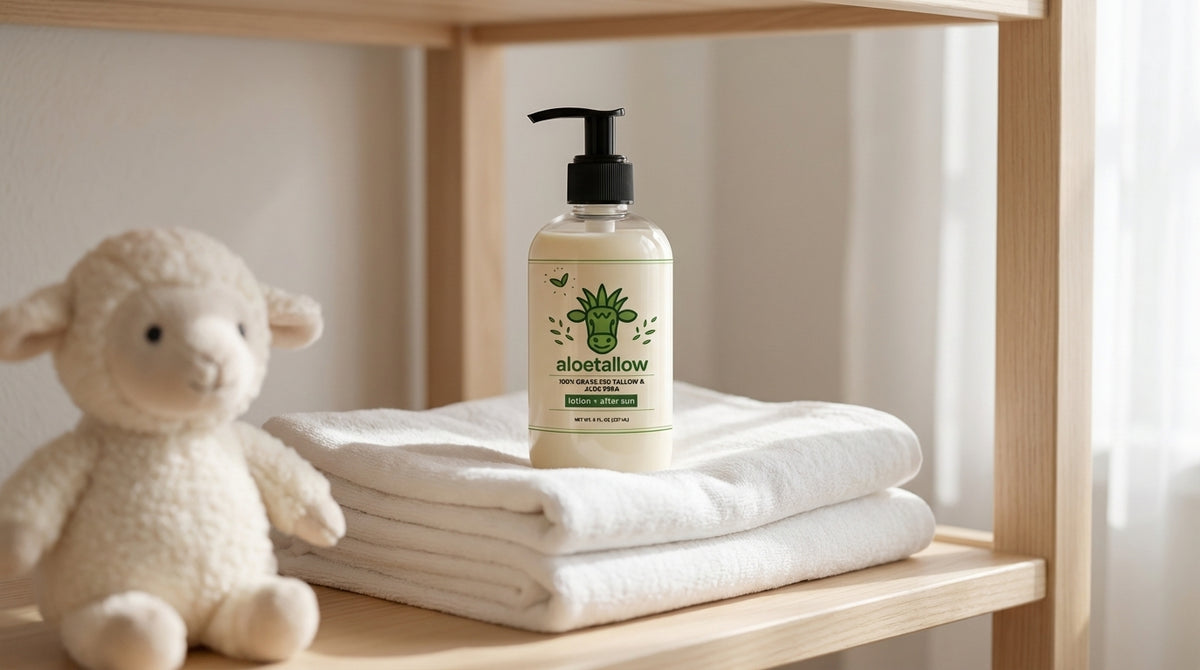
Properly rendered, purified beef tallow from grass-fed sources has a fatty acid profile very close to human skin lipids, which makes it biocompatible. However, every baby's skin is different. Always patch test on a small area first and consult your pediatrician before using any new product on a newborn, especially in the first three months when the skin barrier is at its most immature. Aloetallow uses a minimal ingredient list with grass-fed tallow and aloe vera -- no synthetic fragrance, no harsh preservatives -- which aligns with the principles outlined above for infant skin.

8 ingredients. Grass-fed tallow + aloe vera. Nothing you can't pronounce.
Can I use beef tallow for diaper rash?
Tallow can serve as a barrier protectant in the diaper area, shielding skin from moisture and irritants while providing biocompatible lipids that support barrier function. However, it is not a treatment for diaper rash. If your baby has persistent or severe diaper rash, see your pediatrician -- it may involve a fungal component or other condition that requires specific medical treatment. For routine preventive barrier protection at diaper changes, tallow is a reasonable option.
Does beef tallow clog pores on baby skin?
Comedogenicity ratings were developed from adult skin studies and do not directly translate to infant skin. Tallow has a comedogenicity rating of 2 (on a 0-5 scale), which is considered mildly comedogenic. In practical terms, infant skin does not typically experience clogged pores the way adult skin does because sebum production is minimal after the initial neonatal period. As with any product, monitor your baby's skin after application and discontinue if you notice any adverse reaction.
How often should I apply tallow to my baby's skin?
For routine moisturizing, once or twice daily is generally sufficient -- typically after bath time when the skin is clean and slightly damp, and before bed. For diaper area barrier protection, apply a thin layer at each diaper change. Less is more with infant skin: a thin, even layer provides adequate coverage without overloading the skin. You do not need to apply heavily.
What is the difference between tallow and petroleum jelly for baby skin?
Both are effective occlusives -- they create a physical barrier that reduces moisture loss. The key difference is bioactivity. Petroleum jelly is inert: it sits on the skin surface and blocks water loss but provides no nutrients or lipids the skin can use. Tallow provides occlusion plus biocompatible fatty acids (palmitic, oleic, stearic) that integrate into the skin's lipid barrier, plus fat-soluble vitamins (A, D, E, K). For a developing infant barrier that is actively building its lipid architecture, this integration capacity is a meaningful functional difference.