Sunburn is one of those things people treat as a minor inconvenience. You got too much sun, it hurts for a day or two, you peel, you move on. But what's actually happening beneath that redness is more significant than the discomfort suggests -- and the way most people treat it leaves the real damage unaddressed.
Want the deeper dive on tallow and skin generally? See: Beef Tallow for Skin: Everything You Need to Know.
Understanding what sunburn actually does to your skin -- at the cellular and lipid level -- changes the way you think about recovery. It's not about cooling the surface. It's about giving the skin the specific materials it needs to rebuild what UV radiation destroyed. And that's where beef tallow enters the conversation in a way that most people wouldn't expect.
The biology of sunburn: what UV radiation actually destroys
When UVB radiation penetrates the epidermis, it causes direct DNA damage to keratinocytes -- the cells that make up 90% of your skin's outer layer. This triggers an inflammatory cascade: the body dilates blood vessels to rush immune cells to the site (that's the redness), releases pro-inflammatory cytokines (that's the pain and heat), and begins clearing damaged cells through apoptosis (that's the peeling, 3-5 days later).
But the damage that matters most for recovery -- and the damage most people never address -- happens to the lipid barrier.
A 2012 study in the Journal of Investigative Dermatology demonstrated that UV radiation causes direct lipid peroxidation in the stratum corneum. The fatty acids that hold your barrier together -- palmitic acid, oleic acid, stearic acid, arranged in precise lamellar structures -- get oxidized and broken down. The result is a measurable increase in transepidermal water loss (TEWL) that begins within hours of exposure and can persist for days.
A 2003 study in Photodermatology, Photoimmunology & Photomedicine measured TEWL after UV exposure and found increases of 25-40% above baseline, depending on dose. This means your skin is losing moisture at nearly 1.5 times its normal rate. That's why sunburned skin feels tight, dry, and papery even after you apply moisturizer -- the barrier can't hold water because the lipid structures that normally seal it are damaged.
Simultaneously, UV exposure depletes the skin's antioxidant reserves. A 2015 study in Free Radical Biology and Medicine found that even moderate UV doses significantly reduced vitamin E concentrations in the stratum corneum. Vitamin E is the skin's primary lipid-phase antioxidant -- it protects the barrier's fatty acids from oxidative damage. Once it's depleted, the fatty acids become increasingly vulnerable to further degradation, creating a cycle: UV depletes the antioxidant, which leaves the lipids unprotected, which accelerates barrier breakdown.
Why most sunburn recovery products fail
The conventional approach to sunburn recovery centers on three strategies: cooling, hydrating, and anti-inflammatory drugs. Aloe vera gel for the cooling. A moisturizer with glycerin or hyaluronic acid for hydration. Ibuprofen or aspirin for inflammation. This is the standard advice from dermatology websites, and it's not wrong -- but it's incomplete in a way that matters.
The problem is that none of these strategies address the lipid depletion.
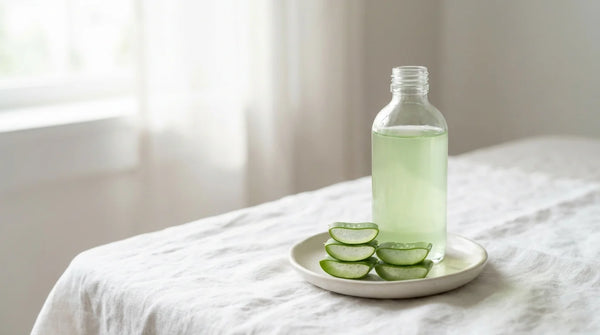
Aloe vera gel cools the surface and provides humectant-type hydration through its polysaccharide content. Excellent for immediate comfort. But aloe is water-based -- it evaporates. Without an effective occlusive layer on top, the hydration it provides is temporary. A 2018 review in the International Journal of Cosmetic Science found that humectant-only formulations provided measurable surface hydration for approximately 2-4 hours before TEWL returned to pre-application levels.
Glycerin-based moisturizers draw water to the skin surface but don't supply any of the fatty acids the barrier needs to rebuild its lamellar structures. Silicone-based products form a temporary seal but are biologically inert -- they slow water loss without contributing any building materials for actual barrier repair.
The result is a recovery approach that manages symptoms on a 2-4 hour cycle while the underlying barrier damage persists. You keep reapplying because the relief keeps fading, and you assume that's just how sunburn recovery works. It isn't. The relief fades because nothing you're applying is fixing the structural problem.
We explored this gap in depth in our post on natural after-sun lotion and how to actually repair sun-damaged skin -- why the standard approach leaves the barrier unrepaired and what a complete after-sun strategy actually requires.
The case for beef tallow: fatty acid replacement at the barrier level
This is where beef tallow does something that no humectant, cooling agent, or silicone can do. It supplies the actual fatty acids that UV radiation destroyed.
Grass-fed beef tallow's fatty acid profile -- approximately 47% oleic acid, 26% palmitic acid, 14% stearic acid -- closely mirrors the composition of the lipid matrix in the human stratum corneum. These aren't foreign compounds being layered on top of the skin. They're the same categories of molecules that your barrier is structurally built from.
A 2010 study in the Journal of Lipid Research examined how the fatty acid composition of topical lipids influenced their incorporation into the lamellar bodies of the stratum corneum. Lipids with compositions similar to endogenous skin lipids were more effectively integrated into the barrier structure than compositionally dissimilar ones. The implication: when you apply tallow to sunburned skin, you're not just creating an occlusive layer. You're supplying raw materials the skin can use to physically reconstruct what was lost.
This is the fundamental difference between symptom management and structural recovery. Conventional after-sun products manage. Tallow repairs.
The fat-soluble vitamin delivery system
Beyond the fatty acid profile, grass-fed beef tallow delivers four fat-soluble vitamins that are directly relevant to sunburn recovery -- and the "fat-soluble" part matters more than most people realize.
Vitamin E (tocopherols and tocotrienols). This is the vitamin UV exposure depletes first. It's the primary antioxidant protecting the lipid barrier from oxidative damage. When you apply tallow to sunburned skin, you're replenishing the specific antioxidant that was consumed during UV exposure -- in a fat-soluble form that integrates into the lipid phase where it actually functions. Water-soluble vitamin E supplements or serums have to cross the lipid barrier to reach the lipid phase. Fat-soluble vitamin E from tallow is already in the right phase.
Vitamin A (retinol and retinol precursors). Vitamin A drives keratinocyte differentiation -- the process by which your skin produces new cells to replace damaged ones. After sunburn, your skin needs accelerated cell turnover to clear the UV-damaged keratinocytes (this is the biological purpose of peeling). A 2015 study in Nutrients confirmed that topical retinol in fat-soluble form supports this turnover process. The vitamin A in grass-fed tallow arrives in exactly that form.
Vitamin D. UV exposure triggers vitamin D synthesis in the skin, but it also damages the structures involved in that synthesis. Topical vitamin D supports barrier homeostasis and modulates the skin's immune response -- both directly relevant to recovery from UV-induced inflammation.
Vitamin K. Sunburn involves significant vascular dilation -- that's what produces the redness. Vitamin K supports coagulation and microvascular integrity, and has demonstrated effects on reducing persistent erythema (redness that lingers after the acute burn subsides). It's a minor component of tallow, but it's there, and it's relevant.
The delivery mechanism matters: these vitamins arrive dissolved in a lipid matrix that matches the skin's own composition. They're not in a water-based serum that has to cross the barrier. They're in a fat that integrates with the barrier. The bioavailability is structurally favorable.
Trans-epidermal water loss: the hidden damage that keeps sunburn going
TEWL is the metric most people have never heard of but that governs most of the discomfort they associate with sunburn. When the lipid barrier is compromised, water escapes from the deeper layers of the skin through the damaged stratum corneum at an accelerated rate. This produces the tight, dry, uncomfortable sensation that persists long after the redness fades.
A 2009 study in the British Journal of Dermatology measured skin barrier function after UV exposure and found that TEWL remained elevated for up to 7 days post-exposure, even after visible redness had resolved. The cosmetic damage (redness) resolves before the structural damage (barrier compromise) does. This is why skin often feels dry and sensitive for a week or more after a sunburn that "looked like it went away" after two days.
Reducing TEWL requires two things: an effective occlusive to physically slow the water loss, and lipid building blocks to repair the barrier so it can hold water on its own again. Tallow does both simultaneously. It's a semi-occlusive that reduces TEWL immediately upon application, and its fatty acids integrate into the barrier for longer-term structural repair.
Petroleum jelly (petrolatum) is arguably the most effective occlusive available -- it reduces TEWL by up to 99%. But it's biologically inert. It seals without repairing. Tallow reduces TEWL less aggressively (it's semi-occlusive, not fully occlusive), but it contributes repair materials while it seals. For sunburn recovery, the repair capacity matters more than maximum occlusion, because the goal isn't to permanently seal the skin -- it's to support the skin in rebuilding its own seal.
For more on how the barrier actually works and why structural repair matters more than surface coating, our post on beef tallow for dry skin covers the mechanism in detail.
The aloe vera complement: why tallow alone isn't the full answer
Tallow alone is a powerful after-sun lipid. But sunburn recovery isn't purely a lipid problem. There's an inflammatory component (the heat, the redness, the pain) and a hydration component (the dehydrated upper layers of the epidermis) that tallow addresses indirectly but aloe vera addresses directly.
Acemannan, the primary bioactive polysaccharide in aloe vera, stimulates the skin's production of hyaluronan -- the same molecule marketed as hyaluronic acid. A 2008 study in Evidence-Based Complementary and Alternative Medicine showed measurable increases in dermal hyaluronan following acemannan application. This supports hydration from within, not just at the surface.
Aloe's anti-inflammatory profile is also well-documented. A 2010 review in the Indian Journal of Dermatology found soothing effects comparable to 1% hydrocortisone cream in mild inflammatory conditions. On sunburned skin, this means real reduction in the inflammatory cascade -- not just a cooling sensation that fades.
The combination works because the two ingredients operate at different depths. Aloe works at the surface and upper dermis: cooling, anti-inflammatory, hydration-stimulating. Tallow works in the lipid matrix of the stratum corneum: structural fatty acid replacement, antioxidant replenishment, semi-occlusive water loss reduction. Together they cover the full spectrum of sunburn damage from surface to barrier.
How to use Aloetallow for sunburn recovery
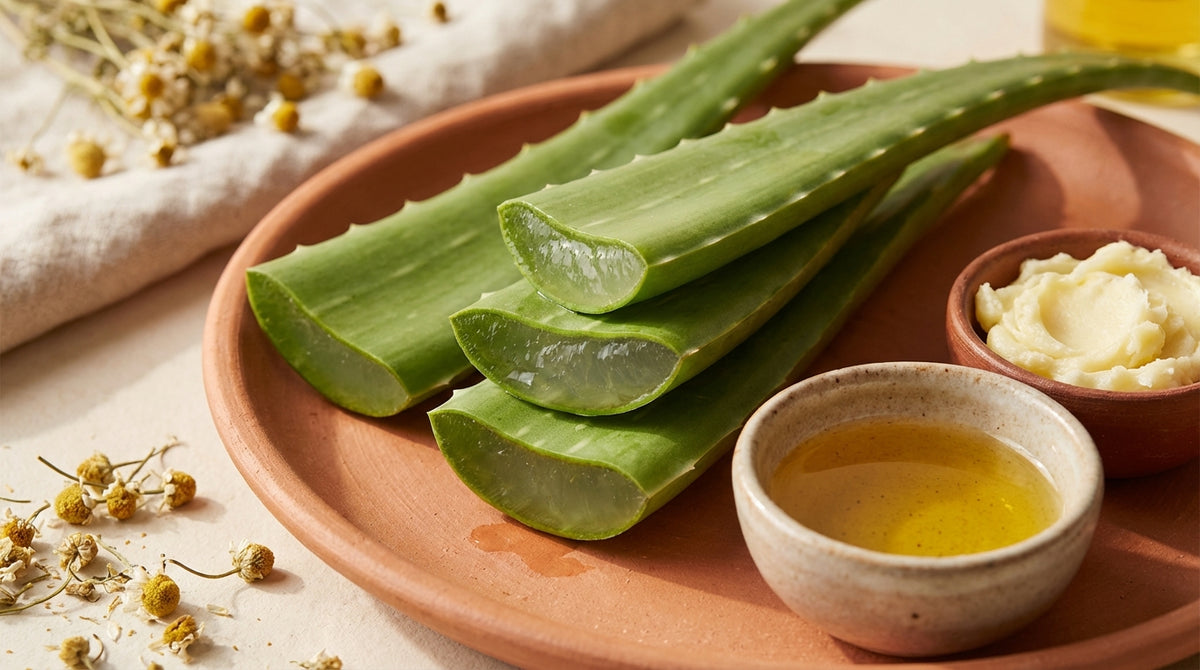
Aloetallow was formulated for exactly this scenario -- 8 ingredients, each chosen for a specific role in skin recovery:

8 ingredients. Grass-fed tallow + aloe vera. Nothing you can't pronounce.
- Grass-fed beef tallow -- replaces depleted barrier lipids with structurally identical fatty acids, delivers vitamins A, D, E, K and CLA
- Aloe vera -- cools inflammation, stimulates hyaluronan production, restores surface moisture
- Coconut oil -- softens damaged skin, supports the barrier with lauric acid's antimicrobial properties
- Shea butter -- deep moisture and skin-smoothing fatty acids for peeling, flaking recovery
- Carrot seed oil -- beta-carotene supports skin tone recovery and helps extend your tan after UV exposure
- Glycerin -- draws and holds moisture for sustained hydration between applications
- Emulsifying wax (2%) -- binds oil and water phases into a stable, absorbable lotion
- PE9010 (1%) -- paraben-free preservative, safe on compromised skin
No fragrance, no alcohol, no menthol, no silicones. Here's the protocol that works best for sunburn recovery:
- First application (within 1-2 hours of coming indoors): Rinse with lukewarm water. Pat skin until just damp. Apply generously to all sun-exposed areas. The aloe provides immediate surface relief while the tallow begins barrier-level work.
- Before bed: Reapply. The skin does most of its repair during sleep, and providing a fresh supply of fatty acids and aloe before the longest recovery window of the day maximizes the repair process.
- Days 2-3: Continue applying 2-3 times daily. UV damage continues developing for 24-72 hours after exposure. The barrier remains compromised through this window. Don't stop treating because the redness faded.
- During peeling (days 3-7): Keep applying. Peeling is your skin shedding damaged keratinocytes. The new skin underneath is fresh, thin, and vulnerable. Continued tallow application supports the new barrier as it forms.
The 8-ingredient formula is particularly important on sunburned skin because the barrier is compromised. A damaged barrier means increased penetration of everything you apply. Fragrances, preservatives, and additives that might be tolerable on intact skin become significantly more likely to cause irritation or sensitization on barrier-compromised skin. Fewer ingredients means fewer potential triggers during the recovery window.
Frequently asked questions
How soon after sun exposure should I apply tallow-based lotion?
As soon as practical -- ideally within 1-2 hours of coming indoors. Lipid peroxidation and TEWL increases begin during UV exposure and escalate for hours afterward. Early application limits the window during which the barrier is unprotected. Cool the skin with lukewarm water first, then apply to damp skin.
Can beef tallow lotion help with peeling after sunburn?
Yes. Peeling is the skin shedding UV-damaged cells, and the new skin forming underneath needs lipid support to build a healthy barrier. Continued application of tallow through the peeling phase provides the fatty acids the emerging barrier needs. It won't prevent peeling (that's a necessary biological process), but it supports the quality of the new skin that replaces what peeled.
Is beef tallow lotion safe to use on severe sunburn or blisters?
For mild to moderate sunburn (redness, tenderness, tightness), tallow-based lotion is appropriate and beneficial. For severe sunburn with blistering, open skin, or signs of sun poisoning (nausea, fever, chills), seek medical attention first. Do not apply any topical product -- including tallow -- to open blisters or broken skin until it has begun to close on its own.
Why does my skin still feel tight hours after applying regular after-sun lotion?
Because most after-sun products rely on humectants (glycerin, aloe extract) and light silicones that provide 2-4 hours of surface hydration but don't repair the lipid barrier responsible for retaining moisture long-term. The hydration evaporates, TEWL resumes at its elevated rate, and the tightness returns. Tallow addresses the structural cause by supplying barrier-rebuilding fatty acids, which is why the relief from a tallow-based product tends to last longer.
Does beef tallow have any SPF or sun-protective properties?
No. Beef tallow is not a sunscreen and does not provide UV protection. It is strictly a recovery product -- designed to support the skin after UV exposure, not to prevent it. Always use proper sun protection (shade, clothing, sunscreen) during exposure. Tallow's role begins after you come inside.