You've probably tried the obvious things. Thick creams. Oils. Drinking more water. Slathering on lotion right after a shower and watching your skin feel tight again an hour later. Dry skin isn't a mystery — but most products treat it like a surface problem, which is why most products don't actually fix it. Here's what the research says is actually happening when skin gets chronically dry, and why tallow addresses it differently than almost anything else on a moisturizer shelf.
For everything tallow does for skin beyond dryness, read: Beef Tallow for Skin: Everything You Need to Know.
What dry skin actually is (it's not a hydration problem)
Dry skin is primarily a barrier dysfunction problem, not a water deficiency problem. This distinction matters more than most skincare marketing lets on.
Your skin's outer layer — the stratum corneum — functions as a physical and chemical barrier. It's made up of dead skin cells (corneocytes) embedded in a lipid matrix composed primarily of ceramides, free fatty acids, and cholesterol. This structure works like a brick wall: the cells are the bricks, and the lipid matrix is the mortar.
When the barrier is intact, it does two things well: it keeps environmental irritants out, and it keeps water in. The latter is measured as transepidermal water loss (TEWL) — how quickly water evaporates out of your skin. A healthy barrier keeps TEWL low. A damaged or depleted barrier allows TEWL to increase, and that's when skin starts feeling dry, tight, flaky, or reactive.
A 2012 study in the Journal of Investigative Dermatology found that people with chronic dry skin showed measurably depleted ceramide levels compared to controls — not just less moisture in the skin, but a structurally compromised barrier that couldn't retain the moisture that was there. This is why drinking more water often doesn't solve dry skin: if your barrier can't hold water in, hydrating from the inside doesn't close the gap.
The causes of barrier dysfunction include:
- Over-washing — hot water and surfactants strip the lipid matrix faster than the skin can rebuild it
- Low humidity — especially in winter or air-conditioned environments where the air draws moisture from skin
- Aging — ceramide synthesis slows after your 30s; the barrier naturally thins over time
- Genetics — mutations in the filaggrin gene (found in a significant percentage of people with eczema and sensitive skin) compromise barrier formation at a structural level
- Topical irritants — fragrance, certain preservatives, and drying alcohols in conventional skincare can damage the barrier faster than skin recovers
The takeaway: fixing dry skin requires repairing the barrier structure, not just adding moisture on top of it.
Why most moisturizers don't actually repair dry skin
Conventional moisturizers fall into three categories: humectants, emollients, and occlusives. Each does something useful, but none of them fix the underlying structural issue.
Humectants (glycerin, hyaluronic acid, urea) draw water into the skin from the environment or from deeper layers of the dermis. They make skin feel immediately softer. The problem: if your barrier is compromised, humectants can actually increase TEWL by drawing water to the surface faster than the barrier can retain it. They're better used under an occlusive layer, not alone.
Emollients (most plant oils, silicones, fatty alcohols) fill the gaps between skin cells to improve texture and reduce flaking. They work as long as you keep applying them. They don't repair the lipid matrix — they sit on top of or between cells, mimicking structure without rebuilding it.
Occlusives (petrolatum, mineral oil, dimethicone) form a physical film over the skin that slows water loss. Petrolatum is actually the gold standard for TEWL reduction — it works extremely well for acute barrier repair. But it's inert. It seals the surface while the skin works to repair itself underneath; it doesn't provide building materials for that repair.
Most moisturizers combine all three. They reduce symptoms. They make skin feel better while you're using them. But they don't address the root issue: a depleted lipid matrix that can't rebuild itself fast enough.
There's also the ingredient list problem. Many moisturizers marketed specifically for dry or sensitive skin contain:
- Fragrance — the most common allergen and sensitizer in skincare; even "unscented" products sometimes contain masking fragrance. Fragrance causes low-grade inflammation that compounds barrier damage over time.
- Drying alcohols — denatured alcohol, SD alcohol, and similar compounds are common in water-based lotions. They feel light and non-greasy, but they disrupt the barrier and trigger rebound dryness.
- Sulfate-based emulsifiers — ingredients like sodium lauryl sulfate (found in many cleansers but also in some creams) are direct barrier irritants, classified as skin sensitizers at higher concentrations.
The irony of chronic dry skin is that many of the products sold to treat it contain ingredients that perpetuate the cycle. You apply. It feels better briefly. The barrier doesn't rebuild. You need to apply again. The cycle continues.
Why beef tallow works differently for dry skin
Beef tallow's fatty acid profile is closer to the composition of human skin fat than almost any plant oil. This isn't a coincidence — it's why tallow has been used on skin for thousands of years before any of this was measured or understood.
Human sebum — the skin's own oil — is composed primarily of triglycerides (41%), wax esters (25%), and squalene (12%), with a fatty acid profile dominated by oleic acid, palmitic acid, and stearic acid. Grass-fed beef tallow contains:
- Oleic acid (C18:1): approximately 40–50% — the same dominant fatty acid in human sebum
- Palmitic acid (C16:0): approximately 25–30% — a key component of skin's ceramide synthesis pathway
- Stearic acid (C18:0): approximately 20–25% — used by skin to synthesize ceramides
- Conjugated linoleic acid (CLA): present in meaningful amounts in grass-fed tallow, essentially absent in grain-fed; CLA has documented anti-inflammatory properties in dermal tissue
This matters because the skin uses dietary fats — and topically applied fats — as substrate for barrier synthesis. When you apply tallow, you're not just creating a surface film. You're providing the raw materials that skin cells use to rebuild the lipid matrix.
A 2018 review in the International Journal of Molecular Sciences documented that palmitic acid and stearic acid are direct precursors in the ceramide synthesis pathway. The stratum corneum uses these fatty acids to produce the ceramides that make up the barrier mortar. In other words: tallow provides what dry skin is actually depleted of.
Grass-fed tallow also contains fat-soluble vitamins that are largely absent from plant oils:
- Vitamin A (retinol): supports cell turnover and cornification — the process by which new skin cells mature into corneocytes that form the barrier
- Vitamin D: plays a role in keratinocyte differentiation and has been shown in research to support barrier homeostasis
- Vitamin E (tocopherols): a fat-soluble antioxidant that protects lipids in the skin from oxidative degradation
- Vitamin K: supports skin elasticity and has documented effects on bruising and discoloration
These vitamins are present because grass-fed cattle synthesize them from the pasture grasses they eat. Animals raised on grain have significantly lower levels of all of these — one of several reasons the sourcing of tallow matters if you're using it for skin.
How to use tallow for dry skin — what works and what doesn't
A few things worth knowing before you start:
Apply to slightly damp skin. Tallow is an emollient and occlusive — it works by holding moisture in. If you apply it to completely dry skin, it seals in the dryness. Apply right after a shower or after misting your face with water, while the skin is still slightly damp. You'll need less product and get better results.
Use less than you think. Tallow is richer and more occlusive than most plant oils. A small amount — a pea-sized portion for the face, a thin layer for the body — is usually enough. If your skin feels greasy an hour after application, you're using too much or not applying to damp skin.
Give it two weeks before you assess. Barrier repair is not an overnight process. The stratum corneum renews itself on a roughly 28-day cycle. If your barrier is depleted, you may see improvement within a week, but give it at least two weeks of consistent use before you evaluate whether it's working for your skin.
For severely dry or cracked skin — hands, heels, elbows — apply a generous layer at night and, if the area tolerates it, cover with cotton gloves or socks. The occlusive seal overnight gives the barrier extended time to repair without being disrupted by contact with water or friction.
Watch the rest of your routine. If you're applying tallow over a cleanser or toner that contains drying alcohols or fragrance, you're undermining the barrier work from a different angle. Barrier repair requires reducing inputs that damage the barrier, not just adding inputs that support it.
Seasonal considerations: In winter and low-humidity environments, you may need to apply more frequently or layer tallow over a humectant like glycerin to maximize retention. In humid summer conditions, a thinner application is usually sufficient.
A note on grass-fed vs. conventional tallow
Not all tallow is the same. The fat profile of the animal reflects what the animal ate.
Grass-fed tallow has measurably higher levels of:
- Conjugated linoleic acid (CLA) — estimated 2–3x higher than grain-fed
- Omega-3 fatty acids — more favorable omega-6 to omega-3 ratio
- Fat-soluble vitamins A, D, E, and K
Conventional tallow from grain-fed animals is still an effective moisturizer and far better for the skin barrier than most synthetic alternatives. But if you're specifically choosing tallow for barrier repair, grass-fed matters.
The other variable is rendering quality. Tallow should be rendered at low temperature (dry-rendered or slow-rendered) to preserve the fat-soluble vitamins and avoid oxidative degradation. Industrially rendered tallow uses high heat, which degrades the more fragile vitamins and can introduce oxidized fats that have the opposite effect on skin. If the tallow you're buying doesn't specify grass-fed and cold-rendered, that's worth asking about.
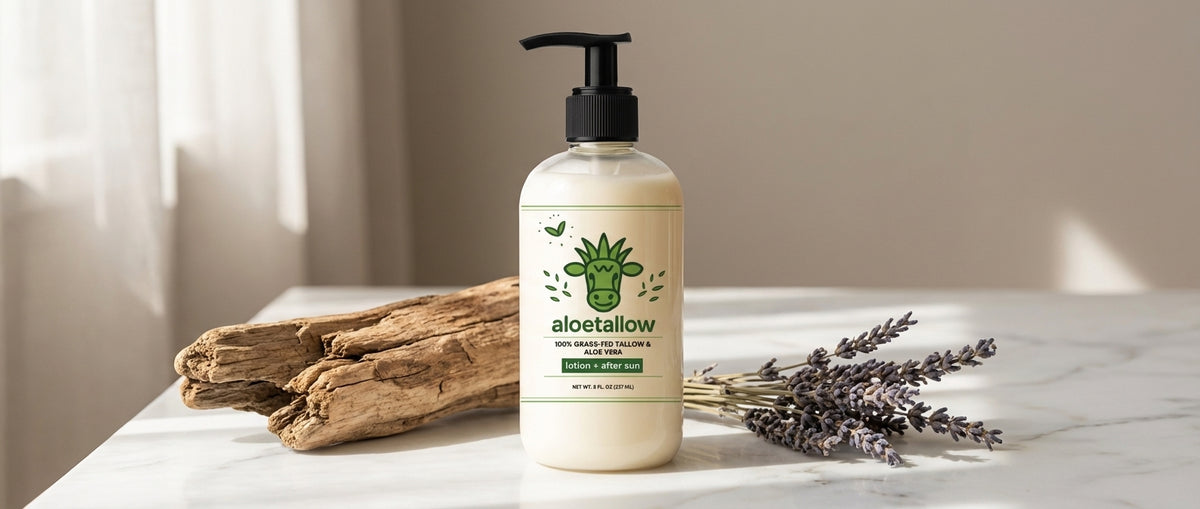
If you're looking for a tallow product formulated specifically for this purpose, Aloetallow combines grass-fed beef tallow with aloe vera — 8 ingredients total, no fragrance, no synthetic preservatives. The aloe provides immediate hydration and a lighter skin-feel while the tallow works on the barrier. We built it specifically for people whose skin doesn't respond well to conventional lotions and who want something simpler and more structurally effective. More than 130 people have left reviews — most describe it as the first product that actually held up week after week instead of just feeling good for an hour.

8 ingredients. Grass-fed tallow + aloe vera. Nothing you can't pronounce.
Frequently asked questions
Will tallow make my skin greasy?
Applied correctly — to slightly damp skin in a small amount — no, not for most people. Tallow is rich, so there can be a brief window of 15–20 minutes after application where skin feels heavier than it would with a water-based lotion. It absorbs. If your skin still feels greasy after 30 minutes, you're applying too much, or applying to completely dry skin rather than damp skin.
Can I use tallow on my face?
Yes. Whether it works on your face depends on your skin type. People with dry, combination, or sensitive skin generally do very well with tallow on the face. People with naturally oily skin or congestion-prone skin may find it too rich for daytime use on the full face, though many use it as an overnight treatment or on dry patches only. The pore-clogging question has a longer answer worth reading if that's a concern.
How is tallow different from lanolin?
Lanolin is a waxy fat from sheep wool, commonly used in barrier creams and nipple balms. It's also effective for dry skin. The key differences: tallow is a better match for the human skin fatty acid profile; lanolin has a higher rate of contact sensitivity (lanolin allergy is one of the more common skin allergens in patch testing). For most people, both work — tallow tends to be better tolerated by sensitive skin.
Does it have a smell?
Tallow has a very mild, faintly buttery scent when freshly applied. Most people find it neutral to pleasant. When combined with aloe vera as in Aloetallow, the scent is minimal. It should not smell rancid or strong — if it does, the tallow was not rendered properly or has oxidized from poor storage. Store tallow products away from direct sunlight and heat.
Can I use tallow if I have eczema or very reactive skin?
Many people with eczema find tallow to be one of the only moisturizers their skin tolerates. The reason usually comes down to the ingredient list: most conventional eczema creams contain preservatives, emulsifiers, or fragrance that trigger flares. A simple tallow formula has fewer potential irritants. That said, eczema is heterogeneous — what works for one person won't work for everyone. Patch test on a small area before applying widely, and talk to your dermatologist about integrating it into your treatment protocol. We've written more specifically about tallow and eczema here.
Is tallow sustainable?
Tallow is a byproduct of the beef industry — it would otherwise be discarded or used in industrial applications. Using it for skincare doesn't require additional animal farming. Whether that makes it "sustainable" depends on how you evaluate beef production as a whole, which is a longer conversation than fits in a skincare FAQ. What's accurate to say is that tallow-based skincare involves no additional land use beyond what already exists for food production.
The honest answer on dry skin is this: if your barrier is depleted, what you put on your skin matters most at the structural level. Tallow doesn't fix everything. It won't overcome severe eczema alone, and it's not a treatment for any medical skin condition. But for chronic dryness driven by barrier dysfunction — which is most chronic dryness — it provides what the barrier actually needs to rebuild, in a form the skin recognizes. That's a different category of product than most of what's sold for dry skin, and worth understanding before you dismiss it based on a comedogenicity number derived from rabbit ears in the 1970s.