You know that feeling. The one where your skin is hot and tight even in the shade, where pulling a shirt over your head stings in a way that surprises you every time, where the cool side of the pillow only stays cool for about thirty seconds. You've already catalogued what you did wrong — forgot to reapply after swimming, stayed out an hour longer than you meant to, thought the clouds were enough cover. And now you're standing in the bathroom holding the aloe gel you grabbed out of the fridge, or reaching for whatever after-sun lotion is under the sink, and there's this particular hope that comes with it. The feeling that you're doing something. That tomorrow your skin will be fine. You apply it, feel the cool relief, and go to sleep thinking: okay, handled. Then you wake up dry. Tight. Sometimes peeling. And you realize the thing you grabbed didn't actually fix anything. It just helped you sleep.
What's actually happening to your skin after sun exposure
The redness and heat you feel after too much sun aren't the damage — they're your body's response to it. The actual damage happened hours earlier, at a structural level most topical products never reach.
Your skin's outer layer — the stratum corneum — functions as a physical barrier. The cells are held together by a lipid matrix: a carefully balanced mix of ceramides, cholesterol, and free fatty acids. That matrix controls how much water your skin holds in and how effectively it keeps irritants out. It's not glamorous biology, but it's the whole ballgame when it comes to how your skin looks and feels the day after a sunburn.
UV radiation disrupts that matrix directly. A 2017 study published in Current Medicinal Chemistry found that UV exposure at sunburn-level doses significantly increases transepidermal water loss — the rate at which your skin leaks moisture — by breaking down the lipid organization in the stratum corneum, including the tight junction proteins that hold it together. Even sub-sunburn UV doses, the kind you accumulate on a cloudy day or a two-hour outdoor walk, cause measurable ceramide depletion in that intercellular lipid layer.
UV also triggers an inflammatory cascade — the release of prostaglandins and cytokines that cause redness, swelling, and the heat you feel radiating off your shoulders at 10pm. And it triggers apoptosis in damaged skin cells: programmed cell death. That's what causes peeling. Your body is shedding the cells that took the worst of it. But underneath those cells is a lipid barrier that UV has already compromised, and no amount of peeling resolves that.
What you're left with the next morning is a barrier that's losing moisture faster than it should, more permeable to irritants than it was before, and structurally depleted of the lipids it needs to rebuild itself. That's the real problem. And it's the problem most after-sun products were never designed to solve.
What "feels good" vs. what actually repairs
This is the distinction most product marketing deliberately blurs, and it's worth being direct about it.
Cooling and soothing are real. The physical sensation of aloe gel pulled cold from the fridge hitting sunburned skin — that relief is genuine. Menthol does create a cooling effect. Water-based products do reduce surface temperature temporarily. These things are not nothing. But they operate at the surface, and sun damage doesn't happen at the surface.
Repair, in the biological sense, requires two things: calming the inflammatory response that UV triggered, and supplying the structural lipids your barrier uses to rebuild itself. Those are different mechanisms, and most products address one at best.
The cooling sensation you feel from a standard after-sun lotion is mostly evaporation. Alcohol evaporates fast and takes heat with it — instant relief, followed by dryness. Menthol activates your skin's cold receptors without actually changing the temperature. Hydrogel formulas feel cooling because of their high water content, but water alone evaporates too, and if there's nothing in the formula to hold it in, your skin ends up drier than it started.
Feeling better and being better are different things. You already know this from waking up the morning after a sunburn — the lotion worked perfectly well at making you comfortable, but your skin is still peeling, still tight, still clearly not okay.
What to look for in an after-sun lotion — the criteria that actually matter
If you're evaluating after-sun products, the ingredient list tells you more than the front label ever will. Here's what to look for.
Aloe vera — at a meaningful concentration, near the top of the list. Aloe's reputation is earned, but only when it's present in amounts that actually do something. The active compound is acemannan, a polysaccharide that has been shown in peer-reviewed research to promote the anti-inflammatory immune response (M2 macrophage polarization), reduce the cytokine cascade UV triggers, and accelerate the re-epithelialization process — the skin cells regenerating across a damaged area. A 2021 study in Phytotherapy Research documented this mechanism specifically. If aloe is listed seventh or eighth on an ingredient label, it's a marketing ingredient, not an active one.
Lipid-matching fatty acids. This is the part most products skip entirely. Your skin's barrier rebuilds itself using ceramides, palmitic acid, stearic acid, and oleic acid. A product that supplies fatty acids matching that profile gives your barrier the structural materials it needs. A product that uses mineral oil, silicones, or short-chain fatty acids like coconut oil's lauric acid coats the surface but doesn't contribute to barrier reconstruction. There's a real difference between occlusive coverage and lipid-compatible repair.
No fragrance — especially not on compromised skin. Fragrance is one of the most common contact allergens, and inflamed, UV-stressed skin is significantly more permeable than healthy skin. Applying fragrance to a sunburn isn't just unnecessary — it's introducing a potential irritant to a barrier that's already failing. This applies to synthetic fragrance and to essential oils (lavender, chamomile, eucalyptus). They smell pleasant. They don't help.
No alcohol as a primary ingredient. Alcohol evaporates fast, which creates the cooling sensation many products are designed around. It also strips lipids from the skin surface and accelerates transepidermal water loss — exactly the problem you're already dealing with after UV exposure.
What most after-sun products get wrong
Flip over a mainstream after-sun bottle and read the ingredient list slowly. You'll typically find a few consistent problems.
Mineral oil shows up in a lot of formulas as the primary moisturizing ingredient. It's effective at one thing: slowing transepidermal water loss by physically sitting on the surface and creating a barrier. For short-term comfort, that works. But mineral oil doesn't interact with your skin's lipid layer. It doesn't supply the fatty acids your barrier needs to repair itself. It coats. When it wears off, your barrier is still depleted and hasn't received any structural help.
Synthetic fragrance is almost universal in mass-market after-sun products. Banana Boat After Sun Lotion contains synthetic fragrance as well as dyes — Red 40, Yellow 5 — that have no skin benefit and documented sensitization risk. On healthy skin, this is largely cosmetic. On sun-stressed, permeable skin, it's a different calculation.
The "clean" alternatives often have their own issues. Products marketed as natural or botanical frequently contain essential oil fragrance — chamomile, lavender, eucalyptus — which are real irritants, particularly on inflamed skin. Many rely on coconut oil as their primary lipid, but coconut oil's fatty acid profile (dominated by lauric acid, a 12-carbon chain) doesn't closely match the long-chain fatty acids your skin barrier uses to rebuild. It absorbs reasonably well, but it's not a structural match.
And across almost every category — conventional, natural, aloe-forward — the formulas are built around what you feel, not what your skin does afterward. That's a reasonable business decision from a product development standpoint. Soothing sensation is easy to demonstrate in the moment. Structural barrier repair takes 24-48 hours and is invisible. So most formulas optimize for the demo.
If you've tried every after-sun lotion on the shelf and still wake up dry and peeling, this is probably why. The product succeeded at its actual design goal. It just wasn't designed to fix your skin.
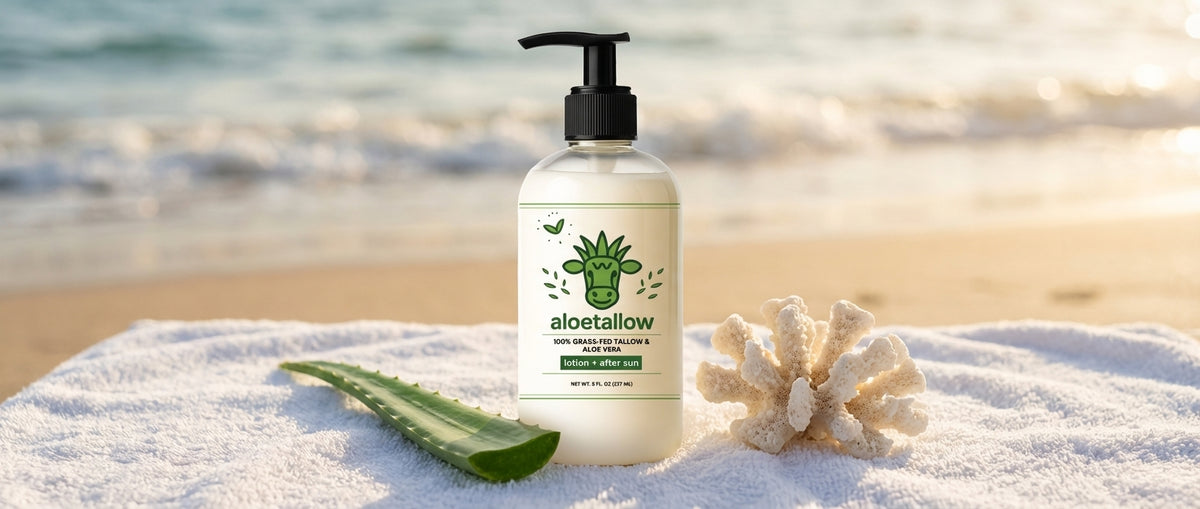
If you're looking for an after-sun lotion built around both of those mechanisms — calming inflammation and supplying barrier-compatible lipids — Aloetallow is what we made for exactly this. It combines grass-fed tallow with aloe vera as the two primary active ingredients. Eight ingredients total. No fragrance, no alcohol, no mineral oil, no dyes. The tallow supplies the long-chain fatty acids — palmitic, stearic, oleic — that match your skin's own lipid profile. The aloe is present as a primary ingredient, not a label claim. Together they address what happens after UV exposure at a structural level, not just at the surface. It's what natural after sun lotion was always supposed to do — before "natural" got replaced by botanical fragrance and low-dose aloe in a petrol-based carrier.

8 ingredients. Grass-fed tallow + aloe vera. Nothing you can't pronounce.
Frequently asked questions
Is aloe vera actually effective for sunburn, or is that mostly marketing?
The honest answer is: it depends on concentration and form. Aloe's active compound — acemannan — has been studied in peer-reviewed research and shown to reduce UV-induced inflammation and accelerate skin cell regeneration. The problem is that most commercial aloe products use concentrations too low to deliver those effects, or process the aloe in ways that degrade the active polysaccharides. Aloe vera gel applied directly from a fresh leaf at home is more likely to contain meaningful acemannan concentrations than most bottled products. When evaluating a formula, check where aloe appears on the ingredient list — if it's below the preservatives, the concentration is cosmetic.
Why does my skin still peel even when I use after-sun lotion right away?
Peeling is triggered by apoptosis — programmed cell death in UV-damaged skin cells — not by lack of moisture. Moisturizing after sun exposure can help the peeling process feel less uncomfortable and may reduce how much flaking you experience, but it doesn't prevent the peeling itself. What moisturizing does prevent is secondary damage: barrier disruption from dryness, cracking, and irritant exposure that prolongs the recovery. If you're still peeling significantly despite applying lotion, the lotion is probably addressing surface hydration without doing much at the lipid-barrier level.
Does what you put on your skin after sun exposure affect your tan?
Yes — indirectly. Melanin production ramps up in the days following UV exposure, which is why a tan often deepens 24-72 hours after you're out of the sun. Maintaining a strong skin barrier during that period helps the tan develop evenly and last longer. Barrier-disrupting products — those with alcohol, harsh emulsifiers, or fragrance that triggers inflammation — can interfere with that process and lead to patchy fading. This is also why tan extender lotion that actually works is usually built around barrier support, not just moisture.
Can I use regular lotion after sun exposure, or does it need to be specifically "after-sun"?
The "after-sun" label is mostly marketing positioning. What matters is what's in the formula, not what category it's sold in. A regular moisturizer built around barrier-compatible lipids with no fragrance or alcohol will outperform a branded after-sun product that's mostly mineral oil and synthetic fragrance. Look at the ingredient list, not the front label. The criteria are the same either way: lipid-matching fatty acids, meaningful aloe concentration if inflammation is a concern, no fragrance, no alcohol as a primary ingredient.
The ritual of after-sun care — the cool lotion, the relief, the sense that you're taking care of your skin — that part is real and worth keeping. It just works better when the product is built around what your skin actually needs after UV exposure, not around what makes it feel good for the thirty seconds after you apply it. Your skin is doing real repair work in the 48 hours after a burn. Give it the right materials and it does that job faster, with less peeling, less dryness, and less of that tight, raw feeling that lingers when the barrier never quite gets what it needed.