You spent time in the sun. The tan came in. Then three days later it's already fading, and by the end of the week you're back to where you started. This isn't bad luck — it's skin biology. But it's also something you can actually slow down, if you understand what's driving the fade and address it directly rather than reaching for a product that just adds more bronze tint to mask it.
Why a tan fades — what's actually happening in your skin
A tan is the result of UV exposure triggering increased melanin production in melanocytes — the pigment-producing cells in the base of your epidermis. Melanin moves upward through the epidermis as cells turn over. The darker color you see at the surface is melanin-containing cells that have migrated up through the skin layers toward the outer surface.
Here's the key: your skin is constantly shedding. The outermost layer of your skin — the stratum corneum — is made up of dead cells that your body continually replaces from below. The average skin cell takes roughly 28–40 days to migrate from the base of the epidermis to the surface, where it flakes off. This process is called desquamation.
When those cells shed, the melanin in them sheds with them. Your tan fades because you're literally losing the pigmented cells that make it visible. The melanocytes in your basal layer can produce new melanin, but without ongoing UV exposure, production slows and the new cells coming up carry less pigment than the ones falling off. The result: progressive lightening.
Several factors accelerate this process:
- Dehydrated skin — when the stratum corneum is dry, cells flake off faster and less uniformly, creating a patchy, ashy appearance that makes a tan look older and uneven
- Barrier damage — UV exposure itself damages the skin barrier; a damaged barrier increases transepidermal water loss, speeds up cell turnover as skin tries to repair, and accelerates the desquamation process
- Hot showers and harsh soaps — both strip the lipid matrix of the stratum corneum, mechanically accelerating cell loss
- Exfoliation — intentional or otherwise (from towel friction, loofahs, or physical scrubs) removes pigmented cells faster than they'd naturally shed
If you want to extend a tan, the primary lever is simple in theory: slow down the rate at which you lose the pigmented cells. That means keeping the barrier healthy, keeping skin hydrated, and minimizing anything that accelerates shedding.
Why most "tan extender" products don't actually work
Walk into any pharmacy or beauty retailer and you'll find dozens of products labeled "tan extender" or "after sun." Most of them rely on one of two mechanisms:
DHA (dihydroxyacetone) — a colorless sugar that reacts with amino acids in the outermost skin cells to produce a brown pigment through the Maillard reaction. This is the active ingredient in all self-tanners. It's not melanin. It's a surface stain that lives in the very top layer of the stratum corneum. These cells shed even faster than melanin-containing cells. The result: a tan that looks orange, fades unevenly, and requires constant reapplication. It doesn't extend your real tan — it adds a separate, artificial layer on top of it.
Bronzing tints — cosmetic pigments (iron oxides, mica, caramel color) that stain the skin surface temporarily. These wash off with the next shower. They create the appearance of a tan, not the extension of one.
Neither of these addresses the actual biology. They're cosmetic workarounds, not barrier support.
Even products that don't use DHA or bronzers often fail at actually extending a tan because they prioritize cosmetic feel — lightweight texture, fast absorption, no residue — over the barrier-supporting ingredients that do the underlying work. A lotion that absorbs in 30 seconds and leaves no feel may feel elegant, but it's often not delivering the occlusive or emollient support that slows desquamation.
What actually keeps a tan longer: barrier support
The science is relatively straightforward. Skin that retains moisture loses cells more slowly. A healthy lipid barrier reduces transepidermal water loss (TEWL), keeps corneocytes intact longer, and creates the conditions where desquamation happens on the skin's own schedule rather than being accelerated by dehydration or damage.
Ingredients that support this fall into two categories:
Occlusives that reduce TEWL: These create a physical barrier over the skin surface that slows water evaporation. Petrolatum is the most studied and effective; tallow is close behind for this purpose, with the added benefit of providing structural lipids that skin uses for repair. The richer and more occlusive the ingredient, the better it performs for slowing desquamation — which is why lightweight "tan extending" lotions often underperform.
Barrier lipids that provide raw materials for repair: Ceramides, free fatty acids, and cholesterol are the building blocks of the stratum corneum's lipid matrix. After UV exposure, this matrix is damaged. Products that provide these lipids give the skin what it needs to rebuild — not just a film on top, but actual structural support.
Grass-fed tallow is one of the few topical ingredients that does both. Its fatty acid profile — high in oleic, palmitic, and stearic acid — closely mirrors the lipid composition of human skin. A 2018 review in the International Journal of Molecular Sciences noted that palmitic and stearic acid are direct precursors to the ceramides that make up the barrier mortar. This means tallow doesn't just seal the surface; it provides substrate for barrier reconstruction after UV damage.
Aloe vera adds a complementary mechanism. A 2013 study in the Journal of Ethnopharmacology documented aloe vera's ability to reduce TEWL and support the skin's natural hydration mechanisms following UV exposure. Aloe also contains polysaccharides that form a light film on the skin surface, adding mild occlusion without heaviness. The cooling, anti-inflammatory effect of aloe in the immediate post-sun window also reduces the barrier-damaging inflammatory cascade that follows sunburn.
Combined, they address the two main drivers of tan fade: barrier damage and dehydration.
Practical guide to extending your tan
Apply moisturizer immediately after sun exposure. The post-sun window is the highest-leverage moment for barrier repair. UV exposure damages the lipid matrix; applying a barrier-supporting moisturizer within minutes of sun exposure (and again before bed) begins repair before the damage compounds. This is why the old advice — "moisturize after the sun" — is directionally correct, even if most of the products sold for it underperform.
Apply to slightly damp skin. Occlusives work by sealing in moisture that's already there. If you apply to completely dry skin, you're sealing in dehydration. Shower, pat skin until just barely dry, then apply immediately. You'll need less product and the hydration lasts longer.
Cool showers, not hot. Hot water strips the stratum corneum's lipid matrix faster than anything else in a daily routine. A 30-second temperature drop at the end of your shower — from warm to cool — makes a measurable difference to barrier integrity. Cold rinsing also tightens the surface and reduces the post-shower flush that can make a tan look temporarily faded.
Avoid physical exfoliation on tanned skin. Loofahs, scrubs, exfoliating mitts — all of these accelerate the mechanical shedding of pigmented cells. If you want to exfoliate, wait until your tan has naturally completed its fade. Using a loofah during peak tan is one of the fastest ways to develop a patchy, splotchy appearance as some areas shed faster than others.
Skip the DHA products while your tan is active. Self-tanner applied on top of a real tan adds an artificial color layer that fades on its own timeline, usually faster than the melanin beneath it. As the DHA layer fades unevenly, it creates a patchy, orange-gray appearance that actually draws more attention to tan fade than just letting the natural tan decline on its own. Wait until your real tan has fully faded before using self-tanner if you want to bridge the gap.
Hydrate systemically. This is the one piece of conventional advice that's actually correct. When you're dehydrated, your body diverts moisture away from the skin. Drinking adequate water doesn't compensate for a compromised barrier on its own, but it creates the conditions where barrier repair is more effective. Think of it as a floor condition rather than a fix.
Reapply through the week, not just the day after. Barrier repair is ongoing. Applying once after sun exposure and then returning to nothing the rest of the week won't extend your tan much. Daily application of a barrier-supporting moisturizer throughout the tan's lifespan — morning or evening, consistently — is what creates measurably slower desquamation.
The role of after sun vs. tan extender — what's the difference
Marketers have created a distinction between "after sun" and "tan extender" that doesn't really exist in the underlying biology. Both categories, when they work, work by the same mechanism: supporting barrier integrity and hydration after UV exposure.
After sun products are typically marketed around cooling and soothing in the immediate post-sun window. Tan extenders are marketed around preserving color. But if a product effectively supports your barrier — provides structural lipids, reduces TEWL, keeps the stratum corneum intact — it does both things simultaneously. The real tan lasts longer because the cells carrying the melanin shed more slowly.
The practical question isn't which category to buy. It's whether the specific product you're buying contains ingredients that actually support barrier function, or whether it's mostly water, fragrance, and a bronzing agent.
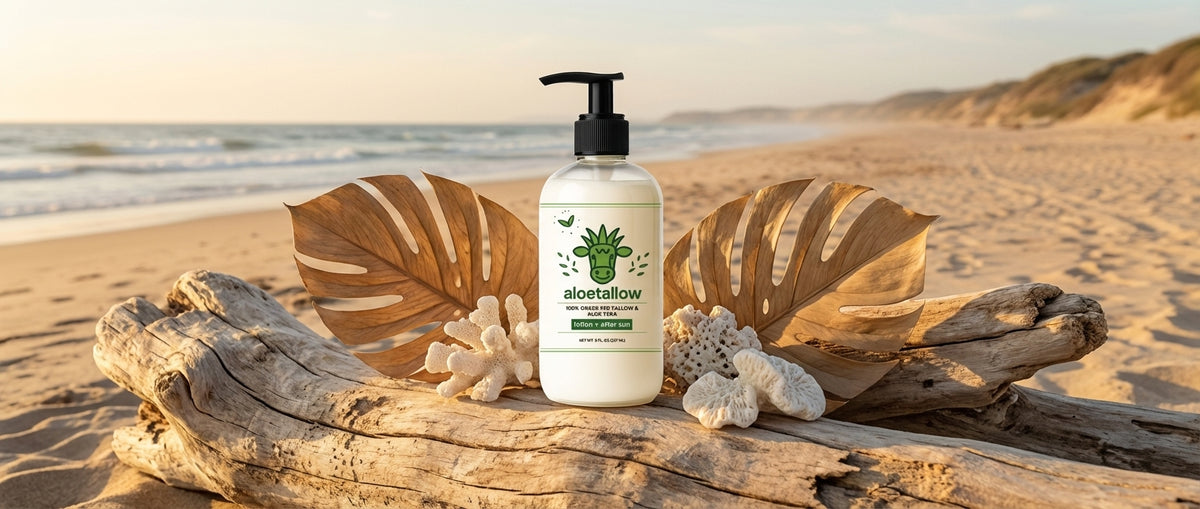
If you're looking for something that does the actual work, Aloetallow is what we made for this. It's grass-fed tallow combined with aloe vera — 8 ingredients total, no fragrance, no synthetic preservatives. The tallow provides the structural lipids your barrier needs to rebuild after UV exposure. The aloe delivers immediate hydration and the post-sun soothing effect. We built it for people who want their skin to actually recover from sun exposure and hold onto the tan they worked for — not just have a layer of DHA sitting on top of it. Over 130 customers have reviewed it, most saying their tan held noticeably longer after switching from conventional after-sun.

8 ingredients. Grass-fed tallow + aloe vera. Nothing you can't pronounce.
Frequently asked questions
How long can you actually extend a tan with good aftercare?
It varies considerably by skin tone, sun exposure level, and how consistent your routine is. For most people, diligent barrier support and avoiding the tan-killing habits above can meaningfully extend a tan by 5–10 days compared to no aftercare. Some people report maintaining significant color for 3–4 weeks with consistent daily moisturizing versus 10–14 days with nothing. The effect is real but not dramatic — you're slowing a biological process, not stopping it.
Can you use tallow on your face after sun exposure?
Yes. The face often shows tan fade first because it's the area people cleanse most aggressively. Apply a small amount to slightly damp skin after cleansing. For daytime use when you'll be going back in the sun, layer SPF on top. Tallow does not contain SPF and shouldn't be used as a substitute for sun protection.
Does tallow have SPF?
No. Some natural skincare circles claim tallow or certain plant oils have SPF — the evidence doesn't support meaningful sun protection from any of these ingredients. Use a proper broad-spectrum sunscreen during sun exposure. Use tallow after, for repair.
Is this safe to use after a sunburn?
For mild sun exposure — redness that resolves within 24–48 hours — yes. Aloe in particular is well-documented for its soothing and TEWL-reducing effects after UV damage. For genuine sunburn (blistering, significant pain, fever), cool the skin with water first, skip any heavy oils in the acute phase, and consult a doctor if the burn covers large areas or is severe. Tallow on an actively inflamed, blistered sunburn can trap heat initially — let acute inflammation subside before applying.
Does skin type affect how well tan extension works?
Yes, in two ways. First, people with naturally more melanin in their skin (Fitzpatrick types IV–VI) tend to develop longer-lasting tans regardless of aftercare, because their baseline melanin production is higher and individual tan additions are proportionally more durable. Second, people with naturally drier skin (often types I–II with fair complexions) tend to see the biggest improvement from barrier support, because their stratum corneum tends to be more depleted and reactive to begin with.
What about tan extender supplements (beta-carotene, lycopene, etc.)?
These are a separate category. Carotenoid supplements taken orally deposit a yellow-orange pigment in the skin (carotenemia) that adds warmth to skin tone — it's not melanin, but it creates a similar visual effect and is completely safe at reasonable doses. They don't extend a real tan mechanically, but they can contribute to a golden color that makes fading less visible. They work independently of and alongside topical barrier support.
The short version on tan extension: your tan fades because skin sheds. Healthy skin sheds on its own schedule. Damaged or dehydrated skin sheds faster. The most effective thing you can do after sun exposure is support your barrier — with the actual structural lipids that the stratum corneum uses to repair itself, applied consistently, starting immediately after sun exposure. Everything else in the "tan extender" category is either a workaround or cosmetic theater. The biology isn't complicated. Most of the products sold for it just aren't built around it.