Here's the situation: you've been using the same bar of soap on your face and body for the last decade, your moisturizer is whatever your girlfriend left at your place, and you're starting to notice that the guy in the mirror looks more tired than he should. Or maybe you've looked into skincare and immediately hit a wall of 47-step routines, $90 serums, and articles that seem to be written for a completely different species.
This post is for you. No jargon. No guilt trips about your current non-routine. No suggestions to buy eight products. Just the science of what men's skin actually needs, why most "for men" products are a waste of money, and the simplest effective system that takes under a minute.
Men's skin is different (but not how the marketing says)
Men's skin is structurally different from women's skin. This is well-documented dermatology, not marketing spin:
- 25% thicker. Men have a thicker dermis due to higher collagen density, driven by testosterone. A 2006 study in Skin Research and Technology confirmed that men's skin averages 25% greater thickness across age groups.
- More sebum production. Testosterone stimulates larger, more active sebaceous glands. Men produce roughly 40% more sebum (skin oil) than women. This is why men are more prone to oily skin and less prone to dryness — until about age 40, when sebum production drops significantly.
- Slower aging, then faster. Men's higher collagen density means they show visible aging later than women — but when it starts, it progresses faster. A 2019 study in Skin Pharmacology and Physiology found that men's collagen loss accelerates more steeply after age 40 compared to women's more gradual decline.
- Regular micro-damage from shaving. If you shave, you're mechanically exfoliating and creating micro-abrasions on your face 3-7 times per week. This compromises the lipid barrier in the shaved areas, increasing TEWL and sensitivity.
What this means practically: men need barrier repair (especially if you shave), hydration that doesn't feel greasy (because you already produce more oil), and UV protection (because when your collagen goes, it goes fast).
What it doesn't mean: you need products labeled "for men" that are functionally identical to regular products but dyed blue, scented with "arctic blast," and priced 30% higher.
Why most men's skincare products fail you
Walk into any drugstore and the "men's skincare" section is a masterclass in marketing over substance. Here's what you'll typically find:
Harsh cleansers. Men's face washes frequently contain sodium lauryl sulfate (SLS) or sodium laureth sulfate (SLES) at high concentrations — industrial-grade surfactants that strip your skin of its natural oils. A 2005 study in Contact Dermatitis found that SLS disrupted the lipid barrier structure and increased TEWL even after a single application. You produce more oil than women, but stripping it all off triggers your skin to overproduce sebum in response, creating the oily-then-dry cycle that makes men think they have "weird skin."
Alcohol-based aftershaves. Ethanol-based aftershaves give you that satisfying sting but damage the already-compromised barrier on freshly shaved skin. The sting isn't "working" — it's your skin reacting to having alcohol poured on micro-wounds. A 2017 review in the Journal of Clinical and Aesthetic Dermatology recommended against alcohol-based post-shave products for this reason.
Moisturizers that are mostly water and silicone. Flip over the average men's moisturizer and you'll find: water, dimethicone (silicone), glycerin, some form of petroleum derivative, and 20-30 other ingredients. The silicone creates a temporary smooth feel — it's literally filling in surface texture like spackle — but it doesn't provide lipids your skin can integrate into its barrier structure.
Synthetic fragrance. "Ocean breeze," "cedar," "sport" — these fragrance compounds are among the most common causes of contact dermatitis in skincare products. The International Fragrance Association lists over 3,000 ingredients used in fragrance blends, many of which are known sensitizers. Your skin doesn't care what you smell like. It cares about not being irritated.
The 3-product routine (under 60 seconds)
This is all you need. Not a simplified version. Not a "beginner" routine. This is the full routine, based on what dermatology actually supports:
- Cleanser (15 seconds) — Gentle, fragrance-free, sulfate-free. Wash your face with it in the morning and at night. That's it. If you're using bar soap, stop — bar soap is typically pH 9-10, while healthy skin is pH 4.5-5.5. The pH mismatch alone disrupts your barrier.
- Moisturizer (15 seconds) — Apply to slightly damp skin right after washing. You want something with lipids your skin can actually use, not just silicones that sit on top. More on what to look for below.
- Sunscreen (15 seconds, morning only) — SPF 30 minimum, broad spectrum. Apply after moisturizer in the morning. This is the single highest-ROI anti-aging product in existence. UV radiation drives 80% of visible skin aging. Everything else is secondary.
Total time: under 60 seconds. Twice a day (minus sunscreen at night). No toner, no essence, no serum, no eye cream, no exfoliant. Those exist, some of them work, and you can add them later if you want. But this three-product foundation handles 90% of what your skin needs.
What to actually look for in a moisturizer
This is where most men go wrong — not because they don't moisturize, but because they pick the wrong one. Here's what matters:
Lipid compatibility. Your skin barrier is built from specific fatty acids — oleic acid, palmitic acid, stearic acid. A moisturizer that delivers these same fatty acids integrates into your barrier and actually repairs it. A moisturizer that delivers petroleum derivatives or silicones sits on top and creates a temporary illusion of smooth skin. A 2019 review in Dermato-Endocrinology confirmed that structural similarity between topical lipids and endogenous skin lipids is a key predictor of barrier integration efficiency.
Short ingredient list. More ingredients = more potential irritants. If you can't pronounce 80% of the ingredients, your skin probably doesn't need 80% of them. Commercial moisturizers average 20-40 ingredients. Most of those are emulsifiers, stabilizers, preservatives, and fragrance — ingredients that serve the product's texture and shelf life, not your skin.
No synthetic fragrance. You have cologne for scent. Your moisturizer's job is to repair your barrier, not make your bathroom smell like a pine forest. Fragrance is the #1 cause of contact dermatitis in cosmetics.
Fast absorption. Men typically don't want to wait 5 minutes for a product to absorb before getting dressed. Lotion format absorbs faster than balm format. Oil-based formulas can feel greasy if not properly emulsified. A well-formulated lotion should absorb within 30-60 seconds and leave no visible residue.
Why tallow works particularly well for men
Beef tallow's fatty acid profile matches human sebum — the oil your skin naturally produces. This matters more for men because:
Shaving damage needs lipid repair. Every time you drag a razor across your face, you remove a thin layer of stratum corneum along with the hair. That's your barrier. Tallow provides the exact fatty acids your barrier needs to rebuild: oleic acid fills the lipid matrix, palmitic acid supports structural integrity, stearic acid reinforces the barrier's occlusive properties. Post-shave is when your skin most needs compatible lipids, and alcohol-based aftershave is the worst thing you can give it.
It absorbs fast despite being a fat. This confuses a lot of guys who expect anything "tallow-based" to feel like rubbing bacon grease on their face. In a properly formulated lotion (not a balm), tallow absorbs quickly because your skin treats it as its own lipids. Foreign substances sit on the surface. Compatible substances get pulled in. It's the difference between water on wax paper (sits on top) and water on a paper towel (gets absorbed).
It handles the oily-dry paradox. Many men deal with simultaneous oily and dry skin — oily T-zone, dry cheeks, or oily during the day and dry after washing. This typically indicates a compromised lipid barrier: the skin overproduces sebum to compensate for barrier gaps. Tallow repairs the barrier, which allows sebum production to normalize. Counterintuitively, applying the right fat reduces oiliness because your skin stops panic-producing its own.
The post-shave protocol
If you shave, your face goes through a micro-trauma cycle every few days. Here's how to handle it:
- Rinse with cool water after shaving. Cool water constricts blood vessels and reduces immediate inflammation. Skip the hot rinse — it increases TEWL on already-compromised skin.
- Skip the alcohol-based aftershave. If you want the antimicrobial benefit without the barrier damage, use something with natural antimicrobial properties (aloe vera, witch hazel at low concentration, or a product containing trace essential oils).
- Apply moisturizer to damp skin immediately. Your barrier is at its most vulnerable right after shaving. Applying a lipid-compatible moisturizer (tallow-based or similar) within 60 seconds of shaving gives your skin the building materials it needs to repair fastest.
This protocol is the single biggest improvement most men can make to their skin. Shaving is the most common source of barrier damage in men's skincare, and most men follow it with the worst possible product (alcohol aftershave) instead of the best (lipid repair).
The AloeTallow formula for men
We don't make a separate "men's" product. Because there's no scientific reason to. The same 8-ingredient formula that repairs a woman's dry, barrier-damaged skin repairs a man's shaving-damaged skin through the same mechanism: lipid compatibility.
- Grass-fed beef tallow — delivers oleic, palmitic, and stearic acids that match human skin lipids
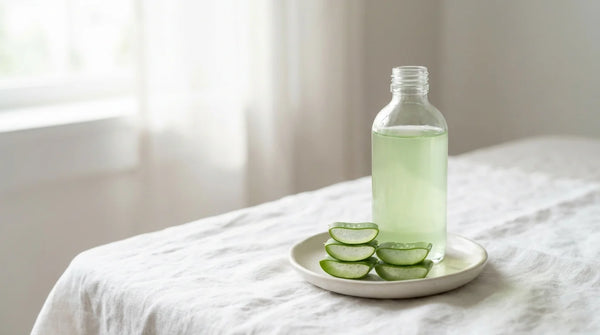
- Aloe vera — acemannan boosts your skin's own hyaluronic acid production; also soothes post-shave irritation
- Jojoba oil — mimics sebum, non-comedogenic, fast-absorbing
- Beeswax — natural emulsifier, mild occlusive
- Rosemary extract — antioxidant preservation
- Vitamin E — antioxidant protection
- Lavender essential oil — mild antimicrobial (replaces alcohol-based aftershave function)
- Frankincense essential oil — anti-inflammatory (reduces post-shave redness)
Lotion format, not balm. Absorbs in 30-60 seconds. No synthetic fragrance. No petroleum derivatives. No blue dye. No "sport" scent. Just the building materials your skin actually uses.

8 ingredients. Grass-fed tallow + aloe vera. Nothing you can't pronounce.
Frequently asked questions
Do men really need moisturizer?
Yes. Men produce more sebum than women, which provides some natural barrier protection — but sebum production declines significantly after 40, and shaving damages the barrier regardless of age. Even in your 20s and 30s, a moisturizer that delivers compatible lipids improves skin texture, reduces post-shave irritation, and prevents the premature barrier degradation that makes skin age faster. It's a 15-second investment that pays off for decades.
Won't moisturizer make my oily skin worse?
The opposite. If your skin is oily, it's often because your lipid barrier is compromised and your skin is overproducing sebum to compensate. This is called "reactive seborrhea." A moisturizer with barrier-compatible lipids (tallow, jojoba) repairs the barrier, which signals your skin to reduce sebum production. A 2020 study in Clinical, Cosmetic and Investigational Dermatology found that proper barrier repair reduced sebum output in participants with combination skin. The key is using the right moisturizer — not a silicone-heavy one that sits on top of the oil.
Can I use the same product on my face and body?
If it's a well-formulated lotion with non-comedogenic ingredients, yes. The skin on your face is thinner and more sensitive than body skin, so anything that works well on your face will work on your body. The reverse isn't always true — heavy body lotions can clog facial pores. AloeTallow is formulated as a face-and-body product. Apply a thinner layer on your face, more generous on body — especially elbows, hands, and any area that gets dry.
What about anti-aging for men?
Three things, in order of impact: sunscreen (prevents 80% of visible aging), barrier-compatible moisturizer (prevents dehydration-driven aging), and sleep (growth hormone drives collagen synthesis during deep sleep). If you want to add a fourth: retinol, starting in your late 20s to early 30s, applied at night with a tallow-based moisturizer over it to protect the barrier. The post on tallow vs retinol covers this in detail.
Is tallow going to make me smell like beef?
No. Properly rendered and formulated tallow has no beefy scent. The smell comes from residual proteins and impurities in poorly rendered tallow — which is a common issue with DIY tallow balms but not with commercially formulated products. AloeTallow uses double-rendered grass-fed tallow in a professionally emulsified formula. The scent is clean and minimal — slight lavender and frankincense from the essential oils. Nobody at your office will know you're wearing beef fat. Your skin will know, though, and it'll thank you.