If you've searched "tallow vs retinol," you've probably seen two types of content. The tallow blogs say retinol is overrated and tallow is all you need. The dermatology sites say tallow is unproven and retinol is the gold standard. Both sides are oversimplifying the science to sell you something — and the truth is more useful than either narrative.
Retinol and tallow don't compete. They do fundamentally different things to your skin through completely different mechanisms. Comparing them is like comparing protein to sleep — both matter, they work on different systems, and telling someone to pick one is bad advice.
Let's actually break this down.
What retinol does (the real mechanism)
Retinol is a vitamin A derivative. When you apply it topically, your skin converts it through a two-step process: retinol → retinaldehyde → retinoic acid. Retinoic acid is the active form that binds to retinoic acid receptors (RARs) in your skin cells.
What happens when retinoic acid activates those receptors:
- Increased collagen synthesis. A 2007 study in Archives of Dermatology found that topical retinol applied to aged skin for 4 weeks significantly increased procollagen I production and reduced matrix metalloproteinase expression — the enzymes that break collagen down.
- Accelerated cell turnover. Retinoids increase the rate at which old skin cells shed and new cells reach the surface. This is why retinol makes skin look "fresher" — you're literally turning over the surface layer faster.
- Reduced hyperpigmentation. By speeding turnover, retinoids help clear melanin deposits that cause dark spots and uneven tone.
The evidence for retinol in anti-aging is extensive. Decades of clinical studies. It works. That's not the debate.
The debate is about what retinol doesn't do — and what it actively damages in the process.
The retinol trade-off nobody talks about enough
Retinoids compromise your skin barrier. This isn't a side effect — it's inherent to how they work. By accelerating cell turnover, retinoids thin the stratum corneum temporarily. A 2018 study in the Journal of Cosmetic Dermatology found that retinoid use increased transepidermal water loss (TEWL) by 25-40% during the adjustment period, which can last 4-12 weeks.
During this period, your skin is:
- More sensitive to UV (mandatory sunscreen — which you should be using anyway)
- Drier, with increased flaking and peeling
- More reactive to other products
- Losing moisture faster than it can retain it
This is the "retinol purge" that skincare communities treat as a rite of passage. It's real, it's uncomfortable, and for some people — particularly those with already-compromised barriers, eczema, or rosacea — it can make skin look significantly worse before it gets better.
Even after the adjustment period, retinoids maintain a slightly elevated rate of cell turnover. That's the point. But it means your barrier is perpetually thinner than it would be without retinol, which means you need strong lipid support to compensate.
This is where tallow enters the conversation — not as a retinol replacement, but as the missing half of the equation.
What tallow does (the real mechanism)
Tallow doesn't stimulate collagen production. It doesn't accelerate cell turnover. It doesn't bind to retinoic acid receptors. Making those claims would be dishonest, and some tallow brands do make them — don't trust brands that position tallow as a retinol replacement for collagen stimulation.
What tallow actually does is deliver lipids that your skin barrier can integrate. Grass-fed beef tallow contains oleic acid (40-50%), palmitic acid (25-30%), and stearic acid (15-25%) — a fatty acid profile that closely mirrors human sebum. A 2019 review in Dermato-Endocrinology confirmed that topical lipids with structural similarity to endogenous skin lipids integrate more effectively into the barrier and reduce TEWL more efficiently than synthetic alternatives.
The specific mechanisms:
- Barrier repair. Tallow's lipid profile fills gaps in the stratum corneum's lipid matrix, reducing water loss and improving barrier function.
- Moisture retention. By reinforcing the lipid barrier, tallow traps existing hydration in the skin rather than adding surface-level moisture that evaporates.
- Anti-inflammatory support. Conjugated linoleic acid (CLA) and palmitoleic acid, both present in grass-fed tallow, have demonstrated anti-inflammatory properties in dermal tissue. A 2014 study in Lipids in Health and Disease documented CLA's anti-inflammatory effects on skin.
Tallow doesn't make new collagen. It protects existing collagen by maintaining the hydration and barrier integrity that keeps collagen structures plump and functional. Dehydrated collagen looks like wrinkles. Hydrated collagen looks like firm skin. The collagen is the same — the hydration state changes how it looks.
Why the smartest approach is both
If retinol stimulates new collagen but compromises your barrier, and tallow repairs your barrier but doesn't stimulate collagen, the obvious question is: why not use both?
This is exactly what dermatologists increasingly recommend. Apply your retinol first — let it absorb for 15-20 minutes. Then follow with a tallow-based moisturizer to seal the barrier and counteract the increased TEWL that retinol causes.
The tallow acts as a lipid buffer. It's giving your skin the structural fats it needs to maintain barrier integrity while the retinol does its collagen-stimulating work underneath. You get the collagen benefits without as much of the dryness, flaking, and sensitivity.
A TikTok search for "can you use retinol with beef tallow" returns thousands of results from people who've discovered this combination independently. The mechanism is straightforward: retinol creates a temporary lipid deficit in the barrier. Tallow fills that deficit with compatible fats. The skin gets both stimulation and repair simultaneously.
When tallow alone makes more sense
Not everyone needs retinol. If your skin concerns are primarily:
- Dryness and dehydration
- Dull, uneven texture from barrier damage
- Sensitivity or reactivity
- General maintenance in your 20s-30s before significant collagen loss
Then a tallow-based moisturizer may be all you need. The "glow" that tallow users report within 1-2 weeks isn't anti-aging in the collagen-stimulation sense — it's barrier repair. Your skin looks better because it's functioning better. It's retaining moisture, reflecting light more evenly, and maintaining the lipid structures that create the appearance of smooth, healthy skin.
If you're in your 20s and don't have significant photoaging, starting retinol may be unnecessary. Focus on barrier maintenance (tallow), hydration, and UV protection. That trio prevents collagen loss more effectively than trying to rebuild it after the fact.
The AloeTallow formula: built for barrier repair
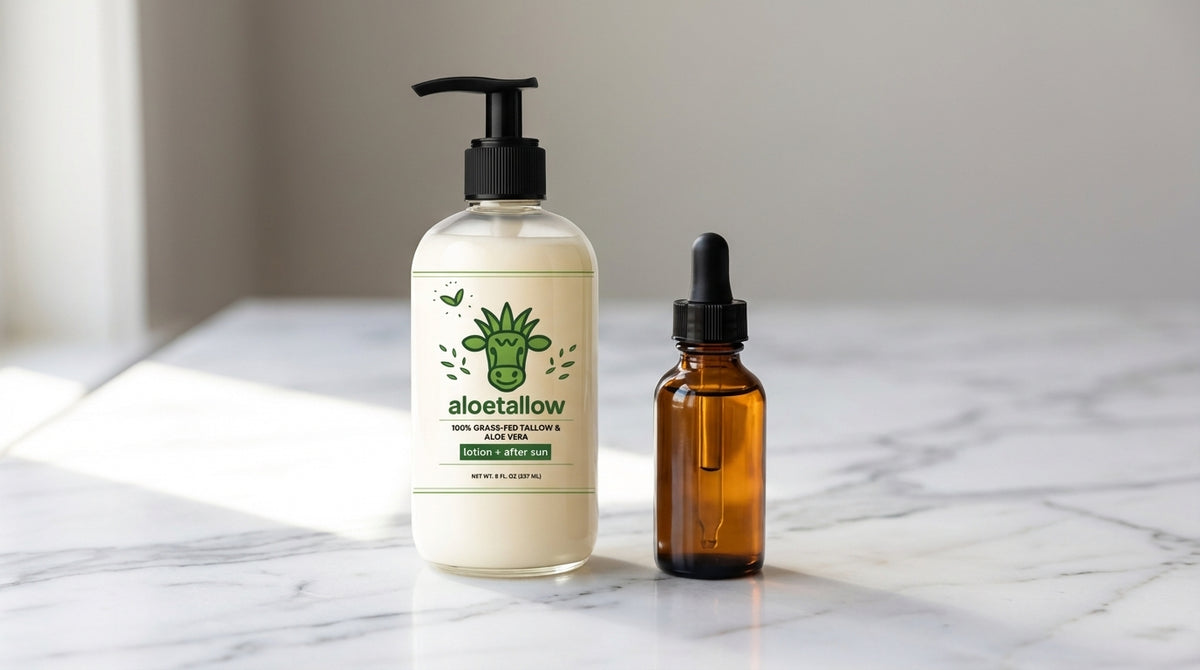
Our formula combines grass-fed beef tallow with aloe vera in an 8-ingredient lotion. The tallow delivers the lipid profile — oleic, palmitic, and stearic acids in ratios compatible with human skin. The aloe vera delivers acemannan, which a 2008 study showed stimulates hyaluronan production in dermal tissue, boosting your skin's own moisture-retention capacity.
Here's the full ingredient list:
- Grass-fed beef tallow — barrier-compatible lipid delivery
- Aloe vera — acemannan for hyaluronan synthesis
- Jojoba oil — closely mimics sebum, non-comedogenic
- Beeswax — natural emulsifier and occlusive
- Rosemary extract — natural antioxidant preservation
- Vitamin E — antioxidant, extends shelf stability
- Lavender essential oil — mild antimicrobial, scent
- Frankincense essential oil — anti-inflammatory properties
It works as a standalone moisturizer for people who don't use retinol. It works as a barrier-repair layer over retinol for people who do. Either way, it's delivering the lipids your skin needs to function at its structural best.
See the full product details here.

8 ingredients. Grass-fed tallow + aloe vera. Nothing you can't pronounce.
Frequently asked questions
Does tallow have retinol in it?
Tallow contains vitamin A (retinyl palmitate), but in very low concentrations compared to skincare-grade retinol products. The form of retinol naturally present in tallow lacks the potency and penetration depth of medical-grade retinol or tretinoin. Tallow's primary skincare mechanism is lipid barrier repair, not retinoid activity. Don't rely on tallow for retinol-level collagen stimulation — that's not what it does.
Can I use tallow and retinol at the same time?
Yes, and this is arguably the best approach for anti-aging. Apply retinol first, wait 15-20 minutes for absorption, then apply tallow-based moisturizer as a barrier-sealing layer. The tallow compensates for the increased TEWL that retinol causes, reducing dryness and sensitivity without interfering with retinol's activity.
Is tallow better than retinol for wrinkles?
They address wrinkles through different mechanisms. Retinol stimulates new collagen production and accelerates cell turnover — it actively rebuilds. Tallow maintains the hydration and barrier integrity that prevents existing collagen from looking worse than it is. For established deep wrinkles, retinol (or prescription tretinoin) has stronger evidence. For prevention, general skin quality, and maintenance, tallow is effective and gentler. For best results, use both.
Why do some people say tallow is a natural retinol alternative?
Marketing. Some tallow brands overstate the vitamin A content in tallow and position it as a "natural retinol." While tallow does contain trace amounts of fat-soluble vitamins including A, D, E, and K, the concentrations are not sufficient to produce retinoid-level effects on the skin. Honest tallow brands — and this is one — will tell you that tallow's primary benefit is lipid barrier repair, not retinoid activity. The post on beef tallow for wrinkles goes deeper on what tallow can and can't do for aging.
What age should I start using retinol vs tallow?
Barrier maintenance (tallow) is beneficial at any age. Retinol is generally recommended starting in the mid-to-late 20s for prevention, or whenever you start noticing fine lines and want to address them actively. Many dermatologists suggest starting with a low-concentration retinol (0.025-0.05%) twice a week and building up gradually. Tallow-based moisturizer can be used from the start as your barrier-repair layer.