If you've spent more than eleven seconds on TikTok in 2026, you've encountered the word "mogging." Someone with a jawline carved by Michelangelo walks into a coffee shop, and the comments erupt: he's mogging everyone in there. The clavicular TikToker flexes a collarbone that could cut glass and suddenly 2 million people are doing neck exercises in their bedroom at midnight.
But here's the thing the looksmaxing community accidentally got right — and it's something dermatologists have been saying for decades with considerably less dramatic lighting: skin quality is one of the single biggest factors in how attractive your face looks. Not bone structure. Not symmetry. Skin.
A 2017 study in Evolution and Human Behavior found that skin homogeneity — evenness of tone, texture, and clarity — was a stronger predictor of perceived attractiveness than facial symmetry. Read that again. Your skin texture matters more than whether your eyes are perfectly even. The mogging community figured this out through TikTok algorithms. Science figured it out through controlled studies. Same conclusion, very different energy.
So if you're here because you genuinely want to upgrade your skin — whether you call it "skinmaxxing," "mogging," "glowing up," or just "not looking like you slept in a dumpster" — let's talk about what actually works. With science. And only a little bit of judgment.
What "skin mogging" actually means (for the uninitiated)
"Mogging" comes from "AMOG" — Alpha Male of the Group. In looksmaxing culture, it means outshining everyone around you in physical appearance. "Skin mogging" specifically refers to having noticeably better skin than everyone else in the room — the kind of skin that makes people ask what you use, or assume you have professional-grade genetics.
The looksmaxing community breaks attractiveness down into "soft" and "hard" factors. Hard factors: bone structure, height, eye shape — things you can't change without surgery. Soft factors: skin quality, hair, body composition — things you can actually improve. Skin consistently ranks as the highest-impact soft factor, which makes it the single best return on effort for anyone trying to look better.
What's interesting is that the science supports this hierarchy. A 2021 study in PLOS ONE found that when participants rated facial attractiveness, skin condition accounted for more variance than any other individual feature. Healthy, elastic, even-toned skin made faces rated as younger, healthier, and more attractive — regardless of the underlying bone structure.
So the mogging guys are onto something. They just haven't read the dermatology journals yet. If you're serious about skinmaxxing — actually making your skin the healthiest it can possibly be — the answer isn't another serum. It's understanding what your skin is built from.
The science of skin elasticity (the real skinmax)
When the looksmaxing community talks about "skin quality," they're usually describing three measurable properties without knowing the technical terms:
- Elasticity — your skin's ability to bounce back when stretched or compressed. This is what makes skin look "tight" and youthful rather than saggy or tired.
- Hydration — how much water your stratum corneum (outermost skin layer) retains. Dehydrated skin looks dull, emphasizes fine lines, and reflects light unevenly.
- Barrier integrity — how well your skin's lipid barrier prevents moisture loss and blocks irritants. A compromised barrier means redness, flaking, and uneven texture.
All three of these are driven by the same underlying biology: collagen and elastin production in the dermis, lipid composition in the stratum corneum, and transepidermal water loss (TEWL). And here's the good news — all three are modifiable through what you put on your skin.
Collagen makes up about 75-80% of your skin's dry weight. After age 25, you lose roughly 1% of your collagen per year. By 40, you've lost 15-20% of your skin's structural protein. This is why skin starts to look "less tight" in your 30s — it's not just hydration, it's literal structural degradation. A 2019 review in Molecules found that topical delivery of fatty acids — particularly oleic acid, palmitoleic acid, and stearic acid — supported dermal lipid composition and reduced markers associated with skin aging.
Guess which natural substance contains all three of those fatty acids in ratios that closely mirror human sebum? We'll get there.
Why most skincare routines fail the mog test
Here's where looksmaxing culture and mainstream skincare advice both go wrong — in opposite directions.
The looksmaxing community tends to focus on retinol, tretinoin, and aggressive exfoliation. These work — retinoids have decades of clinical evidence behind them — but they also compromise your skin barrier in the short term. A 2018 study in the Journal of Cosmetic Dermatology found that retinoid use increased transepidermal water loss by 25-40% during the adjustment period. So you're getting long-term collagen stimulation while your skin looks worse for weeks or months. Not exactly a quick mog.
Mainstream skincare, on the other hand, drowns you in serums, essences, toners, and moisturizers that are 70-90% water with a handful of synthetic emollients. They feel nice. They smell nice. But many of them aren't delivering lipids that your skin can actually integrate into its barrier structure. A 2020 study in Clinical, Cosmetic and Investigational Dermatology found that moisturizers with lipid compositions similar to endogenous skin lipids were significantly more effective at reducing TEWL than synthetic-only formulations.
Translation: your skin wants fats that look like its own fats. Not petroleum byproducts and silicones that sit on top like plastic wrap.
The fatty acid profile that your skin actually recognizes
Your skin's lipid barrier — the thing that determines whether your skin looks hydrated, even, and "glowing" vs. dull, flaky, and tired — is primarily composed of ceramides, cholesterol, and free fatty acids. The fatty acid component includes:
- Oleic acid (40-50% of skin surface lipids)
- Palmitic acid (20-25%)
- Stearic acid (10-15%)
- Palmitoleic acid (5-10%)
Now compare that to grass-fed beef tallow:
- Oleic acid: 40-50%
- Palmitic acid: 25-30%
- Stearic acid: 15-25%
- Palmitoleic acid: 3-5%
The overlap is not a coincidence. Tallow is rendered animal fat. Your skin barrier is built from animal fat (yours). The structural similarity is why tallow absorbs into skin without the greasy residue that plant oils often leave — your skin recognizes the lipid profile and integrates it into the barrier, rather than treating it as a foreign substance sitting on the surface.
A 2019 study in Dermato-Endocrinology confirmed that structural similarity between topical lipids and endogenous skin lipids is a key predictor of barrier integration and repair efficiency. The closer the match, the better the absorption and the more effective the barrier repair.
This is the mechanism behind the "glow" that tallow users report. It's not magic. It's lipid compatibility. Your skin is getting building materials it can actually use. If skinmaxxing has a cheat code, this is it — give your skin fats it recognizes instead of synthetic substitutes it has to work around.
The elasticity equation: tallow + hydration
Skin elasticity isn't just about collagen. It's about hydration held in place by a functioning lipid barrier. Think of it this way: collagen is the scaffolding, water is what keeps the scaffolding flexible, and your lipid barrier is what keeps the water from evaporating.
This is why people with chronically dry skin look older than they are — it's not wrinkle formation, it's transepidermal water loss making existing collagen structures less plump and less bouncy. Fix the barrier, trap the water, and existing collagen looks better immediately.
Aloe vera enters the equation here. While tallow provides the lipid component, aloe's primary active compound — acemannan — has been shown to increase hyaluronan synthesis in dermal tissue. Hyaluronan (hyaluronic acid) is your skin's own humectant; it holds up to 1,000 times its weight in water. A 2008 study in Evidence-Based Complementary and Alternative Medicine found that acemannan stimulated hyaluronan production, meaning it's not just adding surface hydration — it's triggering your skin to produce more of its own moisture-retention molecules.
So the combination works like this: aloe boosts your skin's ability to hold water. Tallow provides a lipid barrier that prevents that water from escaping. Together, they create the conditions for skin that looks hydrated, plump, and elastic — the "skin mog" in looksmaxing terms, or "healthy, well-maintained skin" in dermatology terms. This is skinmaxxing at its core: not 47 products, just the right ones.
The skinmaxxing protocol (backed by science, not Reddit threads)
If you're genuinely trying to skinmax — make your skin the absolute healthiest it can be, the kind that mogs without filters — here's what the science supports:
- Stop destroying your barrier. If you're using harsh cleansers, over-exfoliating, or stacking multiple actives (retinol + AHA + vitamin C + niacinamide on the same night), you're tearing down faster than you're building up. Simplify.
- Hydrate from inside. Drink water. Boring advice. Still true. Dermal hydration starts systemically.
- Feed your barrier real lipids. Your skin barrier needs fatty acids it can integrate. Tallow provides a near-identical lipid profile to your skin's own. Apply to slightly damp skin so the lipid layer traps existing moisture.
- Support your skin's own hyaluronan production. Aloe vera's acemannan does this. It's not surface-level hydration — it's triggering your skin to produce more of its own moisture-holding compounds.
- Protect from UV. Collagen degradation is 80% UV-driven. Sunscreen is the single highest-ROI anti-aging intervention. This isn't optional.
- Sleep. Growth hormone peaks during deep sleep. Growth hormone drives collagen synthesis. 7-8 hours. Non-negotiable.
That's it. That's the skinmaxxing protocol. No 12-step routine. No $400 serum. Feed your skin the right lipids, keep it hydrated, protect it from UV, and sleep. The mogging community overcomplicates this. The skincare industry overcomplicates this. Your skin doesn't want complicated — it wants the right building materials.
A word about the AloeTallow formula
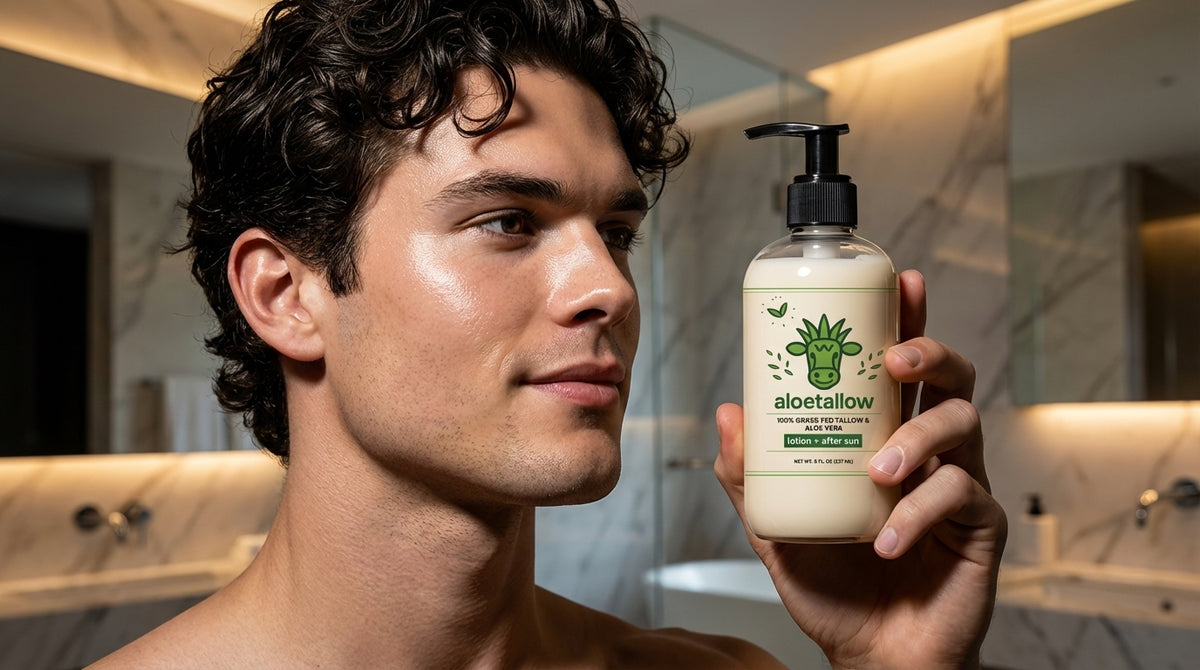
We make a lotion that combines grass-fed beef tallow with aloe vera in a stable, emulsified formula — 8 ingredients total. The tallow delivers the lipid profile your skin barrier needs for elasticity and repair. The aloe delivers acemannan for hyaluronan production. The format is a lotion, not a balm, so it absorbs quickly without the waxy residue that some tallow products leave.
It won't give you clavicular definition. It won't restructure your maxilla. But if you're trying to skinmax — genuinely get your skin to its healthiest, most elastic, mog-ready state — this is the lotion you need to be using. Skin quality is the highest-ROI soft factor in the attractiveness equation, and the research backs that up. AloeTallow gives your skin the exact building materials it needs to look its best. No filters required.
Check it out here if you're serious about skinmaxxing. Or don't. Your skin will still benefit from the protocol above regardless of what product you use — as long as it's delivering the right fatty acids. But if you want the shortcut to skin mogging everyone in the room, this is it.

8 ingredients. Grass-fed tallow + aloe vera. Nothing you can't pronounce.
Frequently asked questions
Is "skin mogging" a real thing?
"Mogging" is internet slang, but the underlying concept is well-supported by research. Multiple studies confirm that skin quality — evenness, hydration, elasticity — is one of the strongest predictors of perceived facial attractiveness, often outranking symmetry and bone structure. So yes, having noticeably better skin than the people around you is measurable and scientifically meaningful. The TikTok community just gave it a funnier name.
How long does it take to see a difference in skin elasticity?
Barrier repair — the immediate "glow" from proper lipid delivery — can be noticeable within 1-2 weeks. Actual elasticity improvements from consistent hydration and lipid barrier support take longer: most studies show measurable changes in skin elasticity at the 4-8 week mark with consistent daily use. Collagen-level changes are even slower — expect 8-12 weeks minimum for structural improvements visible in skin firmness.
Can tallow actually replace my entire skincare routine?
For a lot of people, yes. If your skin's primary issue is dryness, dullness, or barrier damage, a tallow-based moisturizer covers the lipid delivery component, and if it includes aloe vera, the hydration component too. You still need sunscreen during the day and a gentle cleanser to remove it at night. But the 7-product layering routine? Most skin doesn't need it. The post on tallow skincare routine breaks this down step by step.
Is this just another TikTok fad?
Tallow has been used for skincare for literally thousands of years. Ancient Roman, Egyptian, and Japanese cultures used animal fats for skin protection. The "trend" is really a rediscovery. The science behind why it works — lipid compatibility with human sebum — isn't going anywhere. TikTok trends come and go. Fatty acid biochemistry doesn't change based on what's trending.
What's the deal with the clavicular TikToker?
The "clavicular" aesthetic on TikTok emphasizes defined collarbones and neck muscles as markers of fitness and attractiveness. It's part of the broader looksmaxing movement. While we can't help you with your clavicle (that's a gym and body fat question), we can confirm that the skin covering your collarbones benefits from the same lipid barrier support as the skin on your face. Dry, flaky chest skin does not mog anyone.