CeraVe is one of the most recommended moisturizers on the planet. Dermatologists mention it constantly. Reddit swears by it. It's affordable, widely available, and it works for a lot of people.
So why are thousands of people switching to tallow?
Not because CeraVe is bad. But because once you look at what's actually in each formula — and how your skin processes those ingredients — the comparison gets interesting.
This isn't about trashing CeraVe. It's about understanding what you're putting on your skin and whether there's a better option for your specific situation.
What CeraVe Actually Is
CeraVe's selling point is ceramides — lipid molecules that make up about 50% of your skin barrier. The idea is straightforward: your barrier needs ceramides, so put ceramides on it.

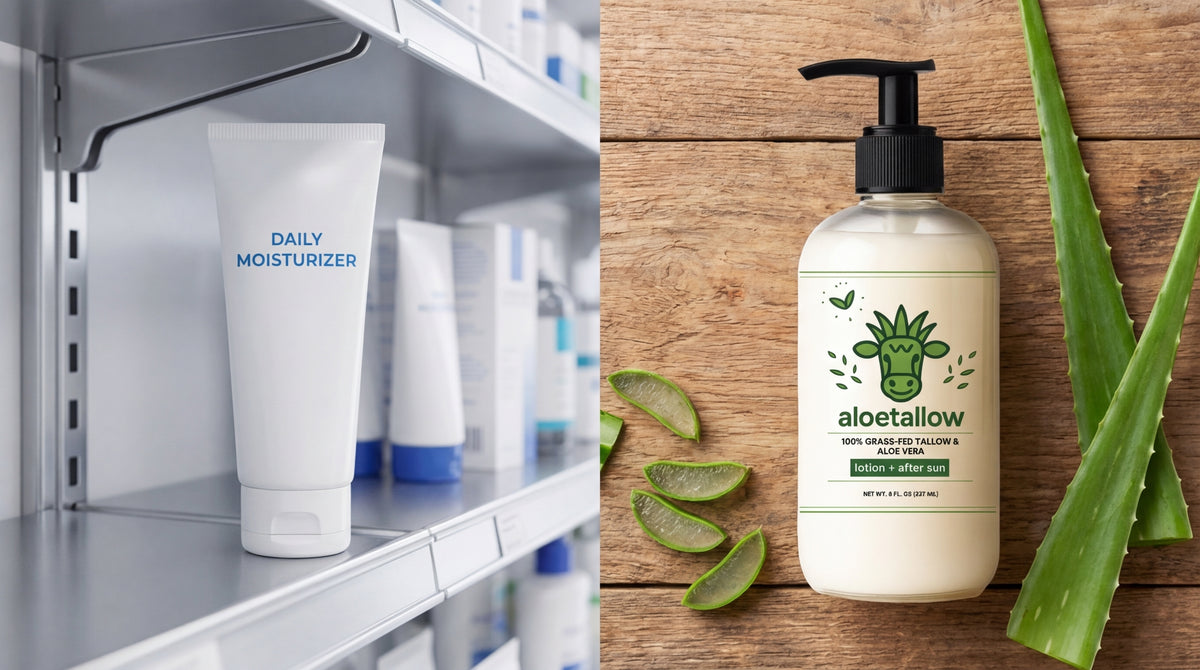
8 ingredients. Grass-fed tallow + aloe vera. Nothing you can't pronounce.
The problem isn't the ceramides. It's everything else in the bottle.
CeraVe Moisturizing Cream contains over 25 ingredients. Here's what you'll find on the label beyond the ceramides:
- Petrolatum — a petroleum-derived occlusive. Effective at sealing moisture, but it's a byproduct of oil refining.
- Dimethicone — a silicone that creates a smooth feel. Doesn't absorb into skin; sits on top as a film.
- Cetearyl alcohol, ceteareth-20, polysorbate 20 — emulsifiers and surfactants needed to blend oil and water phases.
- Phenoxyethanol, ethylhexylglycerin — synthetic preservatives.
- Sodium lauroyl lactylate, carbomer, sodium hyaluronate — texture agents, thickeners, humectants.
None of these are dangerous. But most of them exist to hold the formula together — not to benefit your skin. When you strip away the engineering ingredients, CeraVe's active story is: three ceramides + hyaluronic acid + petrolatum seal.
What Tallow Actually Is
Rendered beef tallow is the fat from cattle, gently processed to remove impurities. What's left is a matrix of fatty acids that's remarkably similar to human sebum — the oil your skin produces naturally.
The fatty acid profile:
- Oleic acid (~47%) — the same omega-9 that makes olive oil beneficial. Penetrates skin efficiently, delivers moisture to deeper layers.
- Palmitic acid (~26%) — a saturated fatty acid that's one of the main components of your skin's own lipid barrier.
- Stearic acid (~14%) — another key component of human sebum. Strengthens the barrier and helps retain moisture.
- Palmitoleic acid (~3%) — an omega-7 fatty acid found in young, healthy skin. Production declines with age.
- CLA (conjugated linoleic acid) — has anti-inflammatory properties and supports skin cell turnover.
Here's the key difference: tallow doesn't need emulsifiers, surfactants, or silicones to work. The fatty acids are bioavailable on their own. Your skin recognizes them because they mirror its own composition.
The Ingredient Count Problem
This isn't about "chemicals are bad." It's about a practical question: how many ingredients does it take to moisturize skin?
CeraVe needs 25+ ingredients because synthetic ceramides don't absorb well on their own. They need delivery vehicles, stabilizers, and penetration enhancers to work. Each added ingredient is another variable — another potential irritant, another thing your skin has to process.
A tallow-based moisturizer like AloeTallow uses 8 ingredients:
- Aloe vera juice
- Grass-fed beef tallow
- Coconut oil
- Shea butter
- Carrot seed oil
- Glycerin
- Emulsifying wax
- PE9010 (preservative)
Every ingredient has a purpose. Nothing is there to hold something else together.
How Each One Handles Skin Barrier Repair
CeraVe's approach: Deliver synthetic ceramides through an emulsion system, then seal with petrolatum and dimethicone. The ceramides supplement what your barrier is missing. The occlusives prevent water loss by creating a physical seal.
Tallow's approach: Deliver a complete fatty acid profile that matches your skin's natural lipid composition. Your skin integrates these fats directly because it recognizes their structure. Shea butter and coconut oil provide additional emollient support, while aloe vera delivers water-based hydration that tallow alone can't.
The difference is integration vs. supplementation. CeraVe adds specific lipids your barrier needs. Tallow provides the full spectrum of lipids your barrier is made of.
Who CeraVe Works Better For
Full honesty here — CeraVe is a solid product in certain situations:
- You need something fast and cheap. CeraVe is $16 at any drugstore. Hard to beat on accessibility.
- You're on prescription retinoids. Dermatologists often recommend CeraVe alongside tretinoin because the ceramides buffer irritation.
- You want zero scent. CeraVe is fragrance-free. Some tallow products include essential oils, though AloeTallow is also fragrance-free with no essential oils.
Who Tallow Works Better For
- Your skin reacts to long ingredient lists. If you've tried multiple moisturizers and keep getting breakouts, redness, or irritation — the problem might be the 20 supporting ingredients, not the active ones.
- You want deep hydration, not just surface moisture. Tallow's fatty acids penetrate and integrate. Petrolatum sits on top.
- You care about what goes on your body. Every ingredient in a tallow-based formula is something you could identify by looking at it. Can you say the same about dimethicone or ceteareth-20?
- Your skin is chronically dry despite using CeraVe consistently. This is more common than you'd think. If your moisturizer works by sealing rather than replenishing, you're managing dryness — not fixing it.
- You have sensitive or reactive skin. Fewer ingredients = fewer potential triggers. Simple math.
The Real Question
CeraVe works. Nobody serious is arguing otherwise. The question is whether you want a formula engineered in a lab with 25+ components, or one built from ingredients your skin already knows how to use.
For a lot of people, the switch to tallow isn't because CeraVe failed. It's because they realized their skin does better with less.
Frequently Asked Questions
Can I use tallow and CeraVe together?
You can, but most people find they don't need to. Tallow provides both the lipids and the occlusion that CeraVe splits across ceramides + petrolatum. If you're transitioning, try tallow at night and CeraVe during the day, then adjust based on how your skin responds.
Is tallow comedogenic?
Beef tallow has a comedogenic rating of 2 (low-moderate). CeraVe's petrolatum is rated 0 but its cetearyl alcohol is rated 2-3. In practice, tallow's biocompatibility means it integrates rather than sitting on top — most people with acne-prone skin tolerate it well.
A 2024 peer-reviewed study published in Cureus (Pham et al., PMC11193910) confirmed that grass-fed beef tallow shares the primary fatty acid composition of human sebum, supporting its biocompatibility with skin.
Does tallow smell?
Properly rendered tallow has very little scent. AloeTallow is fragrance-free with no essential oils — it has a faint, neutral smell that disappears within a minute of application.
Is tallow moisturizer more expensive?
Per ounce, yes. AloeTallow is $29.99 for 8oz vs. CeraVe at ~$16 for 16oz. But most people use less tallow per application because it absorbs more efficiently. A bottle typically lasts 6-8 weeks with daily use.
Related Reading
Sources
- Pham, et al. (2024). Tallow, Rendered Animal Fat, and Its Biocompatibility With Skin. Cureus. PMC11193910