If you've spent any time in the tallow skincare space, you've probably noticed two camps. There are the tallow purists -- raw rendered tallow, maybe whipped with a single oil, nothing else. And there are the aloe devotees -- aloe vera gel for everything, the more the better. Both camps have science behind them. Neither has the full picture.
The reality is that tallow and aloe vera solve different problems through different mechanisms at different layers of the skin. Tallow alone leaves a gap. Aloe alone leaves a gap. But when you formulate them together correctly, those gaps close -- and you get something neither ingredient achieves on its own.
This post breaks down exactly why the combination matters, what each ingredient does that the other can't, and how to evaluate whether a tallow-aloe product is actually well-formulated or just checking ingredient boxes.
What tallow does -- and where it stops
Grass-fed beef tallow is one of the closest lipid matches to human sebum available in skincare. Its fatty acid profile -- approximately 47% oleic acid, 26% palmitic acid, 14% stearic acid -- mirrors the fatty acids that make up the lipid matrix of the stratum corneum, your skin's outermost protective barrier.
This structural similarity is tallow's primary advantage. A 2010 study in the Journal of Lipid Research demonstrated that topical lipids with fatty acid compositions close to endogenous skin lipids were more effectively incorporated into the barrier's lamellar structures than dissimilar lipids. Translation: your skin can actually use tallow's fatty acids as building materials, not just sit them on the surface.
Grass-fed tallow also delivers fat-soluble vitamins A, D, E, and K in bioavailable form -- dissolved in a lipid matrix that integrates with the skin's own lipid phase. Vitamin E replenishes the barrier's antioxidant defenses. Vitamin A supports cell turnover. CLA (conjugated linoleic acid), present in meaningful concentrations only in grass-fed tallow, provides anti-inflammatory activity at the dermal level.
For a comprehensive look at tallow's fatty acid science, our post on beef tallow for skin covers the full breakdown of how these fatty acids interact with human skin biology.
But here's where tallow on its own reaches its limits.
Tallow is a lipid. It's an occlusive-emollient hybrid -- it seals the barrier and integrates with the lipid matrix. What it doesn't do is hydrate. Tallow doesn't add water to the skin. It doesn't draw moisture from the environment or deeper skin layers to the surface. It doesn't have humectant properties. If your skin is already dehydrated -- if the water content of the epidermis is low -- applying tallow alone locks in whatever moisture is currently there (or isn't there). It protects and repairs the lipid barrier brilliantly. It doesn't solve the hydration deficit on its own.
Tallow is also rich. Pure rendered tallow, even from high-quality grass-fed sources, has a heavier texture than many people prefer for daily full-body use. On elbows, hands, and cracked heels it's ideal. On the face, arms, and chest in warm weather, the weight can feel excessive. This isn't a flaw in the ingredient -- it's a formulation limitation of tallow as a standalone product.
What aloe vera does -- and where it stops
Aloe vera has been used topically for thousands of years, and the modern research supports many of those traditional uses. But not all of them, and the mechanism is more specific than "aloe is soothing."
The primary bioactive compound in aloe vera gel is acemannan, a polysaccharide that stimulates the skin's production of hyaluronan -- the same molecule the skincare industry markets separately as hyaluronic acid. A 2008 study in Evidence-Based Complementary and Alternative Medicine demonstrated that acemannan application led to measurable increases in dermal hyaluronan content. This is significant because it means aloe doesn't just add surface moisture -- it supports the skin's own hydration production system.
Aloe also demonstrates well-documented anti-inflammatory properties. A 2010 review in the Indian Journal of Dermatology found that aloe vera gel showed anti-inflammatory effects comparable to 1% hydrocortisone cream in mild inflammatory conditions -- redness, irritation, heat. This makes it directly useful for reactive skin, sun-exposed skin, and skin that's been aggravated by environmental exposure or harsh products.
Aloe contains additional beneficial compounds: various plant sterols, polyphenols, and enzymes that support surface-level skin health. It's lightweight, absorbs quickly, and leaves no residue. For immediate comfort, it's hard to beat.
But aloe has a clear limitation: it's water-based. It evaporates. Without an occlusive to seal it in, the hydration it provides is temporary. A 2018 review in the International Journal of Cosmetic Science found that humectant-only formulations provided surface hydration for approximately 2-4 hours before transepidermal water loss returned to pre-application levels. Aloe draws water in and stimulates hydration -- but it can't hold it there on its own.
Aloe also provides no lipid barrier repair. It doesn't supply fatty acids. It doesn't integrate with the lamellar structures of the stratum corneum. It operates at the surface and upper dermis -- hydrating, soothing, supporting hyaluronan production -- while the deeper lipid barrier remains unaddressed.
The gap each one fills for the other
When you map out what each ingredient does and doesn't do, the complementary nature becomes obvious:
Tallow provides: Lipid barrier repair (structural fatty acids), semi-occlusive moisture sealing, fat-soluble vitamin delivery (A, D, E, K), CLA anti-inflammatory activity, emollient skin softening.
Tallow lacks: Humectant hydration, lightweight texture, immediate cooling/soothing, water-phase anti-inflammatory action.
Aloe provides: Humectant hydration (acemannan-driven hyaluronan production), surface-level anti-inflammatory action, immediate soothing, lightweight texture, rapid absorption.
Aloe lacks: Lipid barrier repair, occlusive moisture sealing, structural fatty acid delivery, fat-soluble vitamin delivery.
Every limitation of tallow is addressed by aloe. Every limitation of aloe is addressed by tallow. They don't overlap -- they interlock.
This isn't a marketing observation. It's a formulation principle. Effective skincare needs to address three things: repair (structural restoration of the barrier), hydrate (water delivery and retention in the epidermis), and protect (reduce inflammation and environmental damage). Most single-ingredient approaches cover one or two of these. The tallow-aloe combination covers all three.
Why the combination works at different depths simultaneously
The mechanism isn't just "both good ingredients in one bottle." The physical interaction matters.
When aloe vera gel is combined with tallow in a properly emulsified formula, the aloe's water-phase compounds absorb into the upper layers of the epidermis first -- the acemannan reaches the dermal layer where it stimulates hyaluronan, and the anti-inflammatory compounds act on the surface vasculature. The tallow's lipid-phase compounds absorb more slowly, integrating into the lipid matrix of the stratum corneum where they begin structural repair work.
The tallow layer also acts as a semi-occlusive over the aloe layer -- meaning the hydration that aloe delivers gets sealed in by the lipid barrier that tallow is simultaneously repairing. Instead of aloe's moisture evaporating in 2-4 hours (as it does when applied alone), it gets locked in by the occlusive lipid layer. And instead of tallow sealing in a skin surface that might already be dehydrated, it's sealing in a skin surface that aloe has actively hydrated.
The result is longer-lasting hydration than aloe alone and more comfortable application than tallow alone, with the full structural repair capacity of both ingredients working simultaneously at different depths.
Understanding how this relates to barrier function more broadly is covered in our post on what tallow skincare is and why the barrier integration mechanism sets it apart from conventional moisturizers.
What to actually look for in a tallow-aloe product
Not all products that list both tallow and aloe vera are formulated to deliver this combination effectively. Here's what separates a well-built tallow-aloe product from one that just includes both on the ingredient label:
- Short ingredient list (under 12 ingredients). If the product has 20+ ingredients and tallow and aloe are buried in the middle, they're not the functional base -- they're token additions. A formula genuinely built around this combination should have tallow and aloe as the primary ingredients with minimal supporting compounds.
- Grass-fed tallow sourcing. The fatty acid advantage of tallow depends on the animal's diet. Grass-fed tallow has 2-3x higher CLA content, better omega-6:omega-3 ratios, and higher concentrations of fat-soluble vitamins than grain-fed. If the product doesn't specify grass-fed, the lipid profile is likely inferior.
- No fragrance or essential oils. Essential oils are among the leading causes of contact dermatitis. If the purpose of a tallow-aloe formula is skin repair and soothing, adding known irritants defeats the purpose. This is especially true for people with sensitive, reactive, or barrier-compromised skin.
- No silicones. Dimethicone and other silicones create an inert film that can interfere with tallow's integration into the lipid barrier. If the formula already has tallow acting as a semi-occlusive, silicones are redundant and potentially counterproductive.
- Lotion form over balm form. A properly emulsified tallow-aloe lotion applies evenly and absorbs well. Solid tallow balms mixed with aloe don't maintain a stable emulsion and tend to separate, which means the two-depth mechanism described above doesn't work as intended.
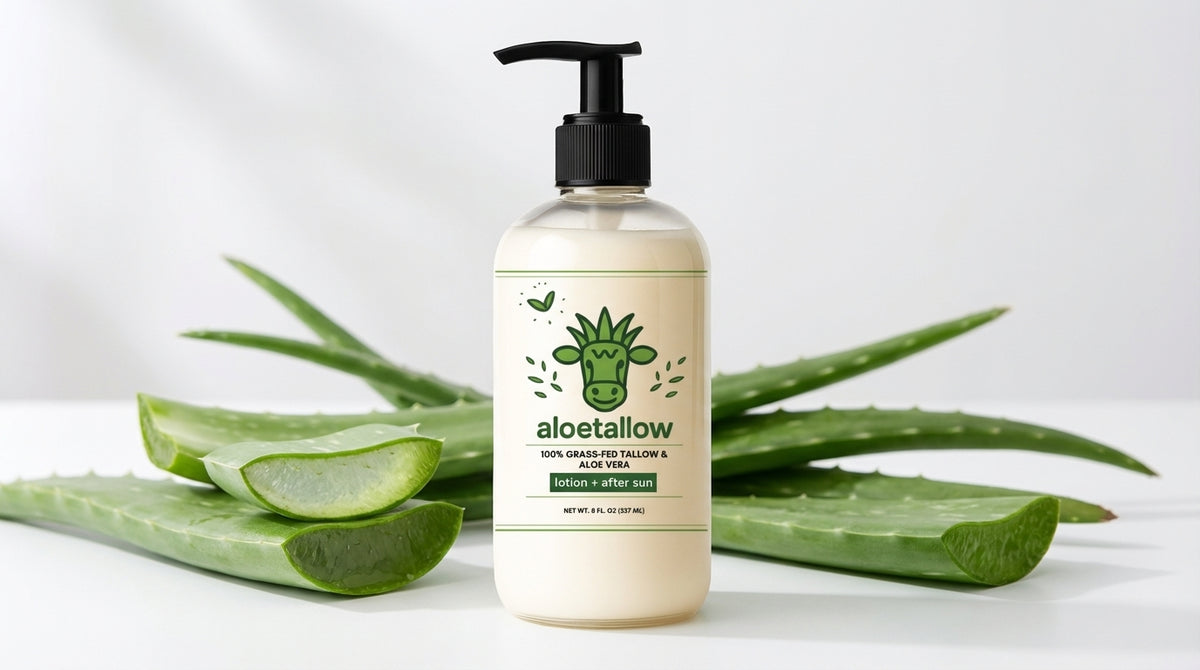
The Aloetallow formula: what we built and why
Aloetallow exists because we couldn't find a product that did this correctly.

8 ingredients. Grass-fed tallow + aloe vera. Nothing you can't pronounce.
We wanted a formula where grass-fed beef tallow and aloe vera weren't token ingredients -- they were the foundation. Where the ingredient count was low enough that nothing interfered with the two primary actives. Where the texture was light enough for daily full-body use but the lipid content was heavy enough for real barrier repair.
The result is 8 ingredients -- here's every single one:
- Grass-fed beef tallow -- the lipid backbone. Mirrors human sebum, delivers vitamins A, D, E, K and CLA directly into the barrier's lamellar structures.
- Aloe vera -- the hydration engine. Stimulates hyaluronan production, soothes inflammation, provides immediate surface comfort.
- Coconut oil -- softens skin and supports the barrier with lauric acid, which also offers natural antimicrobial activity.
- Shea butter -- rich in stearic and oleic acids, adds deep moisture and smooths rough or dry patches.
- Carrot seed oil -- packed with beta-carotene (vitamin A precursor) that supports skin tone and recovery after UV exposure.
- Glycerin -- a proven humectant that draws and holds moisture in the skin for sustained hydration between applications.
- Emulsifying wax (2%) -- binds the water phase (aloe) and lipid phase (tallow) into one stable, absorbable lotion.
- PE9010 (1%) -- a paraben-free preservative that keeps the formula shelf-stable without irritating the skin.
No fragrance, no essential oils, no silicones, no parabens, no synthetic dyes. The tallow and aloe are the formula. Everything else is there to maintain stability and shelf life.
The texture is lighter than a straight tallow balm because the aloe emulsifies with the tallow into a lotion that absorbs readily. But it's richer than a conventional aloe-based moisturizer because the tallow provides genuine occlusive weight. It sits in the space between the two -- exactly where a product designed for daily barrier repair and hydration should sit.
It works on the face, the body, after sun exposure, on dry patches, on reactive skin. Not because it's a jack-of-all-trades formula that does everything adequately. Because tallow and aloe, working together at different depths, address the three fundamental needs of skin maintenance: repair, hydrate, and protect. That's it. That's the whole thesis.
How people are using it
We hear from customers using Aloetallow in several contexts:
- Daily face and body moisturizer -- replacing multi-step routines with a single product that covers both lipid and hydration needs.
- After-sun recovery -- the aloe soothes UV-exposed skin immediately while the tallow begins barrier repair at the lipid level.
- Tattoo aftercare -- aloe's acemannan and glycoproteins support re-epithelialization during tattoo healing. See our guide on the aloe vera tattoo aftercare timeline for exactly how long to continue treatment.
- Dry skin maintenance -- people who've cycled through conventional moisturizers that manage symptoms without fixing the underlying barrier deficit.
- Sensitive skin simplification -- reducing from 15+ ingredient products to 8 ingredients eliminates most potential irritation triggers.
- Post-shower seal -- applied to damp skin after bathing to lock in residual moisture while providing structural lipids.
The versatility isn't accidental. It's a consequence of addressing the foundations of skin health rather than targeting specific symptoms. When the barrier is intact and hydrated, most skin concerns improve. A formula that maintains barrier integrity and hydration simultaneously is useful across a wide range of situations because it's addressing the common root.
Frequently asked questions
Why can't I just layer aloe vera gel under a tallow balm separately?
You can, and some people do. But separately layered products don't create the same stable emulsion as a properly formulated combination. When tallow and aloe are emulsified together, the water-phase and lipid-phase compounds distribute evenly across the skin and absorb at their respective rates simultaneously. Layering separately tends to create a heavier, less evenly distributed application, and the aloe can slide under a thick tallow layer without proper integration.
Is the aloe vera in tallow lotions real aloe or aloe extract?
This varies by product and it matters. Aloe vera "extract" is often a diluted or reconstituted form that retains some compounds but loses much of the acemannan content that drives the hyaluronan stimulation. Look for "aloe barbadensis leaf juice" or "whole leaf aloe vera" on the ingredient list. In Aloetallow, we use aloe vera as a primary ingredient, not a token additive or extract listed at the bottom of a 20-ingredient label.
Can I use a tallow-aloe lotion on my face, or is it too heavy?
A properly formulated tallow-aloe lotion is lighter than pure tallow and heavier than pure aloe gel -- which puts it in a range most people find comfortable for facial use. Use a small amount (pea-sized), warm it between your fingertips, and press gently onto damp skin. If your skin runs very oily or you're actively breaking out, patch test on your jawline for a few days first. For most skin types, the aloe component keeps the texture manageable for facial application.
How long does it take to see results from a tallow-aloe lotion?
Most people notice improved skin texture and reduced dryness within 1-2 weeks of consistent daily use. The stratum corneum turns over roughly every 28 days, so full barrier repair takes about a month. People switching from conventional moisturizers sometimes notice that the cycle of "apply, feel better for a few hours, feel dry again" breaks within the first week -- the hydration lasts longer because the barrier is actually being repaired, not just coated.
What makes Aloetallow different from other tallow-aloe products?
Three things. First, the ingredient count: 8 total. Most competing products list 15-25 ingredients, which means tallow and aloe are diluted among fillers, fragrances, and stabilizers. Second, the grass-fed sourcing: we use 100% grass-fed beef tallow, which delivers the superior CLA content, vitamin profile, and fatty acid ratios that make tallow's barrier-repair properties meaningful. Third, the formulation philosophy: no fragrance, no essential oils, no silicones. The formula is built around the two primary ingredients doing their jobs without interference. Try it yourself and see what a two-ingredient foundation can do.