You've seen it in comment sections, in clean beauty hauls, in the ingredient lists of small-batch skincare brands. Tallow. People either swear by it or scroll past it confused. If you're in the second group -- if you genuinely don't know what tallow skincare is or why anyone would put rendered animal fat on their face -- this post is the honest, no-hype answer.
What the science says about tallow and skin biology
Tallow is rendered beef fat. Specifically, it comes from the suet -- the dense fat surrounding the kidneys and loins of cattle. When rendered slowly at low heat, the fat separates from water, connective tissue, and impurities, leaving a clean, shelf-stable lipid that has been used in skincare, cooking, and wound care for thousands of years.
The reason tallow keeps coming up in skin science conversations isn't nostalgia. It's the fatty acid profile. Your skin's outer barrier -- the stratum corneum -- is held together by a lipid matrix that includes ceramides, cholesterol, and free fatty acids. The dominant fatty acids in human sebum are oleic acid (~25-30%), palmitic acid (~25%), and stearic acid (~5-10%). These are the same fatty acids that dominate grass-fed beef tallow: oleic acid at roughly 40-50%, palmitic acid at 25-30%, and stearic acid at around 14%.
A 2019 review in Dermato-Endocrinology examining the role of dietary and topical fatty acids in skin barrier function found that structural similarity between topical lipids and endogenous skin lipids was a key predictor of barrier integration -- meaning the skin doesn't just sit the fat on top, it can actually incorporate it into the barrier itself. Tallow fits that profile better than most plant oils because its saturated and monounsaturated fat ratio mirrors what human skin already produces.
Beyond the core fatty acids, grass-fed tallow also contains fat-soluble vitamins A, D, E, and K -- all of which play documented roles in skin cell turnover, antioxidant protection, and barrier maintenance. A 2015 study in Nutrients confirmed that vitamin A (retinol) applied topically supports keratinocyte differentiation, the process your skin uses to build new cells and shed old ones. In tallow, this comes in a fat-soluble form that your skin can absorb rather than a synthetic retinol derivative.
Why conventional products fail to do what tallow does
Walk the lotion aisle and read the first five ingredients on any bottle. You'll find a pattern: water, glycerin, some combination of petrolatum, dimethicone, or mineral oil, and then a long tail of emulsifiers, preservatives, and fragrance. These aren't harmful ingredients. But they work through fundamentally different mechanisms than tallow does.
Petrolatum and mineral oil are occlusives -- they form a film on top of the skin that slows transepidermal water loss. Effective, but passive. Glycerin and hyaluronic acid are humectants -- they draw water from deeper skin layers (or from the air, if humidity is high enough) toward the surface. Also useful, but dependent on external conditions and not structurally repairing anything.
Neither category gives the skin the actual fatty acid building blocks it needs to rebuild a compromised barrier. They manage the symptoms of a damaged barrier. Tallow takes a different approach: it supplies the lipid types that the barrier is structurally built from. Think of it as the difference between putting a tarp over a leaky roof versus replacing the shingles.
This distinction matters most for people with chronically dry skin, eczema, or skin that cycles through moisturizers without ever feeling fixed. If your skin barrier is structurally depleted -- which happens with age, over-washing, harsh cleansers, and environmental exposure -- adding occlusives and humectants on top doesn't solve the underlying deficit. You can read more about this in the post on beef tallow for dry skin, which goes deeper on the barrier repair mechanism.
Why the base fat matters -- and why grass-fed is the meaningful distinction
Not all tallow is the same, and the difference comes down to what the cow ate.
Grain-fed cattle produce fat with a different omega-6 to omega-3 ratio than grass-fed cattle. Grass-fed tallow has a more favorable omega-6:omega-3 ratio -- some analyses put it as low as 2:1, compared to 10:1 or higher in grain-fed tallow. This matters because high omega-6 concentrations in topical products are associated with a higher potential for oxidative stress on skin, particularly for people with acne or inflammation-prone skin. A 2014 study in Lipids in Health and Disease found that conjugated linoleic acid (CLA) -- which appears in meaningful concentrations only in grass-fed animal fats -- has demonstrated anti-inflammatory effects in dermal tissue.
Grass-fed tallow also contains higher levels of beta-carotene (the precursor to vitamin A) and vitamin E, both of which act as natural antioxidants in the formula. This isn't a minor formulation detail -- it's a meaningful difference in what the fat actually does when it contacts your skin.
The fatty acid profile that makes tallow such a close structural match to human sebum -- palmitic acid at ~26%, oleic acid at ~47%, stearic acid at ~14% -- is also the reason it absorbs well without leaving a heavy, greasy residue. Saturated and monounsaturated fats are inherently more stable than polyunsaturated fats. They don't oxidize quickly on skin, which means less chance of irritation from lipid peroxidation.
If you're new to beef tallow for skin, the fatty acid science is the most important thing to understand before evaluating any specific product.
Why tallow and aloe work together
Tallow on its own is a strong occlusive-emollient hybrid with barrier-building properties. But it's a fat -- it takes a moment to absorb and can feel richer than some people prefer, especially in warmer weather or on combination skin.
Aloe vera addresses this directly. Aloe's primary active compounds -- acemannan (a polysaccharide), aloin-free gel fraction, and various plant sterols -- work through mechanisms that complement tallow rather than duplicate them. A 2008 study in Evidence-Based Complementary and Alternative Medicine found that acemannan promotes skin hydration and supports the production of hyaluronan, a naturally occurring humectant in dermal tissue. Aloe also has demonstrated soothing properties: a 2010 review in the Indian Journal of Dermatology documented anti-inflammatory effects of aloe vera gel comparable to 1% hydrocortisone cream in mild inflammatory conditions, without the side effects.
In practical terms: aloe makes tallow lighter on the skin, provides immediate surface hydration while the tallow does deeper barrier work, and adds a cooling effect that makes the combination useful for sun-exposed or reactive skin. The two work at different depths -- aloe at the surface and upper dermis, tallow in the lipid matrix of the stratum corneum. That's why formulas combining both tend to work for a wider range of skin types than tallow alone.
For sensitive skin specifically, the simplicity of a tallow-aloe formula is as important as the ingredients themselves. Fewer ingredients means fewer potential irritants. You can read more about this in the post on tallow for sensitive skin.
Practical tips -- what to look for when choosing a tallow product
- Verify grass-fed sourcing. It should be stated explicitly on the label or product page. If it isn't, assume it's grain-fed. This affects the CLA content, the omega-6:omega-3 ratio, and the vitamin A and E levels.
- Count the ingredients. A short list (8-12 ingredients) isn't just a marketing angle -- it's evidence that the formula is built around the tallow rather than using tallow as a token additive in an otherwise conventional moisturizer.
- Avoid fragrance. Essential oils and synthetic fragrance are among the most common causes of contact dermatitis. If the point of switching to tallow is to calm reactive skin, adding fragrance defeats the purpose.
- Check the form. Solid tallow balms work well for targeted application -- hands, elbows, cracked heels -- but can feel heavy on the face or larger body areas. Tallow formulated with aloe or other water-based components tends to absorb more readily and work better as an all-over lotion.
- Start with a patch test. Tallow has a comedogenicity rating of 2-3 on a 0-5 scale. If you're acne-prone, test on your forearm or jawline before going full-face. Most people have no issue, but it's worth checking. More on this in the post on whether tallow clogs pores.
- Give it two to three weeks. Barrier repair is not a one-application event. The skin renews its outer layer roughly every 28 days. Most people notice a meaningful change in dryness, texture, and reactivity within two to three weeks of consistent use.
The AloeTallow formula
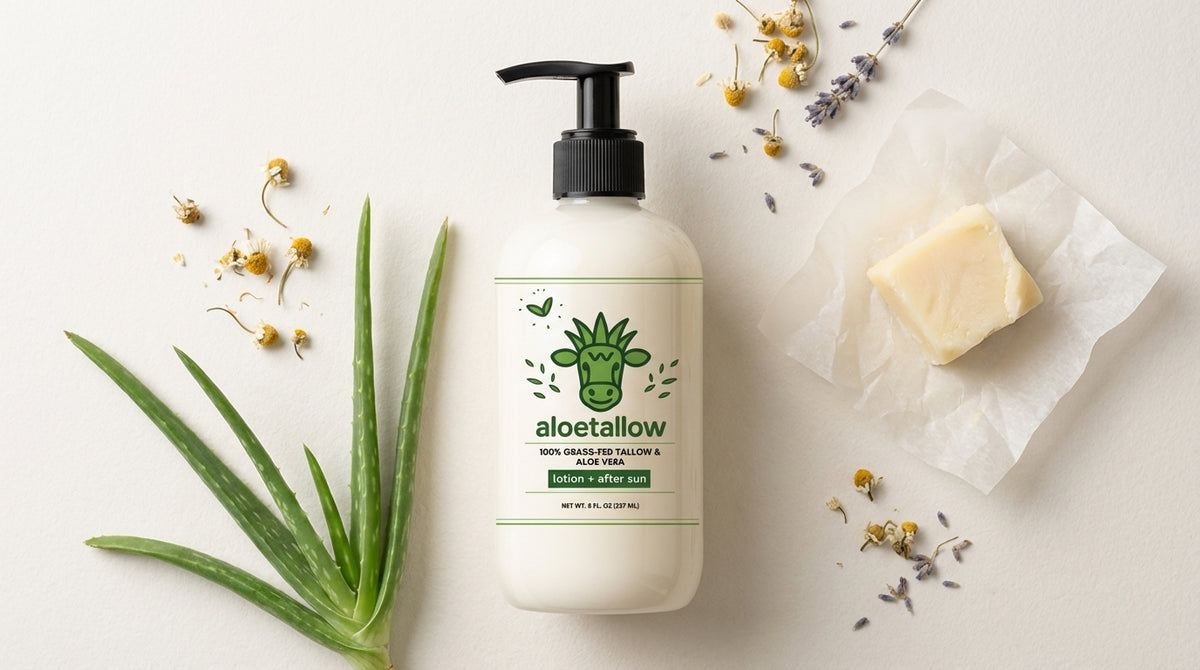
If you're looking for a tallow product built around everything covered in this post, Aloetallow is what we made. It's grass-fed beef tallow combined with aloe vera -- 8 ingredients total, no fragrance, no fillers. The tallow provides the fatty acid profile; the aloe handles surface hydration and keeps the texture light enough to use daily on any body area.

8 ingredients. Grass-fed tallow + aloe vera. Nothing you can't pronounce.
Frequently asked questions
Is tallow skincare just a trend?
Tallow has been used in skincare for thousands of years across multiple continents -- ancient Egyptians, Romans, and Indigenous cultures all used animal fats topically. It fell out of fashion in the 20th century largely because petroleum byproducts (mineral oil, petrolatum) were cheaper to produce at industrial scale, not because tallow was found to be less effective. The current revival is driven by people looking at ingredient labels more carefully and asking whether those substitutions were actually improvements. The short answer is: for barrier function specifically, probably not.
Does tallow smell bad?
Raw tallow has a faint, neutral beef scent. Well-formulated tallow skincare products minimize this through the rendering process (deodorized tallow) and through the overall formula. A well-made tallow lotion should have very little noticeable scent, and what remains typically dissipates within a minute of application. If a product smells strongly of beef, it's either poorly rendered or using undeodorized suet.
Can you use tallow skincare on your face?
Yes, with a caveat for acne-prone skin. Tallow's comedogenicity rating (2-3 out of 5) means it has a moderate potential to clog pores in susceptible individuals -- but this rating comes from outdated rabbit ear tests, not human facial skin studies. Many people with oily or acne-prone skin use tallow on the face without issue. Patch test first, use a thin layer, and give it a few weeks. Those with dry or normal skin types typically do very well with facial tallow application.
What's the difference between beef tallow and lard?
Both are rendered animal fats, but from different sources. Lard comes from pigs (specifically leaf lard from around the kidneys). Beef tallow comes from cattle suet. The fatty acid profiles are similar but not identical -- beef tallow has a higher stearic acid content (~14% vs ~10% in lard) and slightly lower oleic acid. Both have been used historically in skincare. Most tallow skincare products use beef tallow specifically because of its closer structural match to human sebum and because grass-fed sourcing is more widely established in the beef supply chain.
Is tallow good for eczema or very dry skin?
The fatty acid science is promising for both. People with eczema often have a compromised skin barrier -- specifically a deficit in ceramides and free fatty acids that maintain the tight junction structure of the stratum corneum. Tallow's palmitic and stearic acid content can supply some of the saturated fatty acids that eczema-prone skin is deficient in. Several dermatologists have noted this in clinical contexts, though large randomized controlled trials are still limited. You can read the full breakdown in the post on tallow for eczema.
The revival of tallow skincare isn't really about going backward. It's about asking a straightforward question: if your skin barrier is made of a specific set of lipids, why are we moisturizing it primarily with petroleum derivatives and water-binding polymers? Tallow doesn't answer every skincare question, but for barrier function and chronic dryness, it answers the one question that most conventional products don't -- what does the skin actually need to rebuild itself?