Hyaluronic acid is everywhere. It's in your $12 drugstore moisturizer, your $180 department store serum, and roughly 4,000 TikTok videos posted this week. It's the single most popular hydrating ingredient in modern skincare, and for good reason — it works. Sort of.
The problem isn't that hyaluronic acid doesn't hydrate. It does. The problem is that most people don't understand how it hydrates, which means they don't understand its limitations, which means they keep using it as their only hydration strategy and wondering why their skin is still dry.
Tallow works through a completely different mechanism. Understanding the difference between the two isn't just chemistry trivia — it changes your entire approach to hydration and explains why some people can layer on HA serum all day and still have flaky, dehydrated skin by afternoon.
How hyaluronic acid actually works
Hyaluronic acid (HA) is a glycosaminoglycan — a large sugar molecule that occurs naturally in your skin, joints, and connective tissue. Your body produces it on its own. The HA in your dermis can hold up to 1,000 times its weight in water, which is why it's your skin's primary internal humectant.
When you apply HA topically, it does one thing: it attracts water molecules to the skin's surface. It's a humectant. It draws moisture from two possible sources:
- From the environment — in humid conditions (above ~60% relative humidity), HA pulls water from the surrounding air and deposits it on your skin surface. This is when HA works best.
- From deeper skin layers — in dry or low-humidity conditions (below ~40% relative humidity), there isn't enough atmospheric moisture for HA to pull from. So it pulls water from your dermis instead. This is when HA backfires.
A 2019 study in the Journal of Clinical and Aesthetic Dermatology confirmed that topical HA improved skin hydration measurements in controlled (humid) conditions, but the effect was significantly reduced in low-humidity environments. In very dry conditions — winter, desert climates, air-conditioned offices — topical HA can actually increase transepidermal water loss by pulling water from deeper skin layers to the surface, where it evaporates.
This is the dirty secret of hyaluronic acid: without a barrier to trap the water it attracts, the hydration is temporary. HA brings water to the party. It doesn't keep it there.
How tallow works (the other half of hydration)
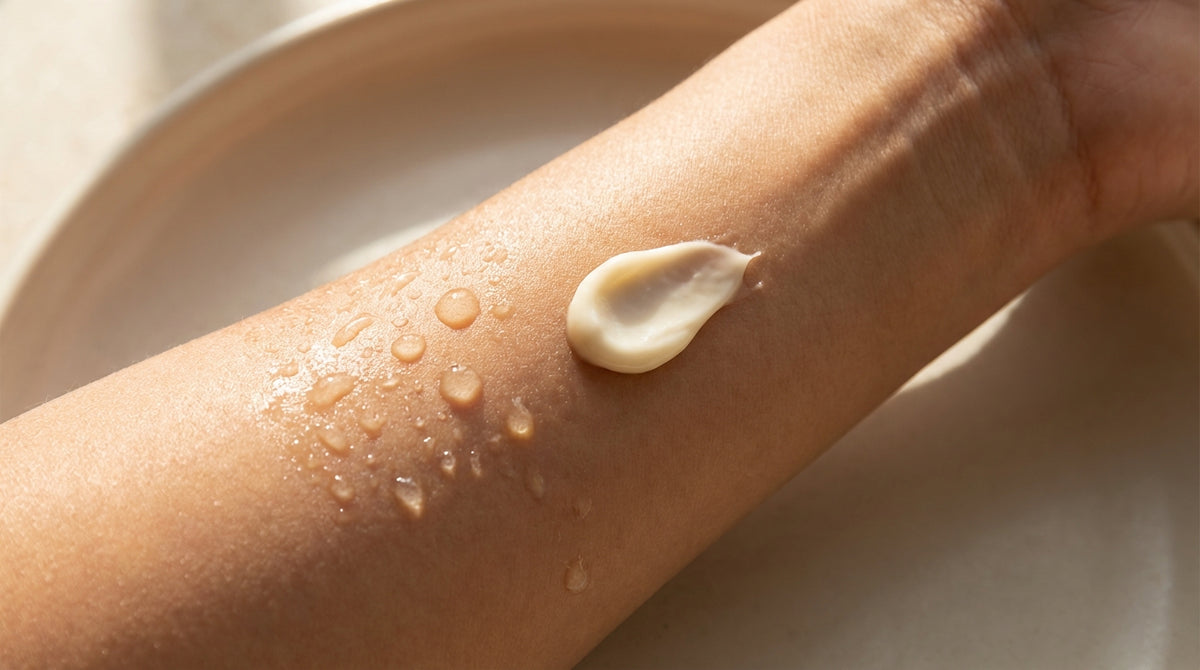
Tallow isn't a humectant. It doesn't attract water. It's an emollient and occlusive — it fills gaps in your lipid barrier and creates a protective layer that prevents moisture from escaping.
Your skin's outermost layer (stratum corneum) is structured like a brick wall: dead skin cells are the bricks, and lipids — ceramides, cholesterol, and free fatty acids — are the mortar. When the mortar is intact, water stays inside. When the mortar has gaps, water evaporates through those gaps. This evaporation is called transepidermal water loss (TEWL), and it's the primary mechanism behind chronically dry skin.
Grass-fed beef tallow contains oleic acid, palmitic acid, and stearic acid in ratios that closely match your skin's endogenous lipids. A 2019 review in Dermato-Endocrinology found that topical lipids with structural similarity to human skin lipids integrate into the barrier more effectively and reduce TEWL more than synthetic alternatives like dimethicone or mineral oil.
In plain terms: tallow doesn't add water. It prevents the water you already have from leaving.
The fundamental difference
Here's the simplest way to understand it:
- Hyaluronic acid = attracts water TO your skin (humectant)
- Tallow = prevents water from leaving your skin (emollient/occlusive)
Both are "hydrating," but through opposite mechanisms. HA is an input. Tallow is a seal. If you only use HA without a barrier layer, you're filling a bathtub with the drain open. If you only use tallow without any underlying hydration, you're sealing a bathtub that's already empty.
The ideal approach uses both mechanisms. This is basic dermatology: apply a humectant to damp skin (to attract and hold water), then seal with an emollient/occlusive (to prevent evaporation). The humectant doesn't have to be a separate HA serum — it can be as simple as applying your moisturizer to skin that's still slightly damp from washing.
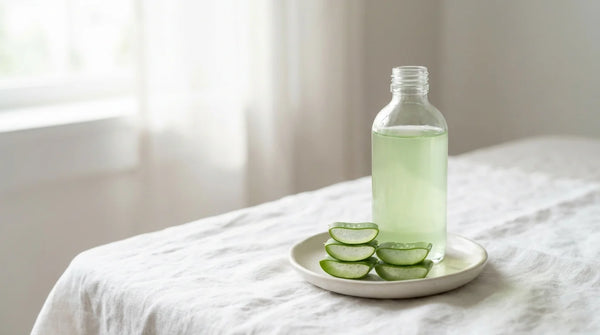
What makes tallow-aloe combinations particularly effective is that aloe vera provides the humectant component naturally. Aloe's acemannan has been shown to stimulate hyaluronan synthesis in dermal tissue — meaning it triggers your skin to produce more of its own HA, rather than just applying synthetic HA to the surface. A 2008 study in Evidence-Based Complementary and Alternative Medicine documented this mechanism. So in a tallow-aloe formula, you're getting both the humectant effect (from aloe's acemannan boosting your skin's own HA production) and the barrier seal (from tallow's compatible lipids) in one application.
When hyaluronic acid falls short
HA has real limitations that its marketing consistently ignores:
Molecular weight matters enormously. Hyaluronic acid comes in different molecular weights. High-molecular-weight HA (>500 kDa) sits on the surface and provides a temporary hydrating film. Low-molecular-weight HA (<50 kDa) penetrates deeper but has been associated with pro-inflammatory responses in some studies. A 2012 study in The Journal of Biological Chemistry found that HA fragments (low MW) activated inflammatory signaling pathways — the opposite of what you want for barrier repair. Most products don't tell you which weight they use.
It doesn't fix the underlying problem. If your skin is chronically dry because your lipid barrier is damaged, HA addresses the symptom (surface dehydration) without fixing the cause (barrier gaps). You'll need to keep reapplying because the attracted water keeps escaping through the compromised barrier. It's a topical bandaid, not a structural repair.
Climate dependency. HA works dramatically better in humid environments. If you live somewhere dry — Arizona, Colorado, air-conditioned offices, heated apartments in winter — HA has less atmospheric moisture to pull from and may actually dehydrate your deeper skin layers. Tallow works identically regardless of climate because its mechanism (barrier sealing) doesn't depend on environmental humidity.
When tallow falls short
Being honest about tallow's limitations too:
It can't attract water. If your skin is severely dehydrated — not just dry from barrier damage but genuinely depleted of water — tallow alone won't fix it. You need to get water into the skin (from humidity, damp application, or a humectant ingredient) before tallow can trap it there.
It's heavier than HA. Hyaluronic acid in serum form is lightweight, watery, and layers easily under other products. Tallow-based products are richer and more substantial. If you prefer a multi-step layering routine, tallow's texture may feel like it disrupts your system. If you prefer simplicity, tallow replaces multiple layers at once.
Comedogenicity varies. Tallow has a comedogenic rating of 2-3 (moderate). Most people tolerate it well, but those with very acne-prone or oily skin may want to patch test. HA is non-comedogenic and universally tolerated. The post on whether tallow clogs pores covers this in detail.
The practical guide: which one do you need?
If your skin is dehydrated but your barrier is intact (your skin feels tight after washing but doesn't flake or get red): HA works well. You have a functioning barrier — you just need more water input.
If your skin is dry with barrier damage (flaking, redness, sensitivity, products stinging on application): you need barrier repair first. That's lipids. HA on a damaged barrier is like pouring water through a colander — it goes right through. Fix the barrier with tallow or another lipid-compatible moisturizer, then add HA if you want extra hydration.
If you want both in one step: a tallow-aloe formula combines humectant properties (from aloe's acemannan stimulating your skin's HA production) with lipid barrier repair (from tallow's fatty acid profile). It's the "both mechanisms in one application" approach.
If you use retinol: retinoids increase TEWL by thinning the stratum corneum. You need robust lipid support. HA adds hydration but doesn't protect the barrier. Tallow provides the structural lipid repair that retinol-treated skin specifically needs. The post on tallow vs retinol covers this combination in detail.
What to actually look for in a moisturizer
Whether you choose HA, tallow, or both, the checklist is the same:
- Does it address your actual problem? Surface dehydration → humectant. Barrier damage → lipid repair. Most people need some of both.
- What's the lipid source? If the moisturizer uses petroleum-derived occllusives (mineral oil, petrolatum, dimethicone), it creates a barrier — but not one your skin integrates into its own structure. Lipids with structural similarity to human sebum (tallow, jojoba) integrate better.
- How many ingredients? More ingredients means more potential irritants, more synthetic emulsifiers, and more complexity your skin has to process. An 8-ingredient formula delivers the same core benefits as a 40-ingredient formula, with less risk of sensitivity reactions.
AloeTallow is an 8-ingredient formula combining grass-fed beef tallow with aloe vera — delivering both lipid barrier repair and humectant-level hydration in a single lotion. No synthetic emulsifiers, no petroleum derivatives, no fragrance beyond trace essential oils.

8 ingredients. Grass-fed tallow + aloe vera. Nothing you can't pronounce.
Frequently asked questions
Can I use hyaluronic acid and tallow together?
Yes, and this is an excellent approach. Apply HA serum to damp skin first (so it pulls water from the surface moisture, not your deeper skin layers), then follow with a tallow-based moisturizer to seal the barrier and trap the hydration. This gives you both the humectant water-attraction and the lipid barrier protection in a layered system.
Does tallow contain hyaluronic acid?
No. Tallow is a lipid (fat) — it contains fatty acids, not glycosaminoglycans. However, when combined with aloe vera, you get an indirect HA boost: aloe's acemannan compound stimulates your skin's own hyaluronan (HA) production. So a tallow-aloe formula doesn't contain HA, but it triggers your skin to produce more of it.
Which is better for winter dry skin?
Tallow, without question. In low-humidity conditions (winter air, heated rooms), HA has less atmospheric moisture to pull from and may draw water from your deeper skin layers — making dryness worse. Tallow's mechanism is climate-independent: it seals the barrier regardless of humidity. For winter specifically, the post on winter dry skin remedies covers the full strategy.
Is hyaluronic acid natural?
Your body produces hyaluronic acid naturally — it's one of your skin's primary structural molecules. The HA in skincare products, however, is typically produced through bacterial fermentation (biofermentation of Streptococcus bacteria), not extracted from a natural source. It's bioidentical to your body's own HA but manufactured synthetically. Tallow is the less-processed option if "natural sourcing" is your priority — it's rendered from animal fat using heat and filtration, with no synthetic production steps.
Why does my skin feel dry even though I use hyaluronic acid?
Almost certainly because your lipid barrier is compromised. HA attracts water to the surface, but if your barrier has gaps, that water evaporates before your skin can use it. You feel temporarily hydrated after application, but within an hour or two the moisture escapes. The solution isn't more HA — it's barrier repair. Add a lipid-compatible moisturizer (tallow, ceramide cream, or similar) over your HA to seal the moisture in. If your barrier is intact and you're still dry, you may be in a low-humidity environment where HA can't effectively pull moisture from the air.