Tallow is having a moment in skincare. Walk through any natural beauty forum or scroll the right corner of the internet and you'll find people who swear by it — for dry skin, for reactive skin, for post-sun skin, for skin that just stopped responding to whatever was in the medicine cabinet. And with that momentum has come a flood of products, each positioned as the answer. Some of them genuinely are. But they're not all the same thing, and using the wrong format for your skin type or routine is one of the more common reasons people try tallow and decide it didn't work. Here's an honest breakdown of five types of tallow products worth considering — what each one does well, where it falls short, and who it's actually built for.
What to know before comparing tallow products
Balm vs. lotion is not a small distinction. A tallow balm is essentially rendered fat with very little else — one to three ingredients, slow to absorb, heavy on skin, and potent. A tallow lotion is emulsified: tallow combined with water and a binder that keeps them from separating. Lotions absorb faster, feel lighter, and work better for daily use on the face and body. Neither is universally better. They solve different problems.
Grass-fed sourcing matters more than most labels admit. Grass-fed tallow has a measurably different fatty acid profile than grain-fed — higher in conjugated linoleic acid (CLA) and fat-soluble vitamins A, D, E, and K. These aren't marketing terms; they're the compounds that make tallow useful for skin repair. If a product doesn't specify grass-fed, there's a reasonable chance it isn't. You can read more about why this matters in our post on beef tallow for skin.
Ingredient count is your quality signal. The longer the ingredient list, the more diluted the tallow tends to be. A five-ingredient tallow product with tallow near the top is almost always more potent than a fifteen-ingredient one where tallow is eighth on the list. Read ingredient lists from top to bottom — that's the order of concentration.
1. Aloetallow — Best for daily use, face and body, and after-sun
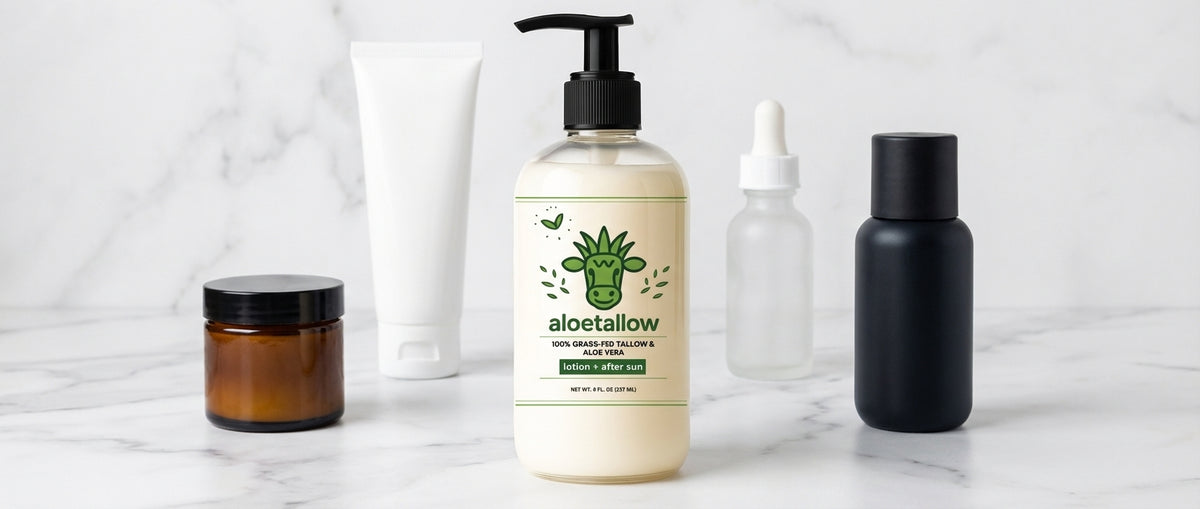
Aloetallow is a grass-fed tallow lotion built around one pairing that most tallow products don't include: tallow combined with aloe vera. The tallow provides the fatty acids — oleic, palmitic, stearic — that the skin uses to repair and reinforce its barrier. The aloe vera adds immediate hydration and a lightweight texture that helps it absorb without sitting on the surface. Eight ingredients total. No fragrance. No fillers. No water stretched with emulsifiers to bulk up the bottle.

8 ingredients. Grass-fed tallow + aloe vera. Nothing you can't pronounce.
The format matters here. Because it's a lotion and not a balm, it absorbs in a few minutes and leaves a finish that works for morning and midday use — on the face, the body, or both. That's not something most tallow balms can claim. It also has a specific use case that sets it apart from the others on this list: it works well applied after sun exposure. The aloe helps with the immediate cooling and hydration that sun-exposed skin needs, and the tallow helps rebuild what hours of UV exposure breaks down in the skin barrier. For anyone who spends time outdoors — at the beach, on a trail, at the pool — having a lotion that handles both roles is more practical than carrying two separate products.
The ingredient list is 8 items. That's the whole formula. If you want to know what's in it, you can read all of it in thirty seconds. Over 130 customers have reviewed it — most describe it as the first lotion that actually held up week after week, not just for the first two days after application.
Where it sits in the market: this is a daily-use product. If you want something for nighttime intensive repair or for cracked heels, a pure balm (see below) may be more potent. But if you want something you'll actually reach for every morning without thinking about it, this is the format built for that.
2. Pure tallow balm — Best for nighttime and severe dryness
A pure tallow balm — typically one to three ingredients, usually just rendered grass-fed tallow with maybe a small amount of beeswax or a single plant oil — is the most concentrated form of tallow you can put on skin. There's no water. There's no emulsifier. There's almost nothing between you and the fat. For severely dry or damaged skin, cracked heels, rough elbows, or skin that's been through something harsh (wind, cold, extended sun exposure), this is one of the most effective barrier tools available. The research on fatty acid delivery for impaired skin barriers supports the idea that higher-concentration lipid application does more structural repair than a diluted one. You can read more in our post on beef tallow for dry skin.
The trade-off is texture and timing. A pure tallow balm applied in the morning means 20 to 30 minutes of feeling like your skin is coated. It's not practical for face use unless you're applying it hours before you leave the house. It's also not fragrance-free in most small-batch versions — many makers add lavender or other essential oils, which matters if your skin is reactive. This is a nighttime product for most people, or a spot-treatment product for specific dry zones. It earns its place, but it's not a daily lotion replacement.
3. Scented whipped tallow blend — Best for sensory experience and gifting
Whipped tallow products are a specific subset of the market: tallow that's been beaten with air to give it a soft, mousse-like texture, often combined with a plant oil like jojoba or rosehip and scented with essential oils — lavender and citrus are the most common. The result is a product that feels luxurious to apply, smells good, and absorbs reasonably well. For people who want a spa-like sensory experience from their skincare, this format delivers it. As a gift, it reads as premium.
The honest caveat: the whipping process doesn't change the chemistry of the tallow — it changes the texture and the experience, not the barrier-repair function. And the added essential oils, while natural, are still fragrance compounds. For most people that's fine. But if your skin is reactive, sensitive, or prone to redness, lavender and citrus EOs are documented irritants at certain concentrations. This is a good product for someone who has generally stable skin and values the sensory side of skincare. It's not the right pick for someone dealing with an impaired barrier or sensitivity — fragrance-free is the safer call in that case.
4. Tallow face serum or facial-focused formula — Best for facial skin specifically
A smaller segment of the tallow market is face-specific: products formulated in small volumes (1-2 oz), often with a lighter carrier oil base — rosehip, sea buckthorn, or squalane — blended with a smaller concentration of tallow to reduce the heaviness on facial skin. These products tend to cost more per ounce and are designed to be layered into a skincare routine, not used as a full-body moisturizer. If you already have a facial skincare routine and want to add a tallow step without overhauling everything, this format integrates more easily.
Where it falls short: it's a face-only product by design, which means if you're also dealing with dry skin on your body, neck, or hands, you're buying a second product. Most of these serums are also too small and too expensive to use liberally, which limits how often people actually reach for them. If you want a tallow product you can use head to toe without rationing it, this isn't that. It's a targeted, face-first option for someone who wants precision over practicality.
5. Budget or starter tallow product — Best for first-timers
There's a category of tallow product built for entry-level buyers: smaller jar sizes (usually 2-4 oz), simpler formulations, and a lower price point that makes it easy to try without a real financial commitment. Some of these come from newer brands still figuring out their formula; some are private-label products with basic sourcing. The honest answer is that quality varies significantly in this tier. Some are genuinely good introductions to tallow skincare. Others have tallow so far down the ingredient list that you're essentially buying a conventional lotion with a tallow label.
If you've never used tallow and want to see whether your skin responds positively before committing to a full-size product, a starter option can be a reasonable first step. What to look for: grass-fed sourced (specified on the label), tallow in the first three ingredients, and an ingredient list short enough to verify. If those three things check out, the product is worth a trial run. If any of them are missing, you may end up deciding tallow doesn't work for you based on a product that was never really tallow-forward to begin with.
How to choose the right one for your skin
- You want a daily lotion for face and body, fragrance-free, practical for morning use: a tallow lotion with a short ingredient list and aloe vera is the right format.
- Your skin is severely dry, cracked, or you need intensive overnight repair: a pure tallow balm applied at night is the most concentrated option.
- You want a gift or a product with a sensory experience and you have stable, non-reactive skin: a scented whipped tallow blend fits that use case well.
- You already have a facial routine and want to add a tallow step without changing everything: a face-specific tallow serum integrates more easily, though it won't cover your body.
- You've never tried tallow and want a low-commitment way to test it: a starter product works — just check that tallow appears near the top of the ingredient list and that the sourcing is specified as grass-fed.
Frequently asked questions
Is tallow lotion safe for the face?
For most people, yes. Tallow's fatty acid profile is close to the natural lipids in human skin, which is why it tends to absorb well rather than sitting on top. The main concern people have is whether it will clog pores — the research on that is less alarming than the assumption. We covered it in detail in our post on does tallow clog pores. The short version: the comedogenicity scale is imprecise, and most people with normal to dry skin do fine. If you have acne-prone skin, starting with a small patch on the jaw or cheek for a week before full face use is the smart approach.
What's the difference between grass-fed and regular tallow in a lotion?
Grass-fed tallow has a higher concentration of CLA (conjugated linoleic acid) and fat-soluble vitamins A, D, E, and K compared to tallow from grain-finished animals. These aren't trace differences — the lipid profile of grass-fed fat is measurably different, and these are the compounds that most directly support skin barrier function and cell turnover. Grain-fed tallow isn't harmful, but it's a different product with a different nutritional profile. When a brand specifies grass-fed on the label, they're telling you something about sourcing quality. When they don't specify, that's a signal worth noting.
Can I use tallow lotion after being in the sun?
Yes, and for many people it's one of the better after-sun options available. Sun exposure depletes the skin's lipid barrier — extended UV exposure breaks down the structural fats that keep the skin sealed and protected. A tallow lotion applied after sun exposure helps replenish those lipids. If the formula also contains aloe vera, you get the immediate cooling and hydration aloe provides alongside the barrier-repair function of the tallow. That dual action is why some people find a tallow-aloe lotion more effective post-sun than either ingredient alone. Note: tallow is not a sunscreen and provides no SPF protection. It's a recovery product, not a preventive one.
The tallow lotion market has matured enough that there are genuinely good options across different formats and price points. The mistake most people make is picking based on the label rather than the formula. Once you know what you're looking for — the texture that fits your routine, the ingredient count that signals quality, whether you need fragrance-free — the right product usually becomes obvious. Most people who've struggled with conventional moisturizers find that the barrier-repair mechanism of tallow does something that humectants and film-formers can't. The format just needs to match how and when you actually use it.