You've tried salicylic acid. Benzoyl peroxide. Niacinamide serums. Maybe tretinoin. Your skin cleared up for a while, then it didn't. Or it cleared the acne but left your face dry, tight, and reactive -- trading one problem for another. At some point you started searching for something that actually works with your skin instead of stripping it down and hoping for the best. And somewhere in that search, you found beef tallow.
The question you're asking is fair: can something made from animal fat actually help acne-prone skin? Or is putting fat on breakout-prone skin the worst idea possible?
The honest answer is that it depends -- on your skin, on the tallow, and on what it's formulated with. Here's what the research says, what Reddit users actually report, and where aloe vera enters the picture.
What beef tallow actually does for skin
Beef tallow's composition is remarkably close to human sebum. A 2005 study in the International Journal of Cosmetic Science analyzed the lipid composition of healthy human skin and found it dominated by palmitic acid, oleic acid, and stearic acid -- the same three fatty acids that make up roughly 80% of beef tallow. That similarity is why tallow absorbs into skin more efficiently than most plant oils. Your skin recognizes it.
Here's the fatty acid breakdown that matters for acne:
- Oleic acid (~47%). A monounsaturated omega-9 fatty acid. It's an excellent emollient and penetration enhancer, meaning it carries other compounds deeper into the skin. But oleic acid is also the fatty acid most associated with comedogenicity. A 2009 study in the Journal of Investigative Dermatology found that oleic acid disrupted the skin barrier in some individuals and increased transepidermal water loss -- which can trigger compensatory sebum production in oily skin types.
- Palmitic acid (~26%). A saturated fatty acid that strengthens the skin barrier. It's a natural component of the stratum corneum's lipid matrix. Palmitic acid is generally well-tolerated and has a low comedogenic profile.
- Stearic acid (~14%). Another saturated fatty acid that reinforces barrier function. A 2018 study in the Journal of Lipid Research found that stearic acid supported ceramide production in keratinocytes -- the lipid molecules that form the structural backbone of a healthy skin barrier. Stearic acid rates 2 on the comedogenic scale, which is low.
- Conjugated linoleic acid (CLA). Present in higher concentrations in grass-fed tallow. CLA has documented anti-inflammatory properties. A 2003 study in the Journal of Investigative Dermatology found it reduced inflammatory markers in skin tissue models. This matters because acne is fundamentally an inflammatory condition.
Tallow also delivers fat-soluble vitamins A, E, and K -- all of which play documented roles in skin repair and barrier maintenance. For a deeper look at how these vitamins interact with skin biology, see the post on natural moisturizer ingredients and what the science backs.
The acne debate: why people get opposite results
If you spend any time on Reddit threads about beef tallow for acne, you'll notice a pattern. Roughly half of the people reporting say their skin cleared up -- fewer breakouts, less redness, better texture. About a third say they noticed no change. And around 20% report breakouts, clogged pores, or worsening acne.
That split isn't random. It reflects real differences in skin biology, tallow quality, and application method. Here's what determines which camp you fall into.
Your skin's oleic acid tolerance
Not everyone's skin responds to oleic acid the same way. A 2010 study in the British Journal of Dermatology found that acne-prone individuals had a different sebum composition than non-acne individuals -- specifically, a higher ratio of oleic acid to linoleic acid in their sebum. Their skin was already oleic-acid-heavy. Adding more oleic acid on top of that tipped the balance further, potentially increasing follicular plugging.
People with naturally dry or normal skin tend to tolerate oleic acid well. People with oily, acne-prone skin -- especially those whose sebum is already oleic-dominant -- are the ones most likely to break out from tallow or any oleic-acid-rich product.
The quality of the tallow
Not all tallow is the same product. Commercial tallow rendered at high temperatures from grain-fed cattle is a different substance than grass-fed tallow rendered slowly at low temperatures. The comedogenic rating of tallow -- commonly cited as 2-4 on the 0-5 scale -- varies precisely because of this difference.
High-temperature rendering oxidizes fatty acids, degrades fat-soluble vitamins, and produces compounds that are more likely to irritate skin and clog pores. Low-temperature rendering preserves the vitamin content, maintains the fatty acid integrity, and produces a cleaner, lighter product.
Grass-fed sourcing matters too. A 2009 study in the Journal of Animal Science found that grass-fed cattle had significantly higher concentrations of CLA and beta-carotene (a vitamin A precursor) in their fat compared to grain-fed cattle. More CLA means more anti-inflammatory activity. More beta-carotene means more retinol availability for skin cell turnover. Both of these factors work against acne formation.
What else is in the formula
Pure tallow on its own is a heavy, occlusive product. Applied straight to acne-prone skin, it sits on the surface longer and creates an environment where existing sebum and bacteria can be trapped. This is the most common cause of tallow-related breakouts: not the tallow itself, but the occlusion trapping what's already there.
What a tallow formula is paired with changes the equation significantly.
Why tallow plus aloe vera changes the equation
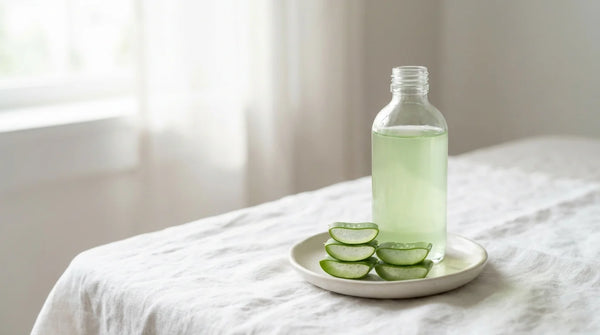
Aloe vera is one of the most studied anti-inflammatory botanicals in dermatology. Its relevance to acne isn't about moisturizing -- it's about directly counterbalancing the specific concerns that make tallow risky for breakout-prone skin.
Anti-inflammatory action. A 2008 review in the Skin Pharmacology and Physiology journal documented aloe vera's ability to inhibit cyclooxygenase and reduce prostaglandin E2 production -- two of the inflammatory pathways directly involved in acne lesion formation. Acne starts as inflammation around the hair follicle. Reducing that inflammation at the site of application is one of the most direct ways to prevent a clogged pore from becoming a visible breakout.
Antibacterial properties. A 2014 study in the Ethiopian Journal of Health Sciences found that aloe vera gel demonstrated antibacterial activity against several bacterial strains relevant to skin health. When tallow creates an occlusive layer, you want antibacterial support working underneath it -- not a free pass for bacteria to multiply in a sealed environment.
Non-comedogenic profile. Aloe vera gel rates 0 on the comedogenic scale. It doesn't clog pores. In a tallow-based formula, aloe vera lightens the texture, improves absorption speed, and reduces the heavy occlusion that causes problems for oily skin. Instead of tallow sitting on the surface trapping sebum, the aloe helps the formula integrate into the skin more quickly.
Skin barrier support without excess oil. Aloe vera contains polysaccharides (primarily acemannan) that support the skin barrier through a hydration mechanism rather than a lipid mechanism. A 2019 study in the International Journal of Biological Macromolecules found that acemannan promoted skin hydration and supported wound healing through mucopolysaccharide pathways. This means aloe provides barrier support that doesn't add more oil to already-oily skin.
The combination works because tallow handles the lipid replenishment and fat-soluble vitamin delivery, while aloe handles inflammation, bacterial control, and lightweight hydration. For acne-prone skin, that balance matters more than either ingredient alone. For more on how tallow and aloe work together, see beef tallow for skin.
Who should try tallow for acne (and who should patch test first)
Based on the research and the patterns people report, here's a practical breakdown.
Likely to see good results:
- People with dry or combination skin who get acne from a compromised skin barrier (over-exfoliation, over-cleansing, retinoid dryness). A 2020 study in the Journal of Clinical Medicine confirmed that barrier damage is an underrecognized driver of acne -- and tallow directly addresses barrier repair.
- People whose acne is primarily inflammatory (red, swollen bumps) rather than comedonal (blackheads, whiteheads). The anti-inflammatory properties of CLA and aloe vera target this acne type directly.
- People who react to synthetic ingredients, fragrances, or preservatives in conventional acne products. Fewer ingredients means fewer potential triggers.
Should patch test first:
- Anyone with oily skin, especially in the T-zone. The oleic acid content means you need to see how your specific skin responds before applying broadly.
- Anyone with a history of comedonal acne (primarily blackheads and closed comedones). This acne type is driven by follicular plugging, and oleic acid can contribute to that in susceptible individuals.
- Anyone currently using active acne treatments (retinoids, benzoyl peroxide, AHAs/BHAs). Introduce tallow on its own first so you can isolate its effects.
How to patch test: Apply a small amount to one side of your jawline or a small area on your cheek every night for 7-10 days. Your jawline is better than your forearm because facial skin has a higher density of sebaceous glands and responds differently than body skin. If you see no new breakouts after 10 days, expand to your full face. If you break out, it's not for you -- and that's useful information, not a failure.
The role of rendering quality in comedogenic rating
One of the most important nuances in the tallow-and-acne conversation is that the comedogenic rating of tallow isn't fixed. It depends on how the tallow was made.
The commonly cited range is 2-4 on the 0-5 comedogenic scale. That's a wide range, and the variation comes down to rendering. Tallow rendered at high temperatures from conventional cattle fat contains more oxidized lipids, more impurities, and a heavier molecular profile. This is the tallow that rates closer to 4. Grass-fed tallow rendered at low temperatures is cleaner, lighter, and retains more of its beneficial compounds. This tallow rates closer to 2.
For context, coconut oil rates 4. Shea butter rates 0-2. Olive oil rates 2. Argan oil rates 0. A comedogenic rating of 2 means "moderately low" likelihood of clogging pores -- not zero, but comparable to many well-tolerated skincare oils. For a direct comparison of tallow against other common skincare fats, see the post on whether tallow clogs pores.
It's also worth noting that the comedogenic scale itself has limitations. The original testing was done on rabbit ear skin, which is significantly more reactive than human facial skin. The scores provide a general guideline, but individual human responses vary enough that a product rated 2 may cause breakouts in one person and be perfectly fine for another.

8 ingredients. Grass-fed tallow + aloe vera. Nothing you can't pronounce.
Frequently asked questions
Will beef tallow make my acne worse?
It depends on your skin type and the tallow quality. If you have oily skin with comedonal acne (blackheads and whiteheads), pure tallow -- especially low-quality, high-temperature-rendered tallow -- can worsen breakouts due to its oleic acid content. If your acne is inflammatory and your skin is dry or damaged from harsh treatments, tallow's barrier-repair properties may actually reduce breakouts. The safest approach is a 10-day patch test on your jawline before full application.
Is beef tallow comedogenic?
Tallow rates 2-4 on the comedogenic scale, with the rating depending heavily on sourcing and rendering quality. Grass-fed, low-temperature-rendered tallow falls at the lower end of that range. Commercial tallow rendered at high temperatures rates higher. Formulation also matters -- tallow combined with non-comedogenic ingredients like aloe vera produces a lighter product that absorbs faster and is less likely to clog pores than straight tallow.
What makes grass-fed tallow different for acne-prone skin?
Grass-fed tallow has higher concentrations of CLA (an anti-inflammatory fatty acid) and beta-carotene (a vitamin A precursor that supports skin cell turnover). Both of these compounds actively work against acne formation. Grass-fed tallow also tends to be rendered at lower temperatures by small-batch producers, which preserves these beneficial compounds and produces a cleaner product with a lower comedogenic profile.
Can I use tallow on my face if I have oily skin?
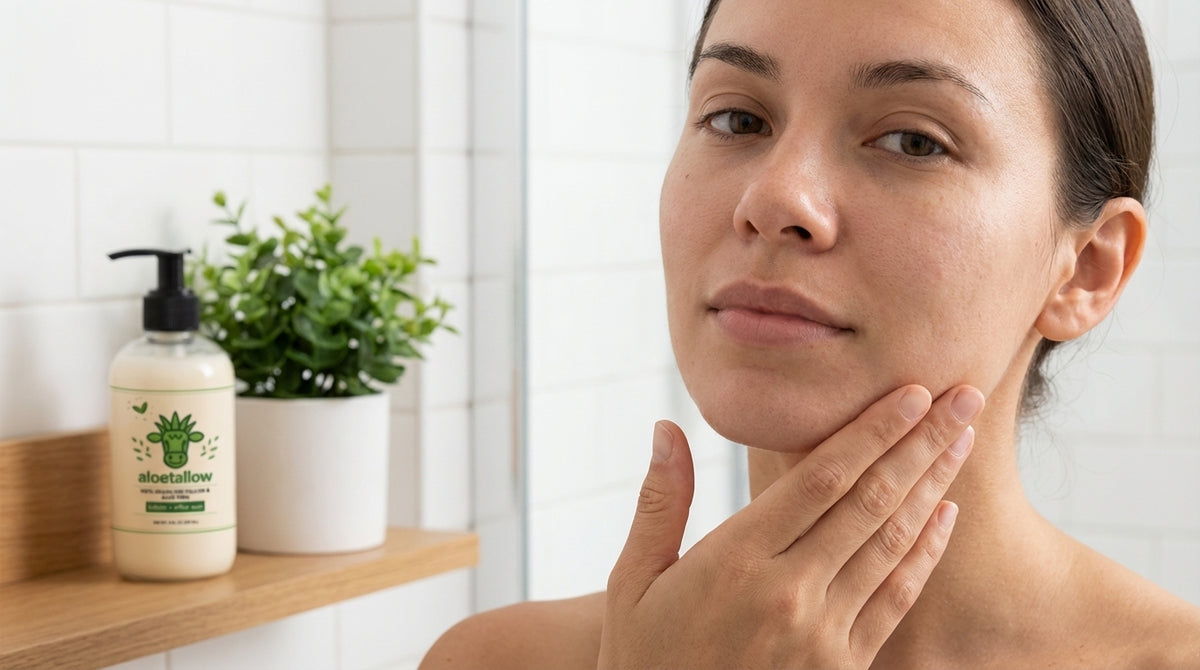
You can, but start small. Apply a thin layer to one area of your face for 7-10 days and monitor for breakouts. If you have oily skin, look for a tallow product that includes aloe vera or other non-comedogenic ingredients that lighten the formula -- straight tallow from a jar is the most likely to cause issues. A product like AloeTallow, which combines grass-fed tallow with aloe vera in a lotion format, absorbs lighter than pure tallow and provides anti-inflammatory support that pure tallow alone doesn't offer.
How long does it take to see results from tallow on acne-prone skin?
Most people who respond well to tallow notice changes within 2-4 weeks. Skin cell turnover takes roughly 28 days, so you need at least one full cycle to assess whether your skin is adapting well. Some people experience a brief purging phase in the first week (a few small breakouts as existing clogs come to the surface), followed by clearing. If breakouts are increasing after two weeks rather than decreasing, tallow may not be the right fit for your skin type.
The internet likes to frame beef tallow for acne as either a miracle or a disaster. The reality is more specific than that. Your skin type, the quality of the tallow, and what it's formulated with all determine the outcome. The research supports tallow as a legitimate barrier-repair ingredient with real anti-inflammatory potential -- but it's not universally tolerated by acne-prone skin, and pretending otherwise doesn't help anyone. Know your skin. Patch test. And pay attention to what your skin is actually telling you, not what a Reddit thread told someone else.