You've read enough ingredient labels to know that "natural" doesn't guarantee anything. You've bought the shea butter lotion that felt heavy and didn't absorb. You've tried the rosehip oil that broke you out. You've used the plant-based cream that your skin seemed to drink up for a week and then just -- stopped working. Finding natural moisturizer ingredients that actually deliver is harder than it should be, because the marketing language has outpaced the science. Most "natural" formulas are built on the same structural logic as conventional ones, just with different names on the label.
The honest answer is that some natural ingredients are genuinely backed by strong research. Others are riding trend momentum with thin evidence. And a few -- ones your grandmother probably used and the beauty industry quietly abandoned in the 1950s -- are returning to attention precisely because the alternatives didn't prove out over time. Here's what the research actually shows.
What the Science Says About Natural Moisturizer Ingredients
Effective moisturization requires at least one of three mechanisms: occlusion (forming a barrier that slows water loss from the skin's surface), humectancy (drawing water toward the skin), or barrier repair (delivering lipids that integrate into the stratum corneum's damaged "mortar"). The strongest natural moisturizer ingredients do at least two of these things simultaneously.
Aloe vera (Aloe barbadensis leaf gel) is one of the most studied plant-based skin compounds available. A 2019 review in the Journal of Dermatological Treatment summarized decades of research on its bioactive components: polysaccharides including acemannan that bind water and form a hydrating film on the skin surface, glucomannan that stimulates collagen synthesis through growth factor receptor interaction, and naturally occurring salicylic acid that gently exfoliates the surface to improve the skin's ability to absorb what you apply next. Aloe is a legitimate humectant with documented barrier-support activity -- not just a soothing agent. This same repair activity is why aloe is used in tattoo healing; if that applies to you, our complete guide on how long to use aloe vera on a new tattoo walks through the full recovery timeline.
Fatty acids from lipid-dense animal and plant sources represent another category with strong mechanistic research behind them. A 2017 analysis in Lipids in Health and Disease mapped the fatty acid profiles of common skin care fats against human sebum. The research showed that structural similarity between a topical fat and the skin's own lipid composition predicts how well that fat integrates into the stratum corneum versus simply sitting on the surface. Palmitic acid (~26% of human sebum), oleic acid (~47%), and stearic acid (~14%) are the primary structural fatty acids your skin barrier uses to maintain its lipid matrix.
Vitamin E (tocopherol) functions as a lipid-soluble antioxidant that protects the skin's lipid structures -- particularly important because polyunsaturated fatty acids in the stratum corneum are vulnerable to oxidative damage from UV exposure and environmental pollutants. A 1999 study in Free Radical Biology and Medicine confirmed topical vitamin E reduces lipid peroxidation in the stratum corneum and supports the cell membrane integrity that healthy hydration depends on. Critically, it works best when delivered within a fat matrix rather than as an isolated additive -- the context matters.
Hyaluronic acid is widely cited in natural skin care marketing, but the research picture is more complicated than the claims suggest. A 2021 review in Molecules noted that high-molecular-weight hyaluronic acid (the type most commonly used in cosmetics) does not penetrate the epidermis -- it sits on the surface and provides temporary plumping. Low-molecular-weight forms penetrate more deeply but require careful formulation to avoid triggering inflammation. As a humectant in a well-designed formula it's genuinely useful, but as a standalone hero ingredient it often underdelivers relative to the marketing.
Why Conventional Natural Products Still Fall Short
Read the ingredient list of a typical "natural" moisturizer sold at a health food store or clean beauty retailer. The structure is almost always the same:
- Water (Aqua) -- listed first, meaning it dominates the formula by volume. Water evaporates. When it does on already-compromised skin, it can accelerate transepidermal water loss (TEWL) rather than reduce it.
- Aloe vera juice -- often listed second or third, but in a water-diluted form that reduces the concentration of its active polysaccharides significantly below what clinical studies use.
- Plant-based emulsifiers (cetearyl glucoside, sodium stearoyl lactylate) -- needed to hold the water and oil phases together. Cleaner than their synthetic counterparts, but still surfactant compounds that can disrupt the skin barrier with frequent use.
- Botanical oils listed mid-formula -- jojoba, rosehip, squalane. These are the functional ingredients, but by the time you're reading them at position eight or nine, they're present in concentrations that may not be clinically meaningful.
- "Natural" fragrance or essential oils -- labeled as "natural" but not necessarily safe. A 2016 study in Contact Dermatitis identified essential oils, particularly lavender, citrus, and ylang-ylang, as among the most common causes of allergic contact dermatitis in cosmetic products.
The structural problem is the same one that affects conventional moisturizers: the formula is primarily water and emulsifier, with beneficial ingredients in supporting roles. A 2015 study in Skin Pharmacology and Physiology found that water-based moisturizers without adequate occlusion showed diminished TEWL improvement within four hours. The "natural" label doesn't change the underlying chemistry.
There's also the plant oil question. Many plant oils -- including popular ones like coconut oil -- contain high proportions of lauric acid and other short-chain fatty acids that don't match human sebum composition well. A 2020 review in the Journal of Investigative Dermatology noted that oleic acid-dominant plant oils (olive oil being the primary example) can actually disrupt the skin's lipid packing and impair barrier function in some individuals, despite being "natural." The structure of the fat matters more than its origin.
This is why the base fat in a moisturizer formula deserves more scrutiny than it typically gets -- even in conversations about natural ingredients.
Why the Base Fat Matters More Than the Active Ingredients
Your skin barrier's lipid structure -- the mortar between corneocytes in the stratum corneum -- is composed of ceramides, cholesterol, and free fatty acids. When you apply a moisturizer, the base fat either integrates into that structure or it doesn't. If it integrates, it provides structural repair and lasting hydration. If it doesn't, it provides surface-level occlusion that washes off and leaves the barrier unchanged.
This is where beef tallow enters the conversation -- not as a novelty ingredient, but as a fat whose composition maps unusually well onto human sebum.
Rendered tallow from grass-fed cattle contains:
- Palmitic acid (~26%) -- matches the most abundant saturated fatty acid in human skin lipids. Structural, barrier-stabilizing.
- Oleic acid (~47%) -- a monounsaturated fatty acid that increases the fluidity and permeability of the stratum corneum, helping other compounds penetrate while maintaining flexibility in the lipid bilayers.
- Stearic acid (~14%) -- a structural fatty acid critical to the ordered "mortar" packing between skin cells. Present in human sebum at similar concentrations.
- Palmitoleic acid (~3-4%) -- an antimicrobial fatty acid naturally found in sebum, declining with age. Associated with skin defense against pathogenic bacteria.
The 2017 Lipids in Health and Disease analysis found beef tallow to have the highest structural similarity to human subcutaneous fat among the animal and plant fats studied -- outperforming coconut oil, shea butter, jojoba, and olive oil on this measure. What this means practically: tallow's fatty acids don't just coat the surface. They're structurally compatible with the skin's existing lipid architecture in a way that supports genuine integration rather than accumulation.
Grass-fed tallow also delivers fat-soluble vitamins A, D, E, and K2 in their naturally occurring forms -- not synthetic isolates. Vitamin E (tocopherol) is present naturally within the fat matrix, which research suggests is the form most available for antioxidant activity in the stratum corneum.
The relevance to dry skin specifically: when your barrier is losing water faster than it can retain it, what you need isn't more water on the surface. You need a lipid layer that actually repairs the mortar so the bricks hold together. The fatty acid profile of tallow provides that repair material in a form your skin recognizes.
Why Tallow and Aloe Work Together
The combination matters because hydration has two sides. Occlusion (slowing water loss from above) and humectancy (drawing water toward the surface from below) work synergistically -- but only when both are present in a compatible formula. Tallow handles the occlusive side. Aloe handles the humectant side. But both do more than their primary role.
Tallow's fatty acids -- particularly the palmitoleic and palmitic acid fractions -- have documented anti-inflammatory properties. A 2011 review in Nutrients examined fatty acids and their role in inflammatory signaling, finding that saturated and monounsaturated fatty acids in the palmitic/oleic family modulate pro-inflammatory cytokine production. For skin that's dry, reactive, or sensitized, reducing the inflammatory load while simultaneously repairing the barrier accelerates recovery.
Aloe's acemannan polysaccharides form a light film that binds water against the skin surface -- complementing tallow's heavier lipid layer rather than competing with it. The acemannan also stimulates fibroblast activity (Journal of Ethnopharmacology, 2009), supporting collagen synthesis in the dermis beneath the barrier. And aloe's naturally occurring salicylic acid gently clears the surface layer, improving the penetration of the fatty acids above it.
The result is a formula where each ingredient makes the other one more effective. This is the pairing that dermatological research identifies as optimal for maintaining skin hydration: an occlusive with structural lipid compatibility, combined with a humectant that has its own repair-supporting activity.
It's also worth noting what the combination avoids. Formulas that rely on synthetic emulsifiers to hold water and oil together are introducing surfactant compounds to the skin with every application. Research by Zoe Diana Draelos, published in the Journal of Cosmetic Dermatology (2018), documented that common emulsifiers including sodium lauryl sulfate and polysorbate compounds can disrupt the skin's lipid bilayers with repeated exposure. A tallow-aloe formula that doesn't require synthetic emulsification avoids this entirely.
What to Look for in a Natural Moisturizer
If you're evaluating natural moisturizer ingredients based on what the research actually supports, here's a practical framework:
1. Start with the base fat, not the active ingredients
If the first ingredient is water, the formula is primarily water. Look for formulas where a functional fat -- one with a skin-compatible fatty acid profile -- is the foundation. The actives matter far less than the vehicle they're delivered in.
2. Check the fatty acid match
Palmitic acid, oleic acid, stearic acid. These are the structural building blocks of your skin barrier. The closer the base fat's composition matches these proportions, the more likely it is to integrate into your barrier rather than simply coating it. Tallow is the closest animal-source match. Among plant oils, jojoba (technically a wax ester) and marula oil have favorable profiles.
3. Verify the aloe concentration
Aloe vera water (aloe vera juice) is not the same as aloe vera gel. The polysaccharide concentration in aloe juice is significantly lower than in gel formulations. If the label says "aloe vera water" or "aloe barbadensis leaf juice," understand that you're getting a diluted form of the active compound.
4. Minimize emulsifiers
Even "natural" emulsifiers are surfactants. Every emulsifier-containing product is applying surfactant chemistry to the skin's surface. Shorter ingredient lists with fewer processing aids are associated with less barrier disruption -- especially for people with sensitive skin.
5. Avoid fragrance, natural or otherwise
"Natural fragrance" still represents undisclosed compounds. Essential oils -- commonly listed as natural alternatives to synthetic fragrance -- are among the most frequently identified contact allergens in cosmetics. A 2016 study in Contact Dermatitis found that fragrance was the leading cause of contact allergy in the European baseline series. Skip it unless you're certain your skin tolerates it.
6. Look for fat-soluble vitamins in context
Vitamin E is more effective as a skin antioxidant when delivered within a fat matrix than when isolated and added to a water-based formula. The same applies to vitamin A (retinol) and vitamin D. If fat-soluble vitamins appear in a water-dominant formula, their bioavailability in the stratum corneum is limited. The delivery vehicle matters as much as the nutrient itself.
The AloeTallow Formula
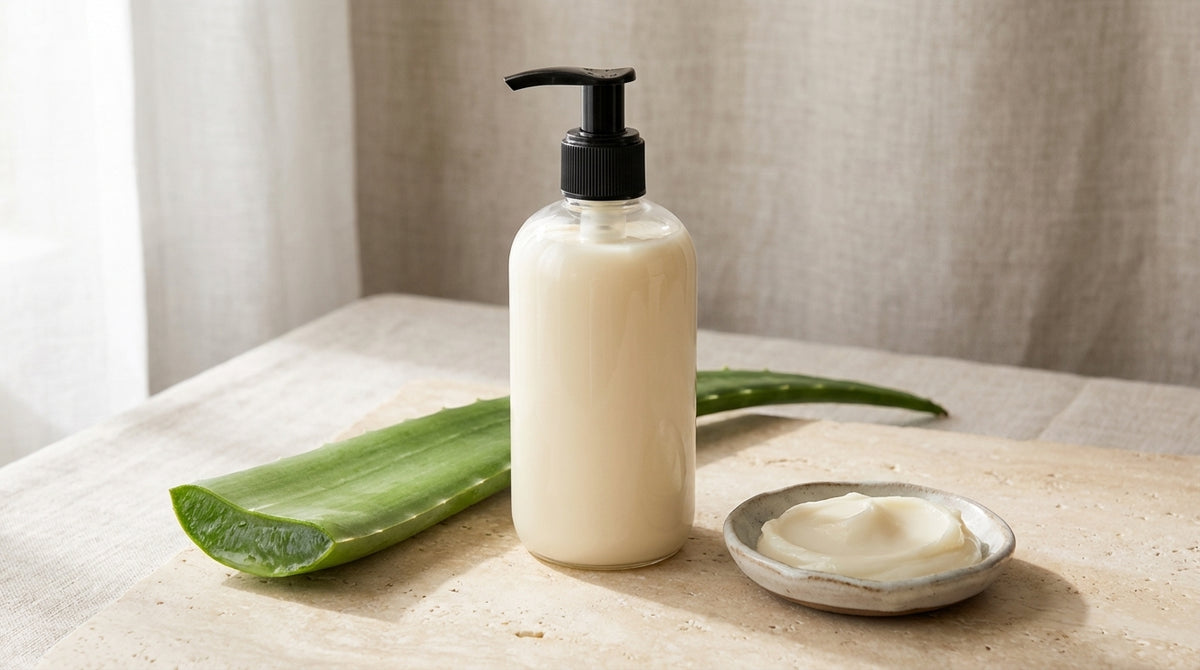
If you're looking for a formula built around what the research actually supports, Aloetallow is what we made: grass-fed beef tallow as the base -- delivering the full fatty acid profile your skin's barrier actually uses -- combined with aloe vera gel for humectant activity and cellular repair support. Eight ingredients total. No water filler, no synthetic emulsifiers, no fragrance. The formula doesn't rely on marketing language about "natural" actives. It relies on fatty acid chemistry and the structural compatibility research that most clean beauty products are still ignoring.

8 ingredients. Grass-fed tallow + aloe vera. Nothing you can't pronounce.
FAQ
What makes a natural moisturizer ingredient actually effective?
Effectiveness depends on the mechanism. An ingredient works if it occludes (slows transepidermal water loss), provides humectancy (draws water toward the skin surface), or delivers structurally compatible lipids that integrate into the skin barrier's lamellar matrix. Most natural ingredients do one of these. A few -- like tallow and aloe in combination -- address multiple mechanisms simultaneously. The key question is always: does this ingredient interact with my skin's biology in a way that produces a measurable improvement in water retention, or does it just feel like it does?
Is shea butter as effective as tallow for dry skin?
Shea butter has a reasonable fatty acid profile -- high in stearic and oleic acids -- and is genuinely useful as a moisturizer base. The research shows it provides good occlusion and some anti-inflammatory activity via triterpenoid compounds. Where it differs from tallow is in palmitic acid content (significantly lower in shea) and in the presence of palmitoleic acid, which shea doesn't contain. For most people shea butter is a solid choice. For people dealing with seriously compromised skin barriers, the closer sebum match of tallow may make a measurable difference.
Can natural ingredients actually repair the skin barrier, or just manage symptoms?
Some can actually repair it. The distinction is whether the ingredient provides structurally compatible lipids that integrate into the stratum corneum's lamellar matrix -- or just creates a surface layer that temporarily slows water loss. Research by Peter Elias at UCSF, published across several Journal of Clinical Investigation papers, showed that lipids structurally similar to the skin's native composition actively support barrier recovery, while dissimilar lipids (or water-dominant formulas) manage symptoms without structural repair. Tallow's high sebum-mimicry puts it in the repair category. Most water-based natural moisturizers, regardless of their active ingredient claims, remain in the symptom management category.
Is jojoba oil a good natural moisturizer ingredient?
Jojoba is technically a liquid wax ester rather than an oil, and it's genuinely interesting biochemically. Its molecular structure closely resembles the wax esters in human sebum, which gives it good skin compatibility and a low likelihood of comedogenicity. It's a useful ingredient, particularly as a lightweight carrier or in combination with heavier occlusive fats. It doesn't provide the full structural fatty acid profile that tallow does, but it's a legitimately well-researched natural ingredient. A 2019 review in Molecules confirmed its anti-inflammatory, wound-healing, and emollient properties in topical applications.
Why do some natural moisturizers stop working after a few weeks?
A few mechanisms can explain this. First, some moisturizers rely heavily on humectants without adequate occlusion -- they draw water to the skin surface initially, but if the barrier isn't repaired, that water continues to evaporate and the net effect diminishes over time. Second, your skin may be adapting to an ingredient that was providing temporary benefit without structural repair. Third, formulas with high water content and emulsifiers can gradually disrupt the barrier they're supposed to support. If a product works for a week and then seems to stop, the question to ask is whether it was ever actually repairing the barrier -- or just managing the symptoms of a barrier that's still broken. If it's the latter, moving to a lipid-first formula is worth trying.