Eczema is not a moisturizer problem. That's the part most skincare advice gets wrong. It's a skin barrier problem — a structural failure in the outermost layer of your skin that lets moisture escape and irritants in. Which means the relevant question isn't "is this moisturizer hydrating enough?" It's: "does this product give the skin what it needs to actually rebuild that barrier?" That's a different question. And it points to a very different category of ingredients.
What actually goes wrong with eczema skin
Your skin's outer layer — the stratum corneum — works like a brick wall. The "bricks" are dead skin cells (corneocytes), and the "mortar" holding them together is a precise mixture of lipids: ceramides, cholesterol, and free fatty acids. When that mortar is deficient or structurally abnormal, the wall leaks. Moisture escapes. Allergens and bacteria get in. The immune system responds. That cycle of inflammation and barrier damage is eczema.
The lipid abnormality in eczema skin is well documented. A 2013 study published in Acta Dermato-Venereologica found that atopic eczema patients have significantly altered ceramide composition in their stratum corneum — specifically, an increase in shorter-chain ceramides that disrupt the lipid organization and reduce barrier effectiveness. A 2014 study in the same journal identified that the chain length of free fatty acids in the stratum corneum matters directly: shorter-chain fatty acids disrupt barrier organization, while longer-chain fatty acids (like palmitic and stearic acid) are critical for maintaining the lamellar structure that keeps the barrier intact.
This is not a hydration problem. You can pile on humectants — hyaluronic acid, glycerin, aloe — and they will help temporarily. But if the underlying lipid architecture is compromised, you're filling a leaking bucket. The repair has to happen at the structural level.
Why conventional eczema products don't fix the barrier
Most prescribed and OTC eczema treatments are designed to manage symptoms, not rebuild the lipid barrier. That's an important distinction.
Topical corticosteroids reduce inflammation — they're effective for active flares, but they don't address the underlying lipid deficiency, and long-term use has real consequences: thinned skin, rebound flares, potential systemic effects in children. They're a tool for the acute phase, not a maintenance strategy.
Standard ceramide moisturizers (CeraVe, Eucerin Atopi-Control) attempt to replenish the ceramide deficit directly. A 2021 randomized trial in Dermatitis found that a ceramide-dominant moisturizer does improve skin permeability and reduce TEWL (transepidermal water loss) in adults with moderate eczema. This is real, and it works. But ceramide creams also come with PEG compounds, preservative systems, and often fragrance — all of which are among the most common sensitizers for eczema skin. The active ingredient works; the delivery vehicle often undermines it.
The people who cycle through every product on the market and still have reactive, broken skin often aren't failing to find the right active ingredient — they're reacting to something else in the formula. Fragrance alone, listed as a single word on the label, can contain dozens of synthetic compounds, many of them known sensitizers. The more complex the formula, the more opportunities for that kind of hidden irritant.
What tallow's fatty acid profile has to do with any of this
Grass-fed beef tallow is predominantly palmitic acid (~25-30%), stearic acid (~20%), and oleic acid (~40-50%). These are not random fats — they are three of the most abundant fatty acids in human sebum and the intercellular lipids of the stratum corneum.
The clinical relevance is starting to emerge. A 2024 study in the Journal of Investigative Dermatology (PMID 39113286) found that topically applied formulations containing palmitic and stearic acid can directly increase lipid production and transport into a tape-stripped (barrier-compromised) stratum corneum, measurably rebuilding the structural integrity of a damaged barrier. This is barrier repair, not management.
Grass-fed tallow also contains conjugated linoleic acid (CLA) — a fatty acid largely absent from grain-fed tallow and most plant oils. A 2021 study in Experimental Dermatology (Tang et al., PMID 33206422) found that topical CLA application significantly reduced atopic dermatitis-like lesions in an animal model — decreasing inflammatory markers (IL-6, IL-1β, TNF-α), normalizing skin pH, increasing hydration, and upregulating filaggrin, the skin barrier protein that is deficient in most eczema patients. It's not a human clinical trial. But the mechanism it's targeting — filaggrin deficiency and inflammatory cytokines — is the same mechanism implicated in human atopic dermatitis.
The honest framing is this: no study has put tallow on eczema skin in a randomized controlled trial. That gap exists. But the component science — what the skin barrier is missing in eczema, and what tallow's lipid profile contains — lines up in a way that isn't coincidental. It's structurally coherent.
The aloe component: why the combination matters for eczema specifically
Eczema skin isn't just lipid-deficient — it's also inflamed and often dehydrated at the surface level. Tallow addresses the lipid-structural side. But on its own, for sensitive, inflamed skin, it can feel heavy, and the occlusive nature of a pure tallow product can trap heat in already-irritated skin.
Aloe vera targets a different layer of the problem. Its primary active components — acemannan polysaccharides, beta-sitosterol, and salicylic acid-adjacent compounds — have documented anti-inflammatory and humectant properties. Acemannan in particular has been shown to support wound healing and reduce transepidermal water loss. The combination of a lipid-barrier rebuilder (tallow) with an anti-inflammatory, water-binding humectant (aloe) addresses both sides of the eczema equation: barrier repair and surface-level inflammation and dehydration.
Practical guidance: using tallow on eczema-prone skin
A few things worth knowing if you're considering this:
Apply to damp skin. Tallow is an occlusive — it seals in moisture more effectively than it adds moisture. Apply immediately after a shower or after dampening the skin with water. You'll get significantly better results than applying to completely dry skin.
Patch test first, always. Eczema skin is reactive by definition. Apply a small amount to the inside of the wrist or bend of the elbow for 48 hours. Don't change anything else in your routine during the same window — you need a clean variable.
Avoid formulas with added fragrance. Essential oils are among the most common eczema triggers. Even "natural" scents like lavender and tea tree oil are well-documented sensitizers for atopic skin. If a tallow product lists any fragrance, essential oil, or botanical extract you don't recognize, that's a reason to pause.
Give it 3-4 weeks. Eczema skin has a dysregulated barrier and immune response. Two or three applications is not enough data. The barrier repair that tallow's fatty acid profile supports is a slower, structural process — not the immediate surface-level effect you get from a heavy petrolatum product.
Don't stop your prescription treatments without talking to your doctor. Tallow is not a steroid replacement. It can complement a treatment plan — particularly as a maintenance moisturizer between flares — but if you're on a prescribed regimen, that conversation belongs with your dermatologist.
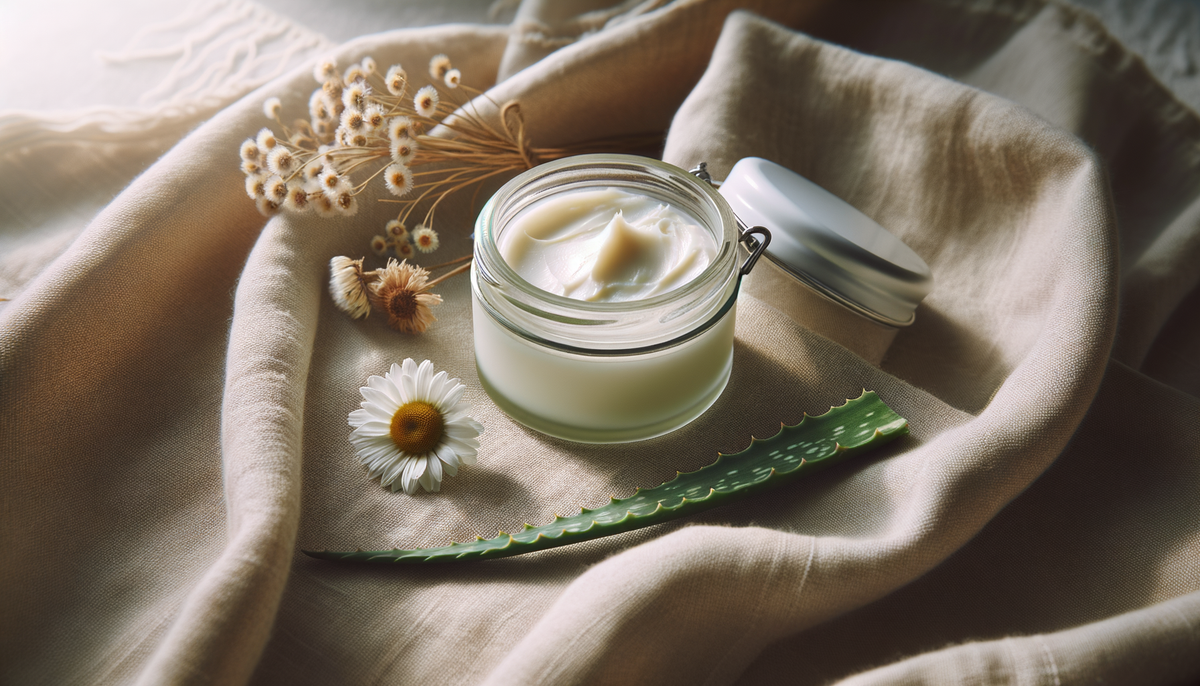
Aloetallow is grass-fed beef tallow combined with aloe vera — 8 ingredients, no fragrance, no fillers. We built it specifically for people whose skin is reactive and whose ingredient lists need to be short and legible. The tallow provides the long-chain fatty acids (palmitic, stearic, oleic, CLA) that map onto the structural deficit in compromised barrier skin. The aloe adds surface-level hydration and anti-inflammatory support. If you have eczema-prone skin and have been burned by "clean" products with long ingredient lists, this is worth trying.

8 ingredients. Grass-fed tallow + aloe vera. Nothing you can't pronounce.
Frequently asked questions
Is tallow safe to use on open or weeping eczema patches?
No. Occlusives of any kind — including tallow, petrolatum, and shea butter — should not be applied to broken or weeping skin. Apply to intact skin only. For actively broken-down or infected areas, see a dermatologist.
Will tallow make my eczema worse?
It depends on what's triggering your eczema. If your flares are triggered by fragrance or synthetic preservatives in conventional moisturizers, switching to a simple tallow formula (no added fragrance) often helps. If your eczema is driven by a food allergy or allergen exposure, no topical is going to fix the root cause. Patch test and give it enough time to be meaningful — at least 3 weeks.
Does tallow have the same fatty acids as skin?
Closely, yes. Grass-fed tallow is dominated by palmitic acid, stearic acid, and oleic acid — three fatty acids that are also dominant in human sebum and the intercellular lipids of the stratum corneum. No animal or plant fat is a perfect replica of human skin lipids, but grass-fed tallow's profile is structurally closer than most alternatives.
Can I use tallow if I'm on steroids for eczema?
Yes, as a complementary moisturizer — but use them at separate times. Apply tallow as a maintenance moisturizer; apply your prescription topical as directed by your doctor. Don't mix them in the same application. Always disclose new skincare additions to your dermatologist.
Why does my tallow product have a faint smell?
Tallow has a very faint, neutral scent that most people describe as barely noticeable. A quality tallow product should minimize this through careful rendering and formulation — not by adding fragrance to cover it. If a tallow product smells strongly of essential oils or artificial fragrance, that's a red flag for eczema-prone skin.
I've tried everything for my eczema and nothing works. Is tallow any different?
The honest answer is: maybe — but for a specific reason. If you've cycled through conventional moisturizers and prescription-managed flares and still have reactive, leaky, uncomfortable skin, the pattern that tallow addresses is a lipid-structural one that most conventional moisturizers don't target at that level. It's not a miracle and it's not a cure. But if the underlying issue is a barrier that isn't getting the structural building blocks it needs, it's a coherent thing to try.
Related Reading
Eczema is complicated. It has genetic, immune, and environmental drivers that no single product addresses. What tallow offers is a structurally sensible answer to one specific part of the problem — the lipid deficit — with a short ingredient list that minimizes the risk of adding a new trigger. For some people, that turns out to be the piece that was missing. For others, the problem runs deeper. Knowing the difference starts with understanding your own skin's patterns — when it flares, what precedes it, and what the flare looks like — not just reaching for the next product.