You're standing in the bathroom, rubbing lotion into your arms for the third time today, and your skin still feels tight by the time you're done drying your hands. You've tried the fancy department store brands. You've tried the dermatologist-recommended ones. You've tried the ones with ceramides and peptides and hyaluronic acid listed on the front like a chemistry exam. And you're still here, skin dry, a little frustrated, wondering what you're missing. That moment — that specific, low-grade, persistent frustration — is why a lot of people end up searching for something older. Something simpler. Something made from ingredients your skin actually recognizes.
Tallow lotion has been having a moment. And with that comes a flood of options, each one claiming to be the right one. Some of them are genuinely good. Some of them are grass-fed in name only. Some are balms disguised as lotions, which matters more than most product pages will tell you. This post is a straight look at what's actually on the market, how the options differ, and how to figure out which one is right for your skin — without the marketing noise.
What makes a tallow lotion actually work
The frustration you feel with conventional moisturizers isn't in your head. Most commercial lotions are built around water as the first ingredient, with emulsifiers and humectants to pull moisture in and film-forming agents to slow evaporation. The problem is that none of that addresses why dry skin happens in the first place — a weakened lipid barrier that can't hold moisture on its own.
Tallow works differently because its fatty acid profile — primarily oleic, palmitic, and stearic acids — closely mirrors the lipids found in healthy human skin. When the skin barrier is compromised, these are the building blocks it needs to repair itself. The research on fatty acid composition and barrier function is well-established: skin that's deficient in oleic and linoleic acids doesn't seal properly, and no amount of humectant will compensate for that long-term. You can read more about how this works in our post on beef tallow for skin.
So a tallow lotion works when it delivers those fatty acids in a form that absorbs without sitting on top of the skin like a grease layer — and when it doesn't dilute the tallow so heavily with water and filler that you're left with a product that's 10% tallow and 90% marketing.
What to look for (and what to ignore)
Before comparing specific products, here's how to read a tallow lotion the right way.
- Grass-fed vs. grain-fed tallow. This matters. Grass-fed tallow has a higher concentration of conjugated linoleic acid (CLA) and fat-soluble vitamins A, D, E, and K. Grain-fed tallow is cheaper to source and shows up in a lot of products that don't advertise the difference. If a product doesn't specify grass-fed, it's probably not.
- Ingredient count. Shorter is usually better, because every ingredient you add is another thing the skin has to process. A five-ingredient tallow lotion is typically more potent than a twenty-ingredient one. The longer the list, the more diluted the tallow tends to be.
- Balm vs. lotion texture. These are not the same thing. A balm is essentially pure or near-pure tallow with maybe one or two additional oils. It absorbs slowly, sits heavier, and works best for very dry or damaged skin, especially at night. A lotion is emulsified — tallow blended with water and an emulsifier — which makes it lighter, faster-absorbing, and more practical for daily use. Neither is better universally; it depends on your skin type and when you're applying it.
- Fragrance. A lot of tallow products add essential oils — lavender, eucalyptus, frankincense. For most people, that's fine. But if your skin is reactive, sensitive, or already compromised, added fragrance (even natural fragrance) can be an irritant. Unscented options exist and are worth seeking out if you're dealing with sensitivity.
- What to ignore: "Whipped" as a quality signal — it's a texture preference, not a formulation upgrade. "Pure" without any specifics on sourcing. Vague claims about "ancestral" or "traditional" skincare without actual ingredient transparency.
How the main tallow products on the market compare
Here's an honest look at the four main categories you'll find when shopping for tallow-based skincare. This isn't a brand war — it's a breakdown by formulation type so you can match the product to what you actually need.
1. Pure tallow balms (1-3 ingredients)
These are the most minimal option: rendered beef tallow, sometimes with a small amount of beeswax or a single oil like jojoba. They are the most potent form of tallow you can put on your skin, and also the most demanding. Balms absorb slowly, can leave the skin feeling coated for 20-30 minutes after application, and work best applied at night or after a shower when your skin has time to absorb. For severely dry skin, cracked heels, or beef tallow for dry skin in harsh winter conditions, balms are often the most effective tool. The trade-off: they're not practical for most people as a daily face or body lotion.
2. Grass-fed tallow lotions (5-10 ingredients)
This is the middle ground, and it's where most of the meaningful variation exists in the market. A well-formulated tallow lotion blends grass-fed tallow with water and a few supporting ingredients — typically an emulsifier to keep it stable, maybe a humectant like aloe vera to help it absorb, and little else. When the ingredient list stays short and the tallow stays high on the list, this format gives you most of the barrier-repair benefit of a balm with a texture that actually works for morning use. The honest answer is that ingredient count is the best proxy for quality here: a ten-ingredient tallow lotion with tallow near the top is almost always better than a fifteen-ingredient one where tallow is eighth on the list.
3. Scented tallow products (added essential oils)
Many tallow brands add lavender, rose, frankincense, or citrus oils. For most people this is a non-issue and can make the product more pleasant to use. But the research shows that essential oils — even naturally derived ones — can be irritating for compromised or reactive skin, particularly if you're dealing with barrier damage or something like tallow for eczema. If your skin is in rough shape, start with unscented and add fragrance later once the barrier is repaired.
4. Grain-fed or commodity tallow products
These exist, and they're often significantly cheaper. The tallow is real, but the fatty acid profile is different — lower in CLA, lower in fat-soluble vitamins, and generally sourced from conventional feedlot cattle. If budget is the primary concern, a grain-fed tallow product is still going to outperform most petroleum-based lotions. But if you're switching to tallow specifically because you want the nutritional density of the fat, grain-fed is a meaningful step down from grass-fed.
Who each type is best for
- Pure balms — Very dry or damaged skin, nighttime use, cracked heels, targeted spot treatment. Not ideal as a daily face lotion for most skin types.
- Grass-fed tallow lotions — Most people. Works for face and body, morning or night, practical enough for daily use. This is the format that gives you the most flexibility.
- Scented tallow products — People with normal-to-dry skin who want a more sensory experience. Avoid if your skin is currently reactive or compromised.
- Grain-fed products — Budget-conscious shoppers who want to try tallow without committing to the premium price point. Understand you're getting a different formulation than grass-fed.
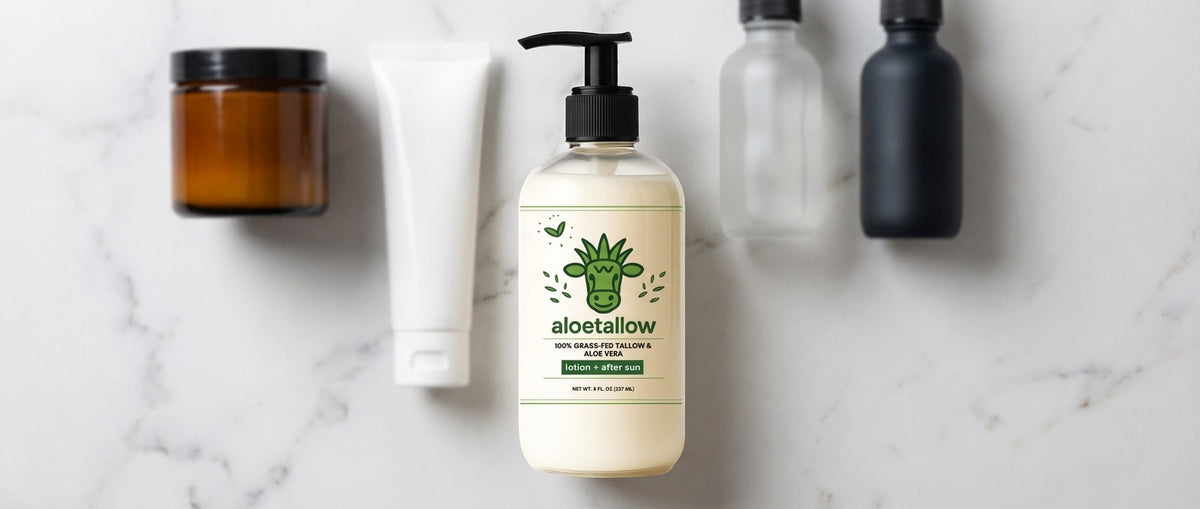
If you're looking for a grass-fed tallow lotion with a short ingredient list and no fragrance, Aloetallow is worth a look. It's grass-fed tallow combined with aloe vera, kept to eight ingredients total, and formulated without fragrance, dyes, or filler. The aloe helps with absorption so it doesn't sit heavy, and the tallow stays high enough on the ingredient list that you're getting the actual barrier-repair benefit rather than a diluted gesture at it. It's not trying to be anything other than what it is — a clean, straightforward lotion built around ingredients that make sense for the skin.

8 ingredients. Grass-fed tallow + aloe vera. Nothing you can't pronounce.
Frequently asked questions
Is tallow lotion safe to use on your face?
For most people, yes. The fatty acid profile of tallow is close to human sebum, which means it's generally well-tolerated even on facial skin. The common concern is that it will clog pores — the research on this is covered in detail in our post on does tallow clog pores. The short version: comedogenicity ratings are more complicated than a single number, and most people who try tallow on their face do not experience breakouts. If your skin is oily or acne-prone, start with a small amount on a patch of skin before going all-in.
How is a tallow lotion different from a tallow balm?
A balm is essentially pure or near-pure tallow — very heavy, absorbs slowly, best for targeted use or nighttime application. A lotion is emulsified, meaning water has been blended in, which makes the texture lighter and more practical for daily use. Balms are more potent but less wearable. Lotions are easier to use consistently, which matters more for long-term skin health than any single potent application.
Does the quality of the tallow (grass-fed vs. grain-fed) actually matter for skin?
The honest answer is yes, though the research specifically on topical application is thinner than the research on dietary consumption. Grass-fed tallow has a measurably different fatty acid profile — more CLA, more fat-soluble vitamins — compared to grain-fed. Whether that difference shows up in a meaningful way on your skin depends on how much of the tallow is actually in the product and how compromised your barrier is to begin with. For a product you're putting on your skin daily, sourcing transparency matters. If a brand doesn't tell you where their tallow comes from, that's worth noting.
Can you use tallow lotion if you have sensitive skin?
Generally yes, and often with better results than conventional lotions that rely on synthetic emollients and preservatives. The caveat is fragrance: if you have reactive or sensitive skin, choose an unscented option and avoid products with added essential oils until your barrier is stronger. Start slow — a small amount on one area — and give it a few days before applying widely.
The tallow lotion market is still small enough that quality varies a lot more than in conventional skincare. The things worth paying attention to are sourcing (grass-fed matters), ingredient count (shorter means more tallow, less filler), texture format (balm vs. lotion is a real difference, not just marketing), and fragrance (a personal call unless your skin is reactive). Everything else on most product pages is noise. Find a product that's transparent about those four things and you're most of the way there.