You've done the research. You know that beef tallow's fatty acid profile closely mirrors human sebum -- that it delivers palmitic acid, oleic acid, stearic acid, and fat-soluble vitamins directly to your skin's lipid barrier. The science checks out. But here's the part most people skip: how you apply tallow matters as much as the tallow itself.
Get the technique wrong and you end up with a greasy film that sits on top of your skin doing very little. Get it right and those fatty acids integrate into your barrier, lock in hydration, and deliver their nutrients where they actually make a difference. This guide covers everything -- timing, technique, face versus body, layering with other products, and the mistakes that quietly sabotage results.
Why application method matters with tallow
Tallow is a lipid-heavy moisturizer. Unlike water-based lotions that rely on humectants to pull moisture from the air (or from deeper skin layers), tallow works primarily as an emollient and occlusive. It fills in gaps between corneocytes, softens the stratum corneum, and creates a breathable lipid layer that reduces transepidermal water loss (TEWL).
That mechanism has a prerequisite: there needs to be moisture in your skin for the tallow to seal in. If you apply tallow to completely dry skin, you get occlusion over dehydration -- a barrier that traps nothing useful. The application timing and preparation steps below exist because of this basic principle. Tallow doesn't generate moisture. It preserves and protects the moisture that's already there.
For the foundational science on how tallow interacts with your skin barrier, the post on beef tallow for skin covers the fatty acid profile, sebum similarity, and barrier repair research in detail.
Step 1: Start with damp skin (the soak-and-seal method)
The single most important application rule for any tallow-based moisturizer is this: apply to damp skin. Not wet, not dry -- damp. This is a variation of what dermatologists call the "soak and seal" method, and it's backed by research on barrier repair.
A 2009 study in the Journal of Allergy and Clinical Immunology demonstrated that applying an occlusive moisturizer within 3 minutes of bathing significantly improved skin hydration and barrier function compared to delayed application. The reason is straightforward: bathing hydrates the stratum corneum by saturating it with water. An occlusive applied immediately afterward traps that water in the tissue before it evaporates.
How to do it:
- Shower or wash your face as normal.
- Pat skin with a towel until it's damp -- not dripping, not bone dry. You should feel slight moisture on the surface.
- Apply your tallow moisturizer within 2-3 minutes of patting dry.
- The tallow's lipid layer seals over the hydrated stratum corneum, and the water stays put.
This alone makes a bigger difference than any other technique adjustment. If you've been applying tallow to dry skin and wondering why it feels heavy or sits on the surface, this is your fix.
Step 2: Use the right amount
Tallow is concentrated. A little goes further than you'd expect, and using too much is the second most common mistake after applying to dry skin.
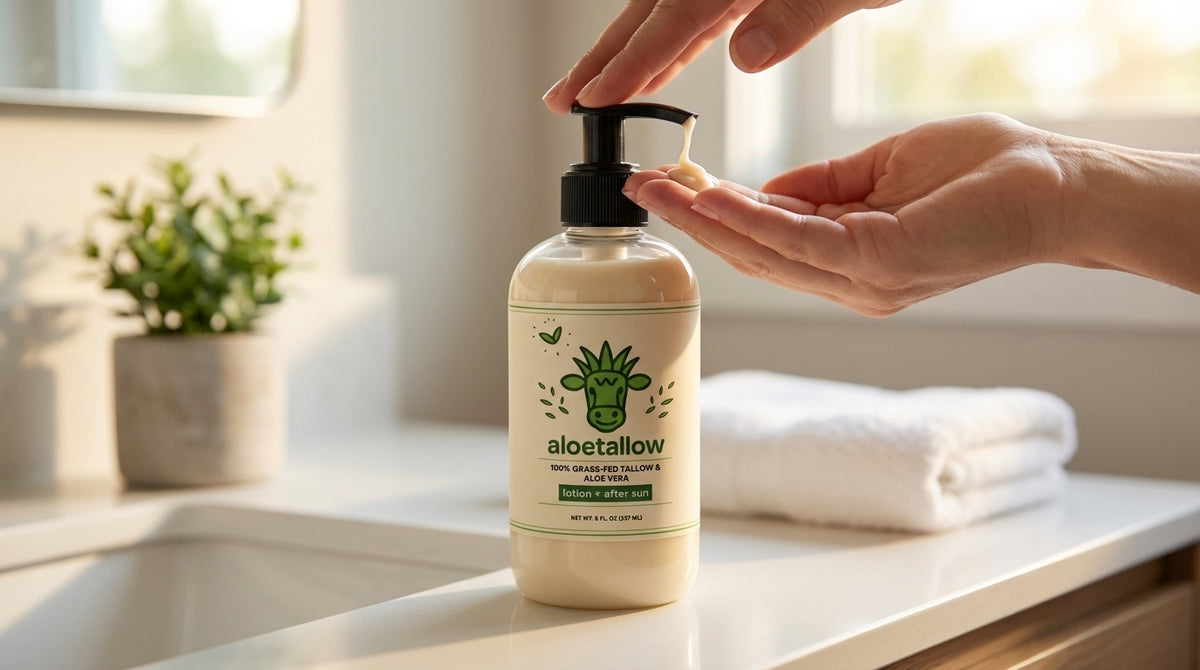
For your face: Start with a pea-sized amount -- roughly the size of a small blueberry. Warm it between your fingertips for 5-10 seconds. This brings the tallow closer to skin temperature and improves spreadability. A pump-bottle format makes dosing easy since one press typically delivers the right amount for a full face application. Apply in gentle upward strokes across forehead, cheeks, nose, and chin. If your skin absorbs it quickly and still feels tight, add a second thin layer.
For your body: Use about the size of a nickel per limb or body section. Arms, legs, torso, and back each get their own portion. Rub between palms first, then apply in long smooth strokes. Focus extra attention on areas prone to dryness: shins, elbows, hands, and feet.
The goal is a thin, even layer -- not a thick coat. Tallow integrates with your skin's lipid matrix best when applied as a thin film. A thick application just extends the absorption time without improving results.
Step 3: Face versus body -- adjust your technique
Facial skin and body skin are structurally different, and your application technique should reflect that.
Face. Facial skin is thinner, has more sebaceous glands, and is more sensitive to occlusion. Apply with your fingertips using light pressing motions rather than rubbing or dragging. Work from the center of your face outward. Avoid pulling the skin, especially around the eyes and mouth where skin is thinnest. If you have an oily T-zone, you can skip the forehead and nose entirely and apply only to the drier areas -- cheeks, jawline, and under-eye area.
For a deeper look at using tallow specifically on the face -- including what the research says about pore size, comedogenicity, and sebum regulation -- see is tallow good for your face.
Body. Body skin is thicker, dries out faster (fewer sebaceous glands per square centimeter), and can handle more product. Apply with your palms using broad, sweeping motions. Pay attention to transition zones -- wrists, ankles, knees, elbows -- where skin folds and loses moisture faster. These areas benefit from a slightly thicker application.
Hands and feet. These get the heaviest use of any skin on your body. Apply a generous amount and, if possible, wear cotton gloves or socks for 20-30 minutes afterward. The occlusion drives the fatty acids deeper into the thickened skin of palms and soles. This is especially effective as a nighttime routine.
Step 4: Morning versus night routines
When you apply tallow shapes what it does for your skin.
Morning application. The goal is protection. Your skin is about to face UV exposure, pollution, wind, temperature changes, and whatever your environment throws at it. A thin layer of tallow in the morning creates a protective lipid barrier that reduces TEWL throughout the day and provides a base layer of antioxidant vitamins (A and E) that help neutralize free radical damage from UV and pollution.
Keep the morning layer thin. You want it to absorb fully within 5-10 minutes so it doesn't interfere with sunscreen application (always apply sunscreen as your last step before makeup or heading outside). If you're wearing makeup, let the tallow absorb for 10 minutes before applying anything over it.
Night application. The goal is repair. Skin's cell turnover and repair processes peak during sleep -- a 2019 review in the International Journal of Molecular Sciences confirmed that transepidermal water loss increases overnight and barrier recovery is most active between 11pm and 4am. A slightly more generous tallow application at night supports these processes by maintaining hydration during the repair window and delivering vitamins A and E when your skin is most metabolically active.
Night is also when you can use the soak-and-seal method most effectively. Shower, pat damp, apply tallow, go to bed. Eight hours of occlusive contact with hydrated skin is the ideal scenario for barrier repair.
Layering tallow with other products
Tallow doesn't have to be your only skincare product. It layers well with other products if you follow the thin-to-thick rule: apply products from thinnest consistency to thickest.
A practical layering order:
- Cleanser (wash off) -- gentle, non-stripping.
- Toner or hydrating mist (optional) -- adds a water layer for tallow to seal over.
- Serum (optional) -- vitamin C, niacinamide, hyaluronic acid. Apply while skin is still damp from toner.
- Tallow moisturizer -- seals everything underneath. This is your occlusive layer.
- Sunscreen (morning only) -- always the last step before UV exposure.
One note on hyaluronic acid: it's a humectant that pulls water into the stratum corneum. Applying it under tallow is an excellent combination -- the hyaluronic acid hydrates, and the tallow seals that hydration in place. Without an occlusive over it, hyaluronic acid in dry environments can actually pull water out of your skin. Tallow prevents that.
Common mistakes that reduce results
Most people who try tallow and feel underwhelmed are making one or more of these errors. Each one has a straightforward fix.
Applying to dry skin. Already covered above, but it bears repeating because it's the most common mistake. Tallow on dry skin creates a seal over dehydration. Always apply to damp skin or over a hydrating layer.
Using too much. A thick layer takes longer to absorb, feels greasy, transfers to clothing and pillowcases, and doesn't improve results. Thin layers integrate with your lipid barrier. Thick layers sit on top of it. Start with less than you think you need.
Skipping it when skin feels oily. This is counterintuitive, but oily skin often benefits from tallow application. Excess sebum production is frequently a compensatory response to barrier dehydration -- your skin overproduces oil because it's trying to replace the lipids it's missing. Providing those lipids externally (especially ones that match sebum's composition) can normalize production over time. A 2014 study in the Journal of Clinical and Aesthetic Dermatology found that barrier repair reduced sebum production in subjects with oily, dehydrated skin.
Not giving it time to absorb before the next step. If you're layering sunscreen or makeup over tallow, wait 5-10 minutes. Tallow needs time to integrate with the stratum corneum. Applying products over it too quickly can pill or create an uneven base.
Storing it in direct heat or sunlight. Tallow contains unsaturated fatty acids and fat-soluble vitamins that degrade with heat and light exposure. Store your product at room temperature, out of direct sunlight. If it's exposed to sustained high heat (like a car dashboard in summer), the fatty acids can oxidize, reducing effectiveness and potentially causing irritation.
The post on beef tallow for dry skin explains why conventional moisturizers often fail at barrier repair and how tallow's approach differs structurally -- useful context for understanding why these application techniques produce better results than what you may be used to with standard lotions.
Building a tallow routine: starter schedule
If you're new to tallow, don't overhaul your entire routine on day one. Introduce it gradually.
Week 1: Use tallow once daily, at night, after showering. Damp skin, thin layer. This lets your skin adjust to a lipid-forward moisturizer without interference from other products or sun exposure variables.
Week 2: Add a morning application. Keep it thin. Layer sunscreen over it after 5-10 minutes of absorption time.
Week 3 and beyond: Adjust based on what your skin tells you. If your skin absorbs the product quickly and feels comfortable, you've found your amount. If it still feels slightly tacky after 15 minutes, you're using too much. If your skin feels tight by midday, try a slightly more generous morning application or add a hydrating mist underneath.
Most people find their ideal routine within 2-3 weeks. The adjustment period exists because tallow's lipid delivery is different from what your skin is used to if you've been using water-and-silicone-based products. Your barrier recalibrates.
The Aloetallow approach
Aloetallow is formulated with 100% grass-fed beef tallow and aloe vera -- 8 total ingredients, no seed oils, no fragrance, no fillers. The aloe vera base provides a built-in hydrating layer, which means the soak-and-seal effect is partially handled by the formula itself. You still get the best results on damp skin, but the aloe component adds water-binding capacity that pure tallow products lack.

8 ingredients. Grass-fed tallow + aloe vera. Nothing you can't pronounce.
Follow the techniques above and you'll get the most out of every application -- whether you're using it on your face, your body, or both.
Frequently asked questions
Can I use beef tallow on my face every day?
Yes. Tallow's fatty acid profile is structurally similar to human sebum, which means facial skin recognizes and integrates it readily. Daily use supports consistent barrier maintenance. Start with once daily (at night) for the first week, then add a morning application if your skin responds well. If you have very oily skin, start with every other day and adjust based on how your skin feels.
How long does it take for tallow to absorb into skin?
A properly thin application on damp skin typically absorbs within 5-15 minutes, depending on your skin type and environmental humidity. Dry skin absorbs it faster because the barrier is actively pulling in lipids. If it's still sitting on the surface after 20 minutes, you've applied too much. Blot the excess gently with a tissue and use less next time.
Should I apply tallow before or after other serums?
After. Tallow is an occlusive -- it creates a lipid seal over your skin. Any water-based serums (vitamin C, niacinamide, hyaluronic acid) should go on first so the tallow locks them in. Applying a water-based serum over tallow reduces its penetration because the lipid layer blocks absorption. Think of tallow as the final seal, not the first layer.
Will beef tallow stain my pillowcase or clothes?
If you apply too much, yes. A thin layer that's fully absorbed before bed won't transfer. The absorption test is simple: touch your skin after 10-15 minutes. If it feels soft but not slick, you're good. If it feels oily or leaves a shine on your fingers, you've over-applied. Blot the excess before getting into bed. Over time, you'll dial in the right amount instinctively.
Is there a difference between using raw tallow and a tallow-based lotion?
Yes. Raw rendered tallow is 100% fat -- no water component, no emulsifiers. It's effective but can feel heavy and waxy, especially in cooler temperatures. A tallow-based lotion combines tallow with water-binding ingredients (like aloe vera) that improve spreadability, add a hydrating component, and create a lighter texture. The fatty acid delivery is similar, but the experience and ease of application differ significantly. A well-formulated tallow lotion gives you the lipid benefits without the heaviness of raw tallow.
The best application technique in the world can't compensate for a poorly formulated product. But a well-sourced, well-formulated tallow moisturizer applied with the right method -- damp skin, thin layers, consistent timing -- is one of the most effective barrier repair strategies you can build into a daily routine. Start simple, adjust based on results, and let your skin tell you what it needs.