You've been told to keep heavy oils off your face your whole life. Moisturizer for your body, something lighter for your face -- that's the standard advice. So when tallow starts showing up in skincare conversations, the instinct to stop it at the jawline makes sense. You can see how a beef fat might behave differently on the thinner, more reactive skin of your face than it does on your arms or legs. That instinct isn't unreasonable. It's just not fully supported by the evidence.
What the science says about comedogenicity
Comedogenicity -- the tendency of an ingredient to clog pores and trigger acne-like breakouts -- is the central concern when people ask whether tallow is appropriate for facial use. And the research on this question is more complicated than the ingredient rating systems suggest.
The comedogenic rating scale most often cited in skincare was developed using the rabbit ear model: a 1972 methodology in which test substances are applied to the inner ear of a rabbit and scored for follicular plugging. The problem is that rabbit ear skin is significantly more sensitive to comedogenic compounds than human facial skin. It was designed to detect the comedogenic potential of ingredients, not to predict real-world outcomes on human faces. A 1989 study in the Journal of the American Academy of Dermatology found that many ingredients rated as comedogenic by the rabbit ear model did not produce comedones when tested on human subjects -- and the correlation between the two was poor.
A 1996 review in Dermatology concluded that the comedogenic scale derived from animal models "has little predictive value for the development of acne in patients." The scale persists because it's simple to cite. It doesn't persist because it's reliable.
Tallow's comedogenic rating -- where it even appears on such scales -- varies widely depending on the source, which itself reflects how inconsistently these ratings translate to human skin. The honest answer is: the animal-model comedogenicity data doesn't tell you much about whether tallow will clog your pores specifically. What tells you more is understanding the composition of tallow relative to what your facial skin already produces.
For a broader look at the comedogenicity question across skin types, the post on does tallow clog pores covers the rabbit ear study and its limitations in more depth.
Why conventional facial products often fall short
The conventional skincare market has a tension built into it: facial products need to feel lightweight and absorb quickly (because that's what sells), but barrier repair requires heavier lipid compounds that don't absorb quickly. The result is that most facial moisturizers optimize for texture at the expense of function.
Silicones -- dimethicone, cyclopentasiloxane, phenyl trimethicone -- are the most commonly used ingredients to create the smooth, fast-absorbing feel of a "non-greasy" facial moisturizer. They form a film on the skin surface that reduces friction and temporarily improves appearance. But silicones are inert. They don't deliver any lipid compounds your skin can use. They don't integrate with the barrier. They coat.
Light plant oils -- jojoba, rosehip, squalane -- are more biologically relevant than silicones, but their fatty acid profiles are quite different from human sebum. Jojoba is primarily wax esters. Rosehip is high in linoleic acid. These are useful ingredients, but they're not close matches to what your facial skin actually secretes. A 2018 review in the International Journal of Molecular Sciences noted that topical lipids with fatty acid profiles closer to endogenous sebum showed superior barrier integration compared to plant oils with dissimilar profiles.
The facial skincare category has also largely abandoned occlusives in favor of lightweight formulas, which means most people's faces are under-protected relative to what their barrier actually needs -- especially in dry climates, air conditioning, and winter. The shift toward "non-comedogenic" labeling pushed brands toward lighter ingredients, but "non-comedogenic" is a marketing claim with no regulatory definition, and the lighter the formula, the less barrier repair it typically provides.
Why tallow's fatty acid profile matters specifically for facial skin
Your face is covered in sebaceous glands -- more than any other area of your body. Those glands produce sebum: a complex mixture of triglycerides, wax esters, free fatty acids, squalene, and cholesterol. The composition of sebum is one reason your face responds differently to topical ingredients than the rest of your body does -- it already has its own lipid management system running, and what you put on top of it either integrates with that system or disrupts it.
Beef tallow from grass-fed animals has a fatty acid profile that sits unusually close to human sebum: roughly 26% palmitic acid, 47% oleic acid, and 14% stearic acid. Human sebum contains palmitic and oleic acid as its dominant fatty acids as well. The similarity isn't incidental. Both are mammalian fats, both optimized by biological selection for similar purposes -- protecting and sealing skin against environmental exposure.
This compositional similarity has a practical implication: tallow-based products are less likely to disrupt sebum production than ingredients that signal unfamiliar lipids to the skin. There's evidence that applying lipids highly dissimilar to endogenous sebum can suppress natural sebum secretion or trigger rebound oiliness -- effects that are well-documented with some synthetic and plant-based oils. Tallow's profile doesn't create that compositional mismatch.
A 2010 study in the Journal of Lipid Research examined how the fatty acid composition of topical products influenced lamellar body secretion in the stratum corneum -- the mechanism by which your skin actually rebuilds its barrier. Lipids structurally similar to endogenous skin lipids were more effectively incorporated into the lamellar structure than dissimilar ones. Tallow's saturated fatty acid content -- dominated by palmitic and stearic -- maps closely to the composition of ceramide precursors your skin synthesizes naturally.
Understanding how this plays out for barrier repair more broadly is covered in the post on barrier cream and what structural integration actually means.
Facial skin vs. body skin -- what's actually different
Facial skin is thinner than body skin on average -- roughly 0.5-2mm dermis thickness compared to 2-3mm on the trunk and limbs. It has a higher density of sebaceous glands and a more active immune response. It turns over faster. It's more reactive to many ingredients because the barrier is thinner and penetration is faster.
None of these differences make tallow categorically wrong for facial use. They do mean a few things in practice.
First, if your skin is very oily or actively acne-prone, any heavy occlusive can be a risk -- not because it's toxic or intrinsically pore-clogging, but because adding more lipid to skin that's already producing excess sebum can worsen congestion mechanically. This applies to tallow the same way it applies to other occlusives. If your face runs oily and breaks out easily, you should patch test any new heavy product before applying it broadly, and it may not be the right fit for your daytime routine.
Second, thinner facial skin with higher turnover means you'll see effects -- positive or negative -- faster than on body skin. The same responsiveness that makes facial skin reactive also makes it faster to respond to effective barrier support. People who find that tallow works for their face often report noticeable improvement in texture and reactivity within a week or two, faster than they'd see on their arms or legs.
Third, quantity matters more on the face than elsewhere. The face doesn't need much. A pea-sized amount warmed between fingertips before applying is enough for the full face. Using more than necessary on thinner facial skin is more likely to cause the texture issues people associate with heavy face products -- it's not an ingredient problem, it's an application volume problem.
For people with tallow for sensitive skin concerns -- redness, reactivity, rosacea-prone -- the short ingredient list is one of the most relevant factors. Fewer ingredients means fewer potential triggers, and tallow-based formulas with 8 or fewer ingredients eliminate most of the fragrance, preservative, and synthetic-filler exposures that drive facial reactivity in conventional products.
Practical tips for using tallow on your face
- Start with a patch test. Apply a small amount to your jaw or inner arm for 3-5 days before using broadly on your face. This is especially relevant if you have a history of cystic acne or very oily skin.
- Use less than you think you need. On the face, a pea-sized amount is typically sufficient. Warm it between your palms until it becomes fluid before pressing gently onto skin -- this improves distribution and reduces the risk of a heavy, greasy layer sitting on the surface.
- Apply to slightly damp skin. After cleansing, pat skin until it's just barely damp (not wet). The occlusive layer then seals in residual moisture rather than just sitting on dry skin.
- Use at night first. If you're uncertain about texture during the day, start with nighttime application. Your skin does most of its repair while you sleep, and the heavier texture is less of a concern when you're not heading out. After 1-2 weeks of nightly use, you'll have a sense of how your skin responds.
- Don't combine with active exfoliants on the same application. Applying a heavy occlusive immediately after a retinol or exfoliating acid significantly increases penetration of the active, which can cause irritation. Use tallow as a standalone nighttime application or apply actives first and allow them to absorb before applying tallow over top -- or alternate nights.
- Check the full ingredient list. Tallow-based facial products range from simple (3-8 ingredients) to complex (20+). The benefit of tallow on the face depends partly on what else is in the formula. Fragrances and essential oils are among the leading triggers of facial contact dermatitis -- a short, fragrance-free list matters more on the face than anywhere else.
The Aloetallow formula
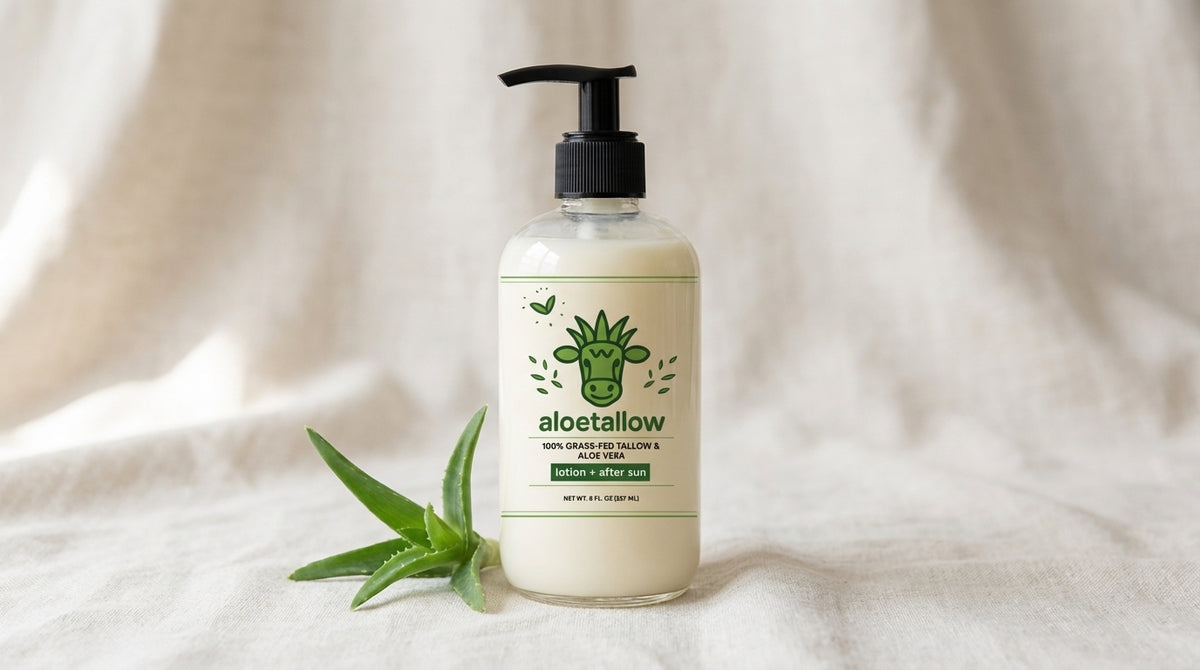
If you want to try a tallow-based product on your face, Aloetallow is what we made for this exact use case: grass-fed beef tallow combined with aloe vera, 8 ingredients, no fragrance, no essential oils, no silicones. The aloe keeps the texture lighter than a straight tallow product would be, which makes it more practical for facial use without sacrificing the occlusive weight that makes tallow useful in the first place.

8 ingredients. Grass-fed tallow + aloe vera. Nothing you can't pronounce.
Frequently asked questions
Will tallow clog my pores if I use it on my face?
For most people with normal-to-dry or combination skin, no. The comedogenicity scale that generates concerns about tallow was developed on rabbit ear skin, which is far more sensitive to pore-clogging than human facial skin. Tallow's fatty acid profile is compositionally close to human sebum, which means it integrates with your skin's lipid system rather than disrupting it. People with very oily or acne-prone skin should patch test first -- any heavy occlusive can cause mechanical congestion on skin that's already producing excess sebum.
How is tallow on the face different from using it on your body?
Facial skin is thinner and turns over faster, so you'll see effects more quickly -- in both directions. The other practical differences are quantity (you need significantly less on the face) and ingredient list scrutiny (fragrances and additives that might be tolerable on body skin are more likely to cause facial reactions). The underlying fatty acid benefit is the same.
Can I use tallow under makeup?
Yes, but allow it to absorb fully before applying anything on top -- at least 10-15 minutes. Because tallow is an occlusive, applying makeup immediately over it can interfere with adhesion. If you're using it as a daytime face moisturizer under makeup, use a very small amount and give it time to absorb. Many people find it works better as a nighttime application in that case.
Is grass-fed tallow different from conventional tallow for facial use?
Grass-fed tallow has a higher concentration of conjugated linoleic acid (CLA) and a better omega-6 to omega-3 ratio than conventionally raised tallow. A 2006 study in the Journal of Nutrition found grass-fed beef fat had approximately 2-3x higher CLA content than grain-fed. CLA has demonstrated anti-inflammatory properties in topical applications. For facial skin that tends toward redness or reactivity, that difference is meaningful.
What if I break out when I first start using tallow on my face?
A breakout in the first 1-2 weeks isn't necessarily the product clogging your pores. When skin has been relying on synthetic emollients, switching to an ingredient with different occlusion characteristics sometimes causes a short-term purge effect as the barrier normalizes. That said, if you're breaking out in the same location consistently after application, and the breakouts are inflammatory (not just small textural bumps), that's a more meaningful signal that this particular formula isn't right for your skin type. Stop using it and reassess.
The question of whether tallow is appropriate for your face doesn't have a universal answer -- but the blanket "keep heavy oils off your face" rule isn't supported by the evidence either. The data on comedogenicity is weaker than the scale implies. Tallow's compositional similarity to sebum makes it a better candidate for facial use than most plant oils. The honest approach is to understand your own skin type, patch test, and give it a few weeks. For most people with dry, combination, or sensitive facial skin, it performs better than what they've been using. For people with very oily or actively acne-prone skin, it may not be the right fit -- and that's worth knowing before you commit.