Your skin is angry. Maybe it started with a new cleanser that stripped everything. Maybe winter air dried you out until your cheeks felt like paper. Maybe you've been dealing with redness and irritation for months and nothing you put on your face seems to stick. So you searched for a barrier cream -- something that would actually protect and repair your skin instead of just temporarily calming it down. And you probably found a wall of products promising "barrier support" and "skin barrier repair" without explaining what any of that actually means at a biological level.
Here's the problem: most barrier creams are designed to make compromised skin feel better in the short term. Fewer are designed to give your skin the raw materials it needs to rebuild itself. That distinction matters more than any marketing claim on the box.
What a Barrier Cream Actually Has to Do
Your skin barrier isn't a vague concept. It's a specific structure -- the stratum corneum -- that functions like a brick-and-mortar wall. The "bricks" are corneocytes (flattened dead skin cells). The "mortar" between them is a precise mixture of ceramides, cholesterol, and free fatty acids, organized into lamellar lipid bilayers. When this structure is intact, it does two critical jobs: it keeps water in and keeps irritants out.
When the mortar breaks down, transepidermal water loss (TEWL) increases. Water escapes through the cracks faster than your body can replace it. Irritants, allergens, and microbes get in through those same gaps. That's when you get dryness, redness, stinging, flaking -- all the symptoms that send people searching for a barrier cream in the first place.
A 2014 review in the Journal of Clinical Medicine outlined the three functions any effective barrier repair product needs to perform:
- Occlude -- form a physical layer that immediately slows water loss while the barrier heals
- Replenish -- deliver lipids that are structurally compatible with the skin's own lamellar matrix so they actually integrate into the barrier rather than sitting on top
- Support -- provide anti-inflammatory and antioxidant compounds that reduce damage and support the cellular repair process
Most products manage the first one. Very few accomplish all three. And the distinction between "sitting on top" and "integrating into the barrier" is where the science gets interesting -- and where most barrier creams fall short.
Why Most Barrier Creams Fail
Pick up a typical barrier cream from a drugstore shelf. Read the ingredient list. Here's what you'll usually find:
- Water (Aqua) -- first ingredient, meaning it's the majority of the formula by volume
- Dimethicone or cyclomethicone -- silicones that create a smooth, slippery film on the skin's surface
- Petrolatum -- an effective occlusive, but one that provides zero lipids for actual barrier rebuilding
- Glycerin -- a humectant that draws water to the surface (helpful, but only if sealed in by a compatible occlusive)
- Cetearyl alcohol, polysorbates, PEG compounds -- synthetic emulsifiers needed to hold the water and oil phases together
- Niacinamide, ceramide NP, or other "actives" -- listed far down the label, present in concentrations too low to be clinically meaningful
The structural problem is clear: these formulas are mostly water. Water evaporates. When it does, it can actually carry moisture away from already-compromised skin -- a phenomenon documented in a 2015 study in Skin Pharmacology and Physiology that found water-based moisturizers without adequate occlusion showed diminished TEWL improvement within four hours.
Silicones deserve their own mention. Dimethicone is the go-to ingredient in barrier creams because it creates an immediate smoothing effect. Your skin feels protected. But silicones don't integrate into the lipid matrix. They form a synthetic film that sits on the surface, temporarily reducing friction and water loss. A 2019 analysis in Cosmetics noted that silicone-based occlusion does not contribute to structural barrier repair the way lipid-based occlusion does. When you wash the silicone off, the barrier is exactly where it was before you applied the product.
Then there's the ceramide question. Many barrier creams now market themselves on ceramide content. Ceramides are genuinely important -- they're the primary lipid class in the stratum corneum's mortar. But isolated synthetic ceramides added at the tail end of an ingredient list, suspended in a water-and-silicone base, don't behave the same way as ceramides delivered within a matrix of complementary fatty acids. Research by Peter Elias and colleagues, published in the Journal of Clinical Investigation, demonstrated that barrier repair requires lipids delivered in the correct ratio -- ceramides, cholesterol, and free fatty acids roughly 1:1:1. Applying one lipid class in isolation, or in the wrong ratio, can actually delay recovery.
The honest summary: most barrier creams manage symptoms. They make damaged skin feel smoother and less irritated temporarily. But they don't give the stratum corneum what it needs to actually rebuild its mortar.
Why the Base Fat Matters for Barrier Repair
If your skin barrier needs compatible lipids to rebuild, then the most important question isn't "what actives are in this product?" It's "what is the base fat, and does it match what my skin actually needs?"
This is where beef tallow becomes relevant -- not as a trend, but as a biochemical match.
Tallow rendered from grass-fed cattle contains a fatty acid profile remarkably similar to human sebum. The key players:
- Palmitic acid (~26%) -- the most abundant saturated fatty acid in human skin lipids, essential for maintaining the structural integrity of the lipid barrier
- Oleic acid (~47%) -- a monounsaturated fatty acid that enhances penetration and flexibility of the stratum corneum
- Stearic acid (~14%) -- a structural fatty acid critical to the "mortar" between skin cells
- Palmitoleic acid (~3-4%) -- an antimicrobial fatty acid found naturally in sebum
A 2017 analysis in Lipids in Health and Disease compared the fatty acid composition of various animal and plant fats to human subcutaneous fat. Beef tallow showed the highest degree of structural similarity -- closer than coconut oil, shea butter, jojoba oil, or olive oil.
Why does structural similarity matter for barrier repair specifically? Because the stratum corneum doesn't accept every lipid equally. The lamellar bilayers have a specific molecular architecture. Fatty acids that match the native composition slot into the existing structure. Fatty acids that don't match -- wrong chain length, wrong saturation level -- can disrupt the packing order and impair rather than improve barrier function.
A 2012 study by Elias et al. in the Journal of Clinical Investigation showed this directly: topical application of lipids in ratios that didn't match the skin's native composition actually delayed barrier recovery compared to no treatment at all. The composition matters as much as the presence of lipids.
Grass-fed tallow also delivers fat-soluble vitamins in their naturally occurring forms -- A (retinol), D, E (tocopherol), and K2. Vitamin E functions as a lipid-soluble antioxidant, protecting the very lipid structures that make up the barrier from oxidative damage. Vitamin A supports the cell turnover process that generates new corneocytes. These aren't added after the fact -- they're inherent to the fat itself.
Why Tallow and Aloe Work Together for Barrier Repair
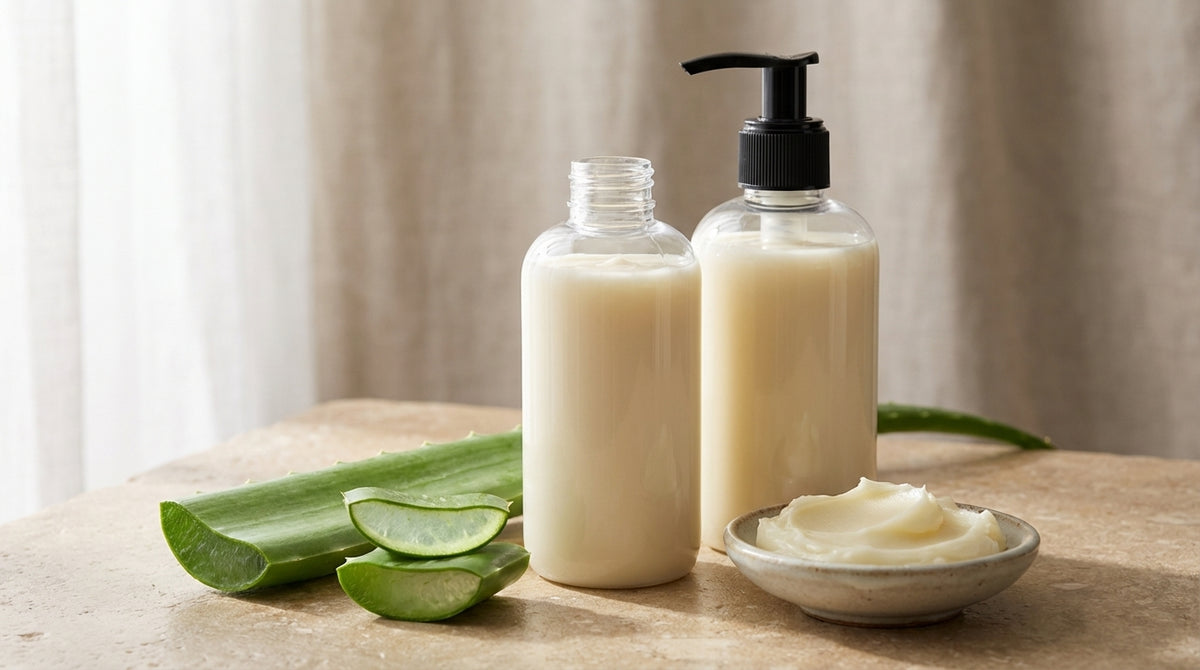
Tallow addresses the lipid side of barrier repair -- the fats, the occlusion, the structural compatibility. But a compromised skin barrier also involves inflammation, dehydration from below, and cellular damage that needs active repair support. That's where aloe vera becomes a functional partner, not a marketing addition.
Aloe barbadensis leaf gel contains over 75 identified bioactive compounds. The ones directly relevant to barrier repair include:
- Acemannan -- a polysaccharide shown to stimulate fibroblast activity and support wound matrix formation (Journal of Ethnopharmacology, 2009). Fibroblasts are the cells responsible for producing collagen and the extracellular matrix beneath the barrier.
- Glucomannan -- interacts with growth factor receptors, promoting collagen synthesis. A study in the Annals of Dermatology (2009) found topical aloe vera increased collagen content and improved skin elasticity.
- Salicylic acid (naturally occurring) -- a gentle exfoliant that clears dead surface cells, allowing lipids to penetrate and integrate more effectively into the lamellar structure
- Polysaccharide film -- aloe gel forms a light hydrating layer that holds moisture against the skin surface, complementing tallow's heavier occlusion
The combination addresses barrier repair from both directions simultaneously. Tallow seals the surface and delivers structurally compatible lipids that integrate into the damaged mortar. Aloe provides water-binding hydration from below, reduces inflammation that would otherwise slow repair, and supports the cellular processes rebuilding the barrier from the inside out.
This is the humectant-occlusive partnership that dermatological research identifies as optimal for barrier recovery -- except both ingredients are also delivering bioactive compounds beyond their primary role. Conventional barrier creams try to achieve the same pairing with water + glycerin + silicone, but those ingredients don't bring the same functional complexity. They manage. They don't rebuild.
What to Look for in a Real Barrier Cream
If your skin barrier is compromised and you're shopping for something that will actually help it recover, here's a practical checklist based on what the science says works:
1. Prioritize the base ingredient
The first ingredient on the label is what you're mostly putting on your skin. If it's water, the formula is mostly water. For barrier repair, you want a lipid-rich base -- something with skin-compatible fatty acids as the foundation, not an afterthought listed at position fifteen.
2. Look for structural lipid compatibility
Palmitic acid, stearic acid, oleic acid. These should come naturally from the base fat -- not be isolated synthetic additives sprinkled in at trace amounts. Tallow, emu oil, and to a lesser extent shea butter provide these natively.
3. Demand real occlusion
Your compromised barrier is losing water. You need something that physically slows that loss while the barrier rebuilds. Animal fats and beeswax provide meaningful, lipid-based occlusion. Silicones provide temporary surface smoothing but don't contribute to structural repair. If you're dealing with seriously dry skin, the occlusive layer matters enormously.
4. Fewer ingredients, fewer variables
A damaged barrier is reactive. Every ingredient is a potential irritant. The most effective barrier repair formulas tend to be short -- sometimes shockingly short. If a product lists 25+ ingredients and calls itself a barrier cream, question what all those compounds are actually doing. People with sensitive skin especially benefit from minimal formulas.
5. Skip the fragrance
"Fragrance" on a label can represent dozens of undisclosed chemical compounds. The International Fragrance Association lists over 3,000 materials used in fragrance formulations. On already-compromised skin, fragrance is one of the most common triggers for contact dermatitis. A real barrier cream shouldn't contain it.
6. Check for anti-inflammatory support
Barrier damage involves inflammation. A formula that includes naturally anti-inflammatory compounds -- aloe vera, certain fatty acids like palmitoleic acid, fat-soluble antioxidants like vitamin E -- will support faster recovery than one that's purely occlusive.
The AloeTallow Formula
We built AloeTallow as a barrier-first formula. Grass-fed beef tallow delivers the structural fatty acids your skin's lipid matrix actually needs -- in ratios that match human sebum. Aloe vera provides hydration, anti-inflammatory support, and cellular repair compounds underneath. The full ingredient list is short enough to read in a few seconds: no water filler, no silicones, no synthetic emulsifiers, no fragrance. If your barrier is compromised and you've been cycling through products that calm things down temporarily but never actually fix the problem, this is a different approach -- one built around what the research says your skin needs to rebuild.

8 ingredients. Grass-fed tallow + aloe vera. Nothing you can't pronounce.
FAQ
What's the difference between a barrier cream and a regular moisturizer?
In theory, a barrier cream is specifically formulated to repair and protect the stratum corneum's lipid structure, while a regular moisturizer just adds hydration. In practice, many products labeled "barrier cream" are just moisturizers with different marketing. The real distinction is whether the formula delivers structurally compatible lipids that integrate into the skin's lamellar matrix -- or just sits on the surface providing temporary occlusion. Read the ingredient list, not the label.
How long does it take for a damaged skin barrier to repair?
Research suggests that a mildly compromised barrier can recover in 2 to 4 weeks with proper support. More severely damaged barriers -- from prolonged irritant exposure, over-exfoliation, or chronic conditions -- can take 6 to 12 weeks. The key variables are removing whatever caused the damage, providing compatible lipids for rebuilding, and not introducing new irritants during recovery. Your skin replaces the stratum corneum roughly every 2 to 4 weeks under normal conditions, so that's the baseline timeline.
Can I use a barrier cream if I have oily or acne-prone skin?
Yes, and you might need to. Oily skin can still have a compromised barrier -- the two aren't mutually exclusive. In fact, some research suggests that excess oil production can be a compensatory response to barrier damage: your skin produces more sebum to try to replace the protective layer it's lost. The key is choosing a barrier cream with lipids that match sebum composition rather than clogging pores. Tallow's similarity to human sebum means it integrates rather than accumulating on the surface. A 2010 review in Dermato-Endocrinology noted that the comedogenicity scale was developed using rabbit ear models, which don't accurately predict human skin responses.
Do I still need a barrier cream if I already use a ceramide product?
Ceramides are one part of the equation, but barrier repair requires ceramides, cholesterol, and free fatty acids in roughly equal proportions. A product that delivers isolated ceramides without the complementary lipids may not improve barrier function as effectively as a formula that provides the full lipid profile. If your ceramide product isn't resolving your barrier issues after several weeks of consistent use, the missing piece may be the fatty acid component -- which is exactly what tallow provides natively.
What are the signs that my skin barrier is actually damaged?
The most reliable indicators: skin that stings when you apply products that didn't used to sting, persistent dryness or flaking that doesn't respond to regular moisturizers, redness or irritation that seems disproportionate to what you're putting on your skin, and a rough or "sandpapery" texture. If your skin feels tight within an hour or two of moisturizing -- even after applying what should be enough product -- that's a strong signal that your barrier isn't retaining water effectively. Increased sensitivity to temperature changes, wind, or products you've used without issue before is another common sign. If you're experiencing eczema-like symptoms, barrier damage is almost certainly part of the picture.