Your skin feels tight before you've even gotten dressed. You moisturize in the morning and by midday your hands look like paper. You drink water, you layer on lotion, and it doesn't seem to matter -- the dryness comes back every single day from November through March. That's not a hydration problem. That's a barrier problem, and most winter skin routines are built around the wrong diagnosis.
What the science says about winter and your skin barrier
Your skin maintains hydration through two main mechanisms: the lipid barrier -- a layered structure of ceramides, fatty acids, and cholesterol -- and natural moisturizing factors (NMFs), which are water-soluble compounds like amino acids and urocanic acid that hold water within the outer skin cells. Both of these systems are under attack in winter.
A 2006 study published in the British Journal of Dermatology measured transepidermal water loss (TEWL) -- the rate at which water evaporates through the skin -- across seasons. Winter conditions produced significantly elevated TEWL compared to summer, and the effect was most pronounced in people who were already using regular moisturizers. In other words, standard moisturizers weren't preventing barrier damage in dry, cold conditions -- they were just masking it temporarily.
The mechanism is straightforward. Cold air holds less moisture than warm air. When relative humidity drops below 40% -- which happens easily indoors with central heating running -- the gradient between your skin and the surrounding air steepens. Water pulls out of your skin faster. Your barrier lipids, which are already more rigid and less fluid in cold temperatures, can't replenish the lost moisture quickly enough.
Wind compounds the problem. A 2014 study in Skin Research and Technology found that wind exposure measurably increased TEWL even at moderate wind speeds, disrupting the thin layer of still air that sits against your skin's surface and normally acts as a buffer against evaporation. This explains why your face feels raw after a walk in cold wind even if the temperature wasn't extreme.
Hot showers -- a winter reflex for most people -- are the third culprit. Heat disrupts the tight-junction proteins between skin cells and temporarily increases barrier permeability. A study in the Journal of Investigative Dermatology (2007) found that even brief thermal stress elevated TEWL for hours after exposure. The relief you feel stepping out of a hot shower is real. The damage happening to your barrier underneath that sensation is also real.
Why most winter moisturizers make things worse
This is the part most product labels don't explain. The majority of winter moisturizers -- even the ones marketed specifically for cold weather -- are built around humectants: glycerin, hyaluronic acid, sorbitol, urea. Humectants pull water from somewhere and bind it to the skin. When it's humid out, they pull from the air, and that's useful. When the ambient humidity is below roughly 45%, they can't pull from the air -- so they pull from the deeper layers of your own skin instead.
A 2013 review in the Journal of Clinical and Aesthetic Dermatology noted this explicitly: in low-humidity environments, humectant-heavy formulas without sufficient occlusives can actually increase skin dehydration over time. They create a short-term softening effect while accelerating the loss of water from the dermis upward to the surface, where it then evaporates.
If you've noticed that a lotion feels great for an hour and then your skin feels dryer than before you applied it -- that's the humectant-in-dry-air problem.
Emollients -- silicones, light plant oils, isopropyl palmitate -- fill cracks and reduce surface friction, which improves texture. But they don't structurally repair the lipid barrier. They coat. They smooth. They don't rebuild the intercellular matrix that holds your barrier together.
Occlusives -- petrolatum, mineral oil, waxes -- create a physical seal over the skin surface that slows TEWL. They work, but they're sitting on top of your skin, not integrating with it. And most of them don't deliver any lipid compounds that your barrier can actually use to repair itself.
The gap in most winter skin routines isn't the wrong product -- it's a category of product that doesn't really exist in conventional skincare: something that is genuinely occlusive (slowing water loss from outside), but also delivering the specific lipid building blocks your barrier needs to repair itself from within. This is where beef tallow for dry skin offers a structural advantage that conventional options don't.
Why the base fat matters in cold conditions
Tallow from grass-fed beef contains a specific fatty acid profile that's unusually relevant to skin barrier repair: roughly 26% palmitic acid, 47% oleic acid, and 14% stearic acid, with smaller amounts of palmitoleic and other minor lipids. This composition is closer to human sebum than almost any other natural fat.
That similarity matters for a specific reason. The lipids in your skin barrier aren't just any fats -- they're a precise mixture of ceramides, free fatty acids, and cholesterol arranged in a lamellar structure. The fatty acids in tallow -- particularly palmitic and stearic acids -- are the same ones your skin uses to synthesize ceramides. When you apply tallow, you're not just coating the surface. You're delivering substrate that your skin can potentially use to rebuild its own barrier.
A 2019 study in Skin Pharmacology and Physiology examined how fatty acid composition of topical lipids affects barrier recovery speed after disruption. Lipids with saturated fatty acid profiles similar to endogenous skin lipids produced faster barrier recovery than synthetic emollients or light plant oils. Tallow's saturated-dominant profile -- stearic + palmitic together -- falls precisely in that beneficial range.
The occlusive weight of tallow is also specifically valuable in winter. Because it's a solid fat at room temperature, it creates a denser barrier film than a liquid oil would. It doesn't penetrate and disappear the way a light oil does. In low-humidity winter conditions where your skin is losing water rapidly, that heavier occlusion is a feature, not a drawback. You want something that stays between your skin and the dry air for hours, not something that sinks in within minutes and leaves you exposed.
For more on beef tallow for skin and how it compares to conventional moisturizer ingredients, the science behind the fatty acid profile is covered in more depth there.
Why tallow and aloe work together in winter
Aloe vera's winter skin relevance is different from tallow's, and the two complement each other in a way that neither achieves alone.
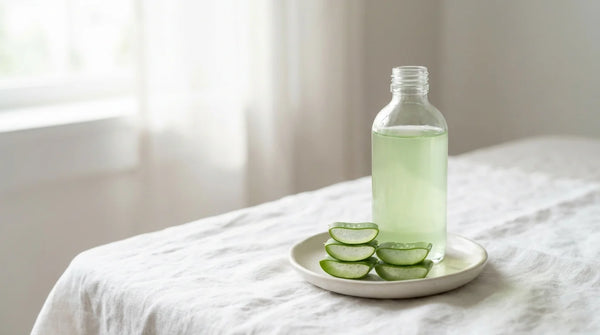
Aloe vera gel is primarily water -- around 98-99% -- with the remaining fraction containing polysaccharides (notably acemannan), amino acids, enzymes, and antioxidant compounds including vitamins C and E. The polysaccharides are the mechanically relevant piece. They form a film on the skin surface that helps retain moisture and has demonstrated mild anti-inflammatory activity in multiple trials.
A 1996 study in the Journal of Ethnopharmacology and follow-up work published in Burns (1995) found that acemannan from aloe accelerated wound healing by stimulating fibroblast activity and collagen synthesis. For winter skin that's been compromised by repeated TEWL -- which creates micro-damage in the barrier over time -- that fibroblast activity is meaningful. It's not repairing wounds. It's maintaining the pace of skin cell renewal that cold weather slows down.
The practical value of combining aloe with tallow is this: tallow addresses the occlusion problem (slowing water loss) while aloe delivers water-phase active compounds that a fat-only preparation can't carry. You get barrier sealing and barrier signaling in a single application. Without the aloe, you're relying entirely on the occlusive film. Without the tallow, the aloe's moisture-binding polysaccharides have nothing to lock them into place against the dry air.
This complementary relationship is what makes the tallow-aloe combination specifically useful in winter -- the season when you need both maximum occlusion and active barrier support at the same time. If you're interested in how this combination addresses more specific barrier conditions, the post on tallow for eczema covers the barrier-repair mechanism in more detail.
Practical tips for managing winter dry skin
The most effective winter skin routines address water loss at multiple points -- not just through what you apply, but how and when you apply it, and what you do to reduce the rate of evaporation in the first place.
- Apply moisturizer within 3 minutes of washing. Your skin is most permeable immediately after water contact. The "three-minute rule" is supported by barrier permeability research -- applying while skin is still slightly damp maximizes ingredient absorption and seals in surface moisture before evaporation begins.
- Lower your shower temperature. Lukewarm, not hot. Even a modest reduction -- from scalding to warm -- significantly reduces post-shower TEWL. You'll adjust within a few days.
- Use a humidifier indoors. Target 45-55% relative humidity in the rooms where you spend the most time. This directly reduces the humidity gradient pulling moisture from your skin and makes humectants in any moisturizer actually function as intended.
- Layer heavy over light. If you're using a serum or lighter product, apply it first. Follow with a heavier occlusive like tallow-based lotion to seal. Applying a light product over a heavy one traps it on the surface where it can't absorb.
- Don't skip your hands. Handwashing is more frequent in winter. Hands have fewer sebaceous glands than other body areas and lose moisture faster. Apply after every wash if your hands are significantly compromised.
- Look for short, fat-based ingredient lists. Ingredients are listed by concentration. If glycerin is in the first three ingredients and there's no occlusive fat in the list, the formula is built for humid-weather use -- it will underperform in winter. What you want to see near the top: a fat that's solid at room temperature, a plant-derived oil, and minimal synthetic fillers.
- Avoid alcohol-containing products on your face and hands in winter. Many toners and hand sanitizers contain ethanol, which disrupts barrier lipids. In winter, that disruption doesn't recover as quickly as it does in summer.
The Aloetallow formula
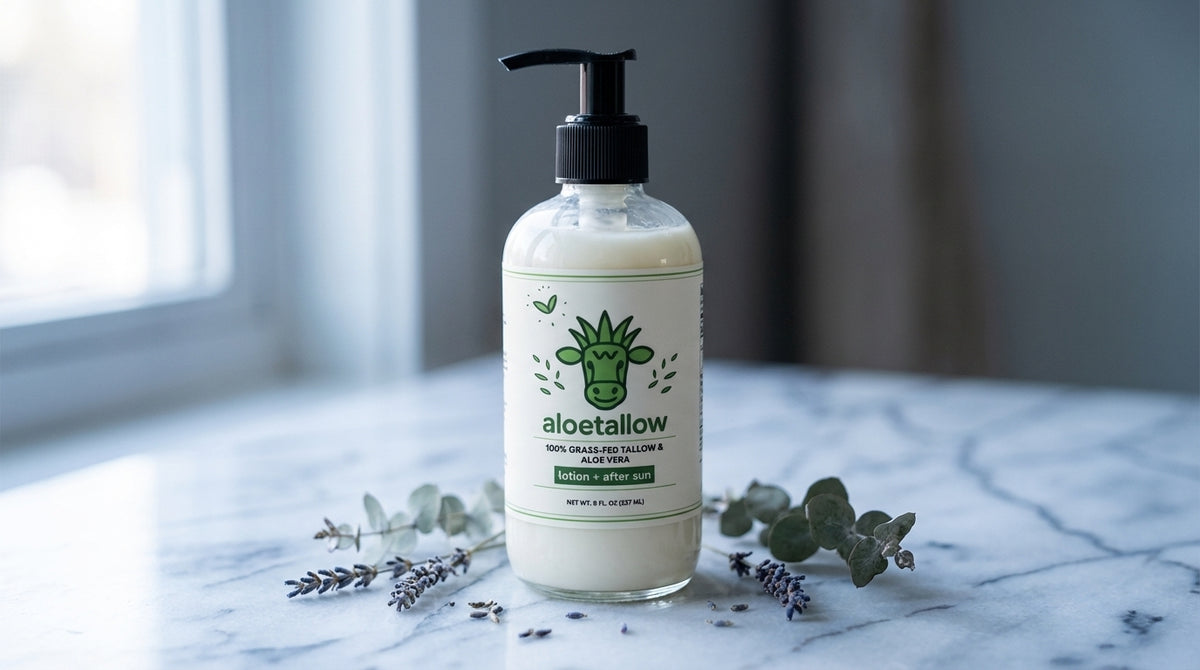
If you want a formula built around this principle -- heavy occlusion in winter conditions, active fatty acid delivery, and the complementary moisture-sealing properties of aloe -- Aloetallow is what we made. It's grass-fed beef tallow combined with aloe vera, 8 ingredients total, no fragrance, no humectants that will work against you in dry air. The tallow is the first fat in the list. It goes on heavier than a conventional lotion and it stays.

8 ingredients. Grass-fed tallow + aloe vera. Nothing you can't pronounce.
Frequently asked questions
Why does my skin get so much dryer in winter even when I moisturize every day?
Most moisturizers address surface texture but don't slow water loss in low-humidity conditions. In dry winter air -- especially indoors with heating running -- humectant-based lotions can actually increase evaporation from deeper skin layers. The fix is switching to a formula with genuine occlusive weight: something that physically slows the evaporation gradient rather than just adding water to the surface.
Is tallow too heavy for daily winter use?
Not for most people. Tallow's fatty acid profile is similar to human sebum, so it absorbs differently than a foreign oil -- it integrates rather than sitting in a greasy layer. A small amount warmed between your palms before applying goes a long way. If you find the texture too heavy for daytime on your face, use it at night and a lighter formula during the day.
Can I use the same product on my face and body in winter?
Yes, if the formula is short and fragrance-free. Facial skin is thinner and more reactive, but the same barrier-repair mechanisms apply. The risk with most body lotions on the face isn't the fat -- it's the fragrance, dyes, and synthetic thickeners that are often present at higher concentrations in body formulas. A tallow-aloe formula with a short ingredient list is appropriate for both.
Do I need a separate lip product?
Lip skin has no sebaceous glands and no hair follicles -- it has almost no built-in barrier protection. A fat-based product applied to lips works the same way it does elsewhere, and tallow's occlusive weight is well-suited to lips in winter. You don't need a dedicated product if what you're using on the rest of your face is genuinely occlusive.
How long does it take to see improvement in winter dry skin?
Barrier repair timelines in the research are typically 2-4 weeks for meaningful structural recovery after significant disruption. Surface texture -- the feeling of tightness and flaking -- usually improves faster, within days, once you're applying something genuinely occlusive. Full barrier normalization takes longer, which is why consistency through the winter matters more than any single application.
Winter skin is a maintenance problem as much as a treatment problem. The barrier damage accumulates slowly over the season -- small increments of TEWL, each individually recoverable, adding up to significant impairment by February. The remedies that work are the ones that slow that accumulation consistently, not the ones that provide a temporary fix on the worst days. Build the routine around barrier protection, not just symptomatic relief, and the results carry through the season rather than expiring by noon.