Why Plant Oils Can't Fully Repair Your Skin Barrier (And What Can)
The Skin Barrier Isn't Just a "Moisture Layer"
If you've ever dealt with dry, tight, or reactive skin, you've probably been told to "repair your skin barrier." But what does that actually mean — and why do so many natural moisturizers fail to do it?
Your skin barrier — the outermost layer called the stratum corneum — is a precisely engineered structure. Think of it like a brick wall: skin cells (corneocytes) are the bricks, and the "mortar" between them is a specific blend of lipids. That mortar isn't random. It follows a remarkably consistent ratio:
- ~50% ceramides
- ~25% cholesterol
- ~15% free fatty acids
- The remaining ~10% is a mix of cholesterol esters and other lipids
When this ratio is disrupted — by harsh cleansers, environmental exposure, the wrong skincare products, or physical injury like tattoo healing — the barrier breaks down. Water escapes (a process called transepidermal water loss, or TEWL), irritants get in, and skin becomes inflamed, flaky, or painfully sensitive.
Natural skin barrier repair means restoring that lipid mortar to its correct composition. And that's where things get interesting.
Why Plant Oils Only Tell Half the Story
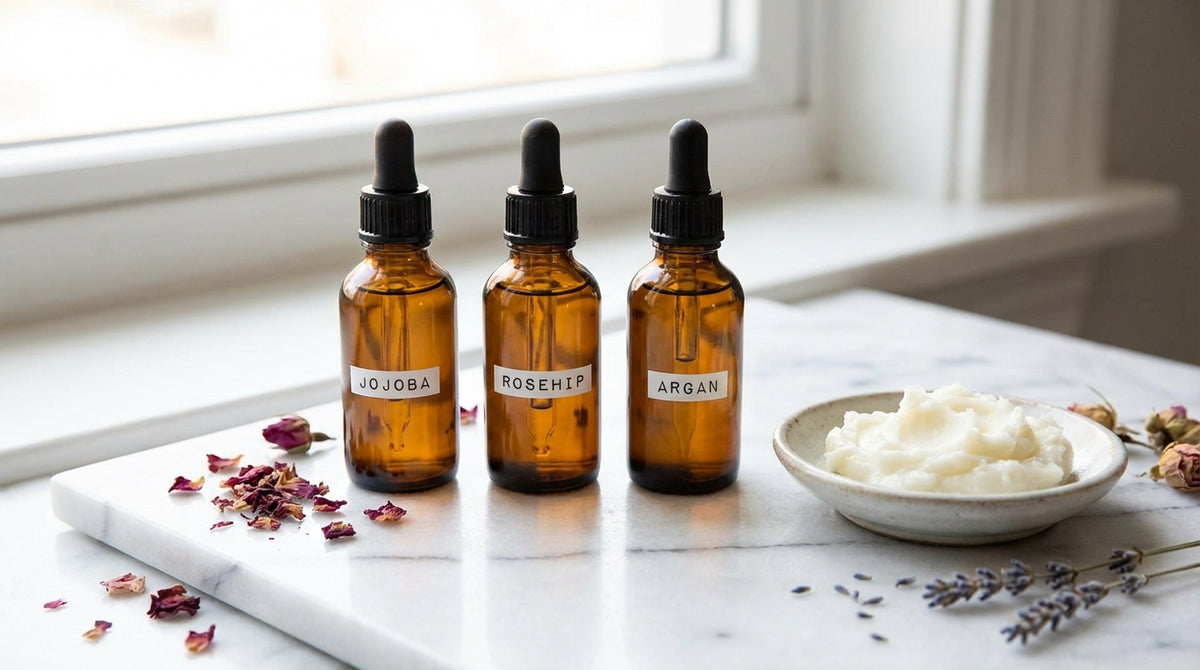
Plant oils like jojoba, rosehip, argan, and squalane are staples of natural skincare. They're popular for good reason — they deliver beneficial fatty acids and feel luxurious on the skin. But there's a fundamental mismatch between the lipid profile of most plant oils and what your barrier actually needs.
Here's the issue: most plant oils are dominated by unsaturated fatty acids. Rosehip oil, for example, is roughly 80% unsaturated (linoleic and linolenic acids). Argan oil is about 80% oleic and linoleic. Jojoba is technically a liquid wax ester, not even a true oil.
Your skin's sebum — the natural oil your body produces to protect the barrier — tells a different story. Human sebum is approximately 41% oleic acid, but also contains significant proportions of saturated fatty acids like palmitic acid (~25%) and stearic acid (~11%). This saturated-to-unsaturated balance is critical for barrier integrity.
Plant oils deliver the unsaturated side of the equation well. But they largely miss the saturated component that gives your barrier its structural rigidity. It's like trying to repair a wall with mortar that's missing one of its key ingredients — you can fill the gaps, but the repair won't hold the same way.
The Ceramide Cream Problem
The skincare industry's answer to barrier repair has been synthetic ceramide creams. These products deliver lab-made ceramides directly to the stratum corneum, and research confirms they can be effective at reducing TEWL and improving barrier function.
But ceramide creams have their own limitation: they typically deliver isolated ceramides without the full spectrum of supporting lipids. Remember, your barrier needs ceramides plus cholesterol plus free fatty acids in the right ratio. A product that delivers only one piece of the puzzle may help, but it's not providing the complete lipid environment your skin is looking for.
Some premium ceramide creams do add cholesterol and fatty acids. But the fatty acid profiles are often simplified — a single fatty acid rather than the complex blend found in natural sebum.
What Human Sebum Actually Looks Like
To understand natural skin barrier repair, you need to understand what your skin produces on its own. Human sebum contains:
- Wax esters (~26%)
- Triglycerides and free fatty acids (~57%)
- Squalene (~12%)
- Cholesterol and cholesterol esters (~5%)
The fatty acid portion includes a mix of saturated chains (palmitic, stearic, myristic) and unsaturated chains (oleic, palmitoleic, sapienic). This complexity is the point — your skin didn't evolve to run on a single oil.
When researchers have compared the fatty acid profiles of various fats to human sebum, grass-fed beef tallow consistently emerges as one of the closest natural matches. A scoping review published in PMC examining tallow's biocompatibility with human skin noted that tallow's lipid composition — rich in palmitic acid, stearic acid, and oleic acid — mirrors the saturated-to-unsaturated ratio found in human sebum more closely than any single plant oil.
This isn't about tallow being "better" than plant oils in some absolute sense. It's about lipid compatibility. Your barrier needs a specific blend, and tallow happens to deliver that blend naturally.
Saturated Fats Aren't the Enemy (On Your Skin)
Dietary advice has trained us to think of saturated fats as harmful. But on the skin, saturated fatty acids play essential structural roles:
- Palmitic acid strengthens the lipid barrier and helps reduce TEWL
- Stearic acid supports barrier integrity and has been shown to have a calming effect on irritated skin
- Myristic acid contributes to the barrier's waterproofing function
These are the fatty acids that most plant oils lack in meaningful quantities. And they're the fatty acids that grass-fed tallow delivers abundantly.
The Case for Full-Spectrum Lipid Support
The most effective approach to natural skin barrier repair isn't choosing between plant oils, ceramides, or animal fats. It's understanding that your barrier needs a complete lipid profile — and selecting products that deliver as much of that profile as possible.
A well-formulated product might combine tallow's sebum-compatible fatty acid profile with complementary ingredients that address hydration (like aloe vera or glycerin) and additional skin-conditioning lipids (like coconut oil or shea butter). This layered approach — structural lipids plus humectants plus occlusive support — addresses barrier repair from multiple angles simultaneously.
Compare this to a product built on a single plant oil or an isolated ceramide. It may help, but it's working with an incomplete toolkit.

The full lipid profile in one product — not isolated ceramides or single plant oils.
8 ingredients. Grass-fed tallow + aloe vera. Nothing you can't pronounce.
The Takeaway
Plant oils aren't bad for your skin. Many deliver real benefits. But if your goal is genuine skin barrier repair, relying solely on plant oils means you're missing the saturated fatty acids your barrier depends on for structural integrity.
The same goes for ceramide-only products — helpful, but incomplete without the supporting lipid cast.
True natural skin barrier repair means giving your skin what it recognizes: a full spectrum of fatty acids in the ratios it already uses. That's the principle behind combining grass-fed beef tallow with ingredients like aloe vera, coconut oil, shea butter, carrot seed hydrate, glycerin, emulsifying wax, and PE9010 — a complete approach rather than a partial one.
Your barrier is sophisticated. The products you use to support it should be too.
Want to learn more? Read our guide on skin barrier repair for your whole body.
Related Reading
This post is for informational purposes only. It is not medical advice.