You've stood in the skincare aisle -- or scrolled through an online store -- looking for a moisturizer that doesn't have a list of unpronounceable ingredients. You find one labeled "clean" or "clean beauty" and feel relieved. Then you flip it over, scan the back, and realize you still can't tell what half those words mean or whether they belong on your skin. Clean beauty is a real concept with real science behind it. But the label itself is unregulated, and that gap between the idea and the reality is worth understanding before you buy anything.
What the science says about skin barrier function and moisturizer chemistry
Your skin's outermost layer -- the stratum corneum -- is not just a passive wrapper. It's a lipid matrix: a carefully organized mixture of ceramides, cholesterol, and free fatty acids that holds moisture in and keeps irritants out. A 2012 study in the Journal of Lipid Research found that these three classes of lipids must be present in roughly equal ratios for the barrier to function correctly. When any one of them is depleted -- from washing, sun exposure, low-humidity environments, or over-exfoliation -- transepidermal water loss (TEWL) increases, and the skin becomes dry, tight, and reactive.
What this means practically: a moisturizer that genuinely supports skin health should contribute to that lipid structure, not just sit on top of it. The distinction matters. Occlusives like petrolatum or dimethicone reduce water loss by forming a physical seal -- they work, but they don't contribute any structural lipids to the barrier. Humectants like hyaluronic acid or glycerin pull water into the upper skin layers, which can temporarily improve appearance but doesn't repair underlying barrier damage. Emollients -- fatty acids, plant oils, and animal-derived fats -- are the class most likely to integrate with the barrier's own chemistry and support long-term function.
A 2018 paper in the British Journal of Dermatology reviewed lipid-based moisturizers and found that formulations containing fatty acids structurally similar to those found in the stratum corneum showed measurably better TEWL reduction over time compared to those relying primarily on humectants or film-forming agents. That's a technical way of saying: similarity to your skin's own chemistry appears to matter more than ingredient count.
Why conventional moisturizers often fall short of "clean"
The term "clean beauty" entered mainstream use around 2016, but it still has no regulatory definition in the United States. The FDA does not require cosmetics to be approved before they go to market, and the word "clean" carries no enforceable standard. A brand can call its product clean while still including synthetic fragrance compounds, PEG-based emulsifiers, or preservatives like methylisothiazolinone -- a known contact allergen flagged by the European Scientific Committee on Consumer Safety in 2016.
Here's what a typical conventional moisturizer label often includes:
- Fragrance (parfum): A single listed ingredient that can legally represent a blend of dozens of undisclosed compounds. Many fragrance components are known sensitizers.
- PEG compounds (PEG-40 stearate, PEG-100 stearate): Polyethylene glycol derivatives used as emulsifiers and surfactants. Concerns center on potential contamination with ethylene oxide and 1,4-dioxane, both listed as possible carcinogens by the EPA.
- Silicones (dimethicone, cyclopentasiloxane): Not inherently harmful, but they form an occlusive film that contributes nothing structurally to the lipid barrier and can accumulate in aquatic environments.
- Synthetic preservatives (parabens, MIT, DMDM hydantoin): Necessary in water-based formulations to prevent microbial growth, but associated with contact dermatitis in sensitized individuals.
None of these ingredients are universally dangerous. The dose, formulation, and individual sensitivity all matter. But if you're looking for a natural moisturizer that minimizes synthetic additives and focuses on lipid-barrier support, most conventional formulas fall short -- not because they contain chemicals, but because they contain synthetic chemicals that substitute for the structural lipids your skin actually needs.
The irony of many "clean" labeled moisturizers is that they swap conventional synthetics for plant-derived alternatives that still don't address the underlying barrier chemistry. Replacing dimethicone with jojoba oil feels cleaner on paper, but jojoba is technically a liquid wax ester -- not a triglyceride -- and it behaves differently in the barrier than ceramide-compatible fatty acids do.
Why the base fat matters -- and what tallow brings to the formula
If the goal of a clean beauty moisturizer is to support the skin's lipid barrier without unnecessary additives, the choice of base fat is not cosmetic -- it's structural. Beef tallow for skin has attracted renewed interest in this context because its fatty acid composition is unusually close to that of human sebum.
Grass-fed tallow's typical fatty acid profile breaks down roughly like this:
- Oleic acid (omega-9): ~47% -- the same dominant fatty acid in human sebum, known to support skin softness and transepidermal absorption
- Palmitic acid: ~26% -- a primary component of the stratum corneum's own lipid matrix
- Stearic acid: ~14% -- a saturated fatty acid that stabilizes the barrier and contributes to emollient texture
- Palmitoleic acid (omega-7): ~3-4% -- an antimicrobial fatty acid that declines with age in human sebum
A 2020 review in Cosmetics (MDPI) noted that fatty acids structurally similar to sebum composition tend to penetrate the stratum corneum more readily than those with significantly different chain lengths or saturation levels. Tallow's profile is not a coincidence -- it comes from an animal whose skin physiology shares evolutionary overlap with ours.
Grass-fed tallow also contains fat-soluble vitamins A, D, E, and K, which are present in the fat tissue and survive the rendering process. Vitamin A supports skin cell turnover. Vitamin E is a lipid-soluble antioxidant. These aren't marketing claims -- they're documented components of the raw material.
For people researching beef tallow for dry skin, the appeal isn't novelty -- it's the idea that you're applying something structurally compatible with what your skin already produces, rather than an engineered substitute.
Why tallow and aloe work together
A clean beauty moisturizer built around tallow alone still has a limitation: tallow is lipid-dense and anhydrous, which means it has no water-phase and no mechanism for drawing ambient moisture into the skin. Aloe vera gel addresses exactly that gap.
Aloe barbadensis leaf contains acemannan, a polysaccharide that acts as a humectant -- drawing and binding water in the upper skin layers. A 2009 study in the Journal of Ethnopharmacology found aloe vera gel to have measurable anti-inflammatory activity through inhibition of the COX-2 pathway (the same pathway targeted by ibuprofen), and a separate 2015 study in the Journal of Dermatological Treatment found topical aloe to improve skin hydration and reduce TEWL when applied consistently.
When aloe and tallow are combined in a single formula, the mechanisms layer rather than overlap. The tallow provides lipid-barrier support, structural fatty acids, and occlusive properties. The aloe provides humectant action, surface hydration, and anti-inflammatory compounds. Neither one alone accomplishes both jobs. Together, they cover the three primary functions of barrier repair: lipid replenishment, water retention, and inflammation management.
From a clean-formula standpoint, this combination also has an advantage: because tallow is naturally self-preserving (saturated fats are highly resistant to oxidation), and because aloe's low pH discourages microbial growth, a well-formulated tallow-and-aloe product can remain stable with a much shorter ingredient list than a water-based cream requires. Fewer ingredients means fewer potential sensitizers, which is the actual goal behind the clean beauty concept.
What to look for in a genuinely clean moisturizer
Here's a practical checklist when you're evaluating whether a moisturizer is actually clean versus just labeled that way:
- Short ingredient list: Fewer ingredients means fewer potential irritants. A barrier-supportive moisturizer doesn't need 25 components to work. If the list is long, scrutinize it.
- No fragrance or parfum: This is the single easiest way to reduce sensitization risk. "Unscented" and "fragrance-free" are different -- unscented may contain masking fragrances. Look for fragrance-free.
- Lipid-based carrier: Look for a base that provides structural fatty acids -- tallow, shea butter, or oils with oleic/palmitic acid dominance. Avoid formulas where water is listed first and the lipid content is minimal.
- Recognizable preservative system (or none): If the formula contains water, it needs a preservative. Vitamin E (tocopherol) and rosemary extract are common in cleaner formulas. Avoid MIT, DMDM hydantoin, or unlisted "fragrance" compounds.
- No PEG emulsifiers: If you see PEG-followed-by-a-number anywhere in the list, the formula relies on synthetic emulsification chemistry.
- Grass-fed source for animal fats: Grass-fed tallow has a different fatty acid ratio than grain-fed, with higher conjugated linoleic acid (CLA) content. It also reflects better welfare and more transparent sourcing.
- Third-party transparency: "Clean" brands should be able to tell you exactly where each ingredient comes from. If sourcing information isn't available, treat the label with some skepticism.
It's also worth understanding what "clean" doesn't mean. It doesn't mean allergen-free -- natural ingredients like lanolin, beeswax, and certain plant extracts are common sensitizers. It doesn't mean preservative-free -- that's only possible in anhydrous (water-free) formulas. And it doesn't mean more effective. The research on barrier function consistently points to structural compatibility as the primary driver of efficacy, not the natural-versus-synthetic origin of an ingredient.
For tallow for sensitive skin, the argument for simplicity is especially strong. When you're reactive, the fewer ingredients you introduce, the easier it is to identify what your skin responds to.
The AloeTallow formula
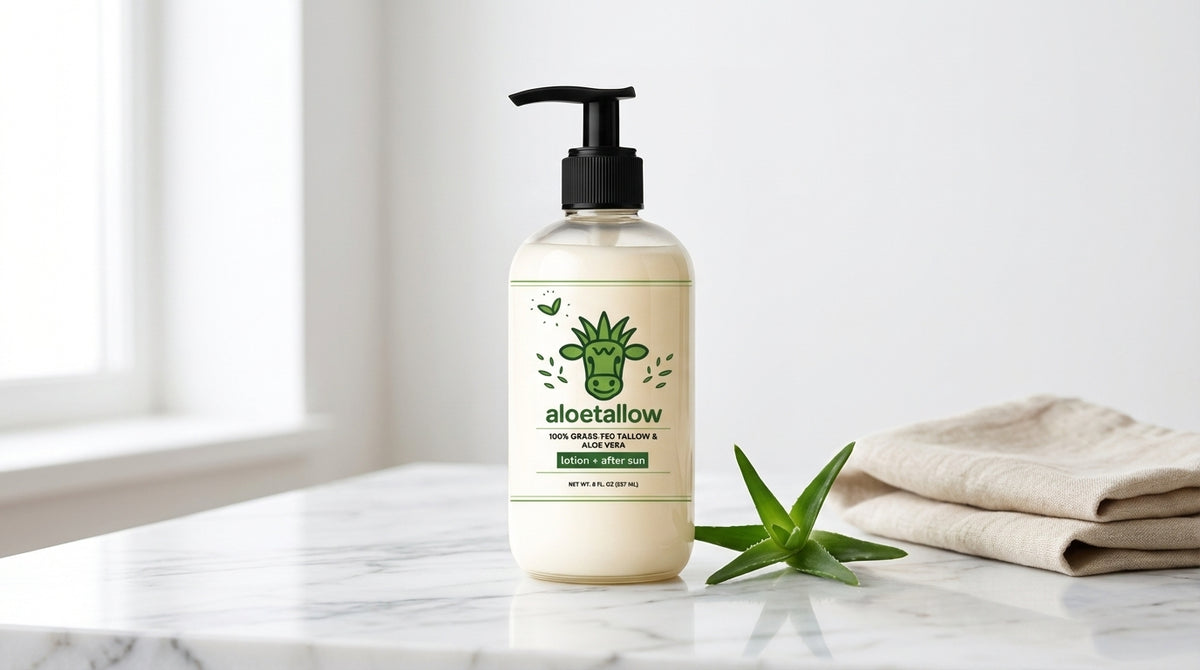
If you're looking for a moisturizer built around this framework, Aloetallow is what we made. It's grass-fed beef tallow combined with aloe vera -- 8 ingredients total, no fragrance, no synthetic emulsifiers. The formula is anhydrous in its base, which means it doesn't require a preservative system, and the fatty acid profile maps closely to the stratum corneum's own lipid composition.

8 ingredients. Grass-fed tallow + aloe vera. Nothing you can't pronounce.
Frequently asked questions
Is "clean beauty" a regulated term?
No. In the United States, the FDA does not regulate the term "clean" in cosmetics. Any brand can use it without meeting a specific standard. Some third-party certification programs (like EWG Verified or Made Safe) have their own criteria, but these vary and are voluntary.
Does "natural" mean the same thing as "clean"?
Not necessarily. Natural refers to the origin of an ingredient -- it means it was derived from a plant, mineral, or animal source rather than synthesized in a lab. Clean typically refers to the safety profile and absence of certain synthetic additives. A product can be natural and still contain allergens, irritants, or poorly sourced ingredients. A product can also be "clean" by safety standards while including some synthetic components.
Do I need a fragrance-free moisturizer?
If your skin is reactive, dry, or barrier-compromised, fragrance-free is worth prioritizing. Fragrance is the most common cause of contact dermatitis in skincare products, and the American Contact Dermatitis Society has consistently listed fragrance as a top allergen. Even "natural" fragrances -- like essential oils -- can be sensitizing. If you're troubleshooting a skin reaction, fragrance-free is the clearest variable to eliminate first.
Can a moisturizer with a short ingredient list still be effective?
Yes -- and the research on barrier repair suggests shorter can be better. The skin doesn't need dozens of active compounds to repair its lipid matrix. It needs the right structural lipids in a form it can use. A 5-ingredient formula built around compatible fatty acids can outperform a 30-ingredient formula built around humectants and film-formers.
Is tallow comedogenic?
The comedogenicity scale commonly cited in skincare was originally developed using rabbit ear skin -- significantly more reactive than human facial skin. Most people with normal to dry skin find tallow non-comedogenic in practice. If you have oily or acne-prone skin, patch-testing is always a reasonable first step with any new ingredient, tallow included. For a fuller breakdown, see our post on beef tallow for skin.
The clean beauty conversation matters -- not because the label is reliable, but because it's pointing at something real. Your skin's barrier is made of lipids, and the moisturizer you choose either works with that chemistry or around it. Understanding the difference is more useful than any marketing claim on the front of the bottle.