If you live with eczema, you've probably tried more products than you can count. Some helped a little. Some made things worse. A few did nothing at all. And somewhere in that cycle, you started looking for options that weren't a prescription steroid or a fragrance-loaded "gentle" cream. The honest answer is that several natural approaches do have real science behind them -- and understanding why they work (or don't) makes it easier to choose what's actually worth trying.
What the science says about eczema and the skin barrier
Atopic dermatitis -- the clinical name for eczema -- is not simply dry skin. It's a chronic inflammatory condition with a significant genetic component. A 2006 discovery published in Nature Genetics identified loss-of-function mutations in the FLG gene (filaggrin) as a primary driver of atopic dermatitis. Filaggrin is a structural protein that binds keratin filaments in skin cells and breaks down into natural moisturizing factors (NMF) that help maintain the barrier's water-retention capacity. When filaggrin is deficient or absent, the skin barrier becomes structurally compromised: more permeable to irritants and allergens, less capable of retaining moisture, and more prone to inflammatory responses.
A 2014 study in the Journal of Allergy and Clinical Immunology found that infants with filaggrin mutations had measurably higher transepidermal water loss (TEWL) before any visible eczema symptoms appeared -- suggesting the barrier failure precedes the inflammation rather than results from it. This is an important distinction, because it means approaches that address barrier function aren't just managing symptoms -- they may be interrupting a key part of the underlying mechanism.
What this tells us about natural relief options: approaches that restore or mimic the skin's lipid and structural components are likely to be more mechanistically relevant than those that only address inflammation or surface hydration. Both matter -- but barrier repair tends to be the more durable intervention.
Why conventional moisturizers and treatments often fall short
Standard eczema management typically involves two tools: topical corticosteroids to reduce inflammation during flares, and emollients to maintain barrier function between them. Both have their place. But the emollient category is where "natural" and "conventional" diverge most visibly -- and where the science gives clearest guidance.
Most drugstore moisturizers marketed for eczema-prone skin are water-based emulsions. They feel light, absorb quickly, and reduce visible dryness for a few hours. But a 2016 study in the British Journal of Dermatology found that water-based emollients with high water content may actually increase TEWL after the water evaporates -- the so-called "rebound drying" effect -- compared to lipid-rich formulations that maintain an occlusive layer. In other words, the lighter the moisturizer, the shorter its effect on actual barrier function may be.
Fragrance is the other major issue. The American Contact Dermatitis Society has consistently ranked fragrance as the leading cause of allergic contact dermatitis. Eczema-prone skin is already barrier-compromised, making it more susceptible to sensitization from fragrance compounds than healthy skin. Many products marketed as "gentle" or "sensitive skin" still contain parfum or natural fragrance -- a single listed ingredient that can represent dozens of undisclosed compounds.
For a closer look at why barrier repair is the right framework, the post on barrier creams goes deeper on the mechanisms.
Why the base fat matters -- and what lipid compatibility means for eczema skin
Eczema skin is specifically depleted in certain lipids. A 2011 study in the Journal of Investigative Dermatology found that the stratum corneum of atopic dermatitis patients had significantly lower ceramide levels compared to controls -- particularly ceramide 1 and ceramide 3, which are critical for maintaining the lamellar structure of the barrier. This lipid deficiency isn't just dryness -- it's a structural gap in the barrier's architecture.
This is why the fatty acid profile of a base emollient matters more for eczema-prone skin than for normal skin. The stratum corneum's lipid matrix is composed primarily of ceramides (~50%), cholesterol (~25%), and free fatty acids (~15%), with oleic acid, palmitic acid, and stearic acid as the dominant fatty acid components. An emollient that provides these fatty acids in forms the skin can use has a different relationship with the barrier than one that simply coats the surface.
Grass-fed tallow's fatty acid profile maps closely to this composition:
- Oleic acid (omega-9): ~47% -- the dominant fatty acid in human sebum and a key component of the stratum corneum's lipid matrix
- Palmitic acid: ~26% -- present in the barrier's own structure; supports emollient penetration
- Stearic acid: ~14% -- a precursor to ceramide synthesis and a structural stabilizer in the lipid bilayer
- Palmitoleic acid (omega-7): ~3-4% -- an antimicrobial fatty acid that declines with age and is often depleted in compromised skin
A 2020 review in Cosmetics (MDPI) noted that emollients with fatty acid profiles similar to sebum composition showed better stratum corneum integration compared to those with significantly different chain lengths. The logic applies directly to tallow for eczema -- the fat's structural similarity to what the skin already produces may make it more effective at filling the lipid gaps that eczema creates.
For a broader overview of how this base fat works, see the post on beef tallow for skin.
Why tallow and aloe work together for eczema-prone skin
Tallow addresses the lipid deficit in eczema skin, but it's anhydrous -- it contains no water and no humectant action. For skin that's already losing water at an elevated rate (eczema patients consistently show higher baseline TEWL), you also need a water-retaining mechanism at the surface. Aloe vera fills that role.
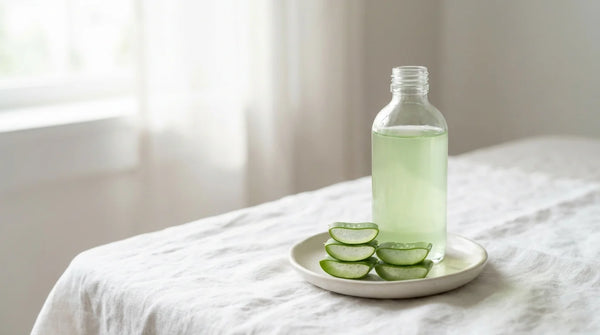
Aloe barbadensis leaf gel contains acemannan, a high-molecular-weight polysaccharide that acts as a humectant and forms a film on the skin surface that slows TEWL. A 2015 study in the Journal of Dermatological Treatment found that topical aloe vera application improved skin hydration and reduced TEWL in clinical measurements over a 4-week period. A separate 2009 study in the Journal of Ethnopharmacology documented aloe's anti-inflammatory activity through inhibition of the COX-2 pathway -- the same enzymatic pathway involved in eczema-related skin inflammation.
The combination of tallow and aloe is mechanistically complementary in a way that matters for eczema-prone skin specifically. Tallow provides lipid-barrier replenishment. Aloe provides surface hydration and anti-inflammatory support. Neither replaces medical treatment during a flare -- but for day-to-day maintenance and symptom management, addressing both the structural and inflammatory components simultaneously is more complete than addressing only one.
The formula also has practical advantages for sensitive skin: because tallow is naturally resistant to oxidation (saturated fats have high stability), and aloe's low pH inhibits microbial growth, a tallow-and-aloe formula can remain stable with a short ingredient list. Fewer ingredients means fewer potential sensitizers -- which matters more for eczema-prone skin than for almost any other skin type. For more on why ingredient simplicity is a functional advantage, see the post on tallow for sensitive skin.
Other natural approaches -- and what the evidence shows
Tallow and aloe aren't the only natural approaches with research behind them. Here's an honest look at several others commonly used for eczema symptom management:
Colloidal oatmeal
Oat-derived avenanthramides are well-documented anti-inflammatory compounds. A 2015 review in the Journal of Drugs in Dermatology found colloidal oatmeal to have measurable anti-inflammatory, antihistamine, and barrier-repair properties. The FDA recognized colloidal oatmeal as a skin protectant in 2003. It works best in conjunction with a lipid-based emollient rather than as a standalone moisturizer -- the anti-inflammatory action is real, but it doesn't address the underlying lipid deficiency.
Wet wrap therapy
Wet wrap therapy -- applying moisturizer under a damp bandage or fabric layer -- has consistent clinical evidence behind it. A 2014 study in the Journal of the American Academy of Dermatology found wet wrapping reduced eczema severity scores significantly in pediatric patients. The mechanism is mechanical: the damp layer slows TEWL and improves emollient absorption. It's not a product -- it's a technique -- but it's one of the better-supported natural interventions.
Coconut oil
Virgin coconut oil is often recommended for eczema due to its lauric acid content and antimicrobial properties. A 2014 randomized controlled trial in the International Journal of Dermatology found virgin coconut oil to be superior to mineral oil for reducing TEWL and eczema symptom severity in pediatric patients. The limitation: coconut oil is high in lauric acid (~50%), which has a different chain length than the oleic/palmitic acids that dominate the stratum corneum's own composition. It's effective, but structurally less similar to skin's own lipids than tallow or shea.
Evening primrose oil and borage oil
Both are high in gamma-linolenic acid (GLA), an omega-6 fatty acid involved in skin barrier synthesis. Early studies showed promise for oral supplementation, but a Cochrane review in 2013 found the evidence for topical and oral GLA supplementation in eczema to be inconsistent and insufficient to draw firm conclusions. These remain worth watching, but the evidence base is weaker than for lipid-based emollients.
Sunflower seed oil
High in linoleic acid (omega-6), sunflower oil has shown barrier-supportive effects in some studies. A 2004 study in the Journal of Investigative Dermatology found sunflower oil preserved stratum corneum integrity better than olive oil in premature infant skin. However, sunflower oil has high polyunsaturated fat content, which makes it prone to oxidation -- a limitation for shelf stability without added preservatives.
Practical tips for managing eczema symptoms naturally
- Apply immediately after bathing: The "soak and seal" method -- applying emollient within 3 minutes of getting out of the bath or shower while skin is still slightly damp -- has consistent clinical support for improving moisture retention in eczema-prone skin.
- Use fragrance-free everything: Soap, laundry detergent, moisturizer, and any fabric softener. Fragrance is the leading cause of contact sensitization in compromised skin.
- Choose lipid-rich emollients over light lotions: The research is consistent -- heavier, lipid-rich formulas maintain better barrier function over time than lightweight, water-based ones.
- Avoid overwashing: Hot water and surfactants strip the skin's natural lipid barrier. Lukewarm water and a gentle, fragrance-free cleanser -- or no cleanser at all on dry areas -- reduces baseline barrier disruption.
- Patch-test new products: Eczema skin is more sensitization-prone than healthy skin. Even natural ingredients can cause reactions. Apply a small amount to the inner arm for several days before full-body use.
- Keep the ingredient list short: The fewer ingredients in your daily emollient, the easier it is to identify any trigger. A formula with 8 ingredients is easier to troubleshoot than one with 28.
- Address environmental triggers in parallel: Dust mites, pet dander, and synthetic fabric contact are common co-triggers. Natural skincare alone won't compensate for consistent environmental irritation.
The AloeTallow formula
If you're looking for a lipid-based, fragrance-free option built around these principles, Aloetallow is what we made. It's grass-fed beef tallow combined with aloe vera -- 8 ingredients total, no fragrance, no synthetic emulsifiers. The fatty acid profile maps closely to the stratum corneum's own lipid composition, and the aloe adds humectant and anti-inflammatory support. It won't replace medical treatment during an active flare, but for day-to-day barrier maintenance it's built around the mechanisms the research consistently points to.

8 ingredients. Grass-fed tallow + aloe vera. Nothing you can't pronounce.
Frequently asked questions
Can natural approaches replace prescription eczema treatments?
No -- and it's important to be clear about that. Prescription topical corticosteroids and newer biologics like dupilumab have strong clinical evidence for reducing eczema severity. Natural approaches are most useful for daily barrier maintenance and preventing flares -- not for treating active inflammation. If you're experiencing a flare, a dermatologist is the right starting point. Natural options and medical treatment are not mutually exclusive.
Is tallow safe for eczema-prone skin?
Most people with eczema-prone skin tolerate tallow well, particularly because it's fragrance-free and has no known common allergens in its pure form. That said, every person's skin sensitization profile is different. As with any new emollient, patch-testing on a small area before widespread use is the cautious approach. The beef tallow for dry skin post covers common concerns about tolerability in more depth.
How often should I apply moisturizer if I have eczema?
Clinical guidelines from the National Eczema Association recommend applying emollient at least twice daily, and more frequently during flares or in low-humidity environments. Consistency matters more than timing -- the goal is to maintain the barrier continuously rather than repair it reactively.
Does diet affect eczema?
There is evidence that certain foods can trigger eczema flares in some individuals -- most commonly dairy, eggs, and wheat in children. A 2017 study in the Journal of Allergy and Clinical Immunology found food allergies were identifiable in a subset of pediatric eczema patients, but not universally. In adults, the dietary connection is less consistent. If you suspect a food trigger, an elimination protocol with a physician or dietitian is more reliable than guessing.
What's the difference between eczema and contact dermatitis?
Atopic dermatitis (eczema) is a chronic inflammatory condition with a genetic component -- the filaggrin mutations discussed above are a key driver. Allergic contact dermatitis is a reaction to a specific external substance (a fragrance compound, a metal, a plant extract) and typically resolves when the trigger is removed. They can coexist -- people with eczema are more susceptible to contact sensitization precisely because their barrier is compromised. If you're unsure which you're dealing with, patch testing performed by a dermatologist can identify specific contact allergens.
The most useful thing you can take from the research on eczema is this: the skin's barrier is the primary target, and the interventions that address it most directly -- lipid replenishment, humectant support, fragrance elimination -- have the most consistent evidence behind them. Natural and synthetic are less useful categories than structurally compatible and structurally irrelevant. Work from there.